

Week 11-Reflecting on the Group Project


Through this week’s group project, I realised that artworks are not simply placed within a space. Their meaning is shaped by the venue’s structure, viewing routes, stopping points, and interpretive texts.
During the exercise, we photographed possible locations and discussed what kinds of artworks they might support. Throughout this process, my own judgments were refined and adjusted based on my peers’ feedback. For example:
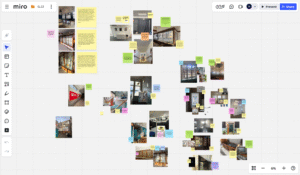
Screenshot from our collective project.
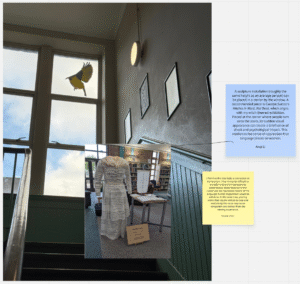
Screenshot taken by me from the collective project webpage, showing Houde’s feedback on my proposed spatial arrangement.
However, Houde’s feedback made me realize that a space’s dramatic quality does not necessarily mean it is effective for displaying artworks.
I realized that placing an artwork in an unexpected location might create a momentary sensory impact for the viewer, but it does not necessarily help the viewer understand the work’s content. Especially when the work requires careful reading and extended viewing, a strong spatial effect might distract the viewer from the work itself.
This issue concerns not only “where to place the artwork,” but also how to guide the audience.
Robert J. McMurtrie (2022, pp. 107–109) similarly argues that curators need to consider viewing stations, visitor movement, congestion, and the placement of labels. This suggests that viewing is not static; curators must consider how pathways, positioning, and interpretive texts influence the audience’s viewing experience.
This is particularly important for my own curatorial project. Witches in Word, Not Deed is not suited for placement in a corner designed primarily for foot traffic. Since the form of the work’s skirt is already sufficiently striking, I do not need to consider how to further enhance its visual impact. Instead, I aim to guide viewers from an initial attraction toward a more careful reading and understanding of the work.
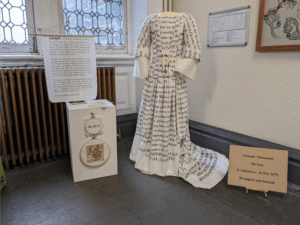
Sutton, C. (2026) Witches in Word, Not Deed. Available at: https://carolynasutton.crevado.com/witches-in-word-not-deed (Accessed: 8 April 2026).
Therefore, I plan to place the work against a wall. This will allow viewers, upon entering the space, to more clearly sense that they are immersed within the spatial environment created by the work. Additionally, explanatory text can be incorporated onto the wall to help viewers transition from visual engagement to a deeper understanding.
This collaboration has changed the way I assess space.
Houde’s response made me realize that my previous judgments regarding spatial placement were almost unquestionable. I tended to prioritize whether a location could evoke a strong emotional impact, rather than first asking whether it could convey the work’s meaning. I assumed I knew which locations would be most effective, but collective collaboration broke this inertia. As contemporary art theorist Eva Fotiadi (2014, p. 3) suggests, many innovative exhibitions arise precisely from collaboration.
In this case, collective work did not simply add opinions, but interrupted my assumptions and showed me that curatorial judgement develops through collaboration and refinement.
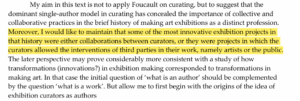
Screenshot from page 3 of Fotiadi, E. (2014) ‘The canon of the author. On individual and shared authorship in exhibition curating’, Journal of Art Historiography, 11(11).
Bibliography:
Fotiadi, E. (2014) The canon of the author. On individual and shared authorship in exhibition curating. Journal of art historiography. 11 (11), 1.
McMurtrie, R. J. (2022) Observing, recording, visualising and interpreting visitors’ movement patterns in art museums: A mixed method approach. Multimodality & society (Online). [Online] 2 (2), 93–113.