

Week8-Further Confirm The Archival Artworks In The Exhibition.


This week’s course content reminded me of the blog post from Week 4 on “curatorial archives.” It got me thinking: if my project is meant not only to present authentic history but also to translate historical materials into the language of an authentic exhibition, how should I select artworks?
I ultimately chose Carolyn Sutton’s Witches in Word, Not Deed.
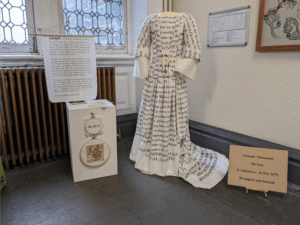
Sutton, C. (2026) Witches in Word, Not Deed. Available at: https://carolynasutton.crevado.com/witches-in-word-not-deed (Accessed: 8 April 2026).
Hal Foster, an American art historian and critic, argues that “the archive” in contemporary art is not simply the presentation of existing documents. Instead, artists collect, reorganise, and recontextualise different materials. Through this process, they produce new historical relationships (Foster, 2004, p. 5).
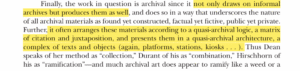
Screenshot of page 5 from Hal Foster’s article An Archival Impulse (Foster, 2004).
As a result, I realized that archival artworks can use various media to bring oppressive historical language back into the present.
Carolyn Sutton’s work resonates deeply with my theme. She prints the accusations and misconceptions directed at women during witch hunts onto skirts, transforming this violent language—which originally existed only in history—into a visual form. For viewers, this form is easier to grasp, as they see not merely historical documents, but how language has actually been imposed upon women’s bodies.
However, archival artworks still have certain limitations.
Giovanna Zapperi, a professor of art history (2013, p. 23), argues that while feminist archival art makes suppressed women’s histories visible again, this reconstruction is not an objective presentation of history; rather, it is a rewriting imbued with the artist’s stance and desires (2013, pp. 26–27).
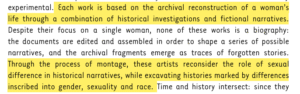
Screenshot of page 23 from Giovanna Zapperi’s article Woman’s Reappearance: Rethinking the Archive in Contemporary Art—Feminist Perspectives (Zapperi, 2013).
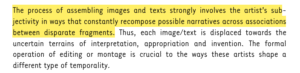
Screenshot of page 27 from Giovanna Zapperi’s article Woman’s Reappearance: Rethinking the Archive in Contemporary Art—Feminist Perspectives (Zapperi, 2013).
This makes me worry that viewers might focus more on the form of the Witches in Word, Not Deed skirt, thereby diminishing their understanding of the cruelty of history. The text on the skirt has a strong visual impact, but viewers may not necessarily stop to read it. Drawing on the methodology proposed by Reesa Greenberg (2012, p. 166) in her analysis of Telling Histories, I decided to design a way to help the audience gain a deeper understanding of this history. For example, by presenting historical materials through an interactive interface and curating the content so that viewers see the key points first.
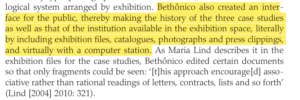
Screenshot of page 166 from Reesa Greenberg’s article Archival Remembering Exhibitions (Greenberg, 2012).
In practical terms, this work has already been on tour and has been exhibited at several venues across Scotland.
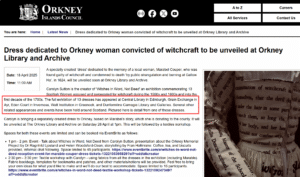
Screenshot of the Orkney Islands Council news webpage, ‘Dress dedicated to Orkney woman convicted of witchcraft to be unveiled at Orkney Library and Archive’ (Orkney Islands Council, 2025).
This indicates that the work has a degree of portability and experience with touring exhibitions. It has already been adapted for various spaces, such as libraries and archives, and does not rely solely on large international art museums. Furthermore, since the artist is based in Edinburgh, I believe the logistics of transportation and installation are relatively manageable.
At the same time, Carolyn Sutton’s longstanding engagement with public cultural institutions demonstrates her commitment to education and public discourse, which extends beyond
large institutions. Based on this, I believe a collaboration with her is feasible.
Bibliography:
Foster, H. (2004) An Archival Impulse. October. [Online] 110 (110), 3–22.
Zapperi, G. (2013) woman’s reappearance: rethinking the archive in contemporary art—feminist perspectives. Feminist review. [Online] 105 (105), 21–47.
Greenberg, R. (2012) Archival Remembering Exhibitions. Journal of curatorial studies. [Online] 1 (2), 159–177.