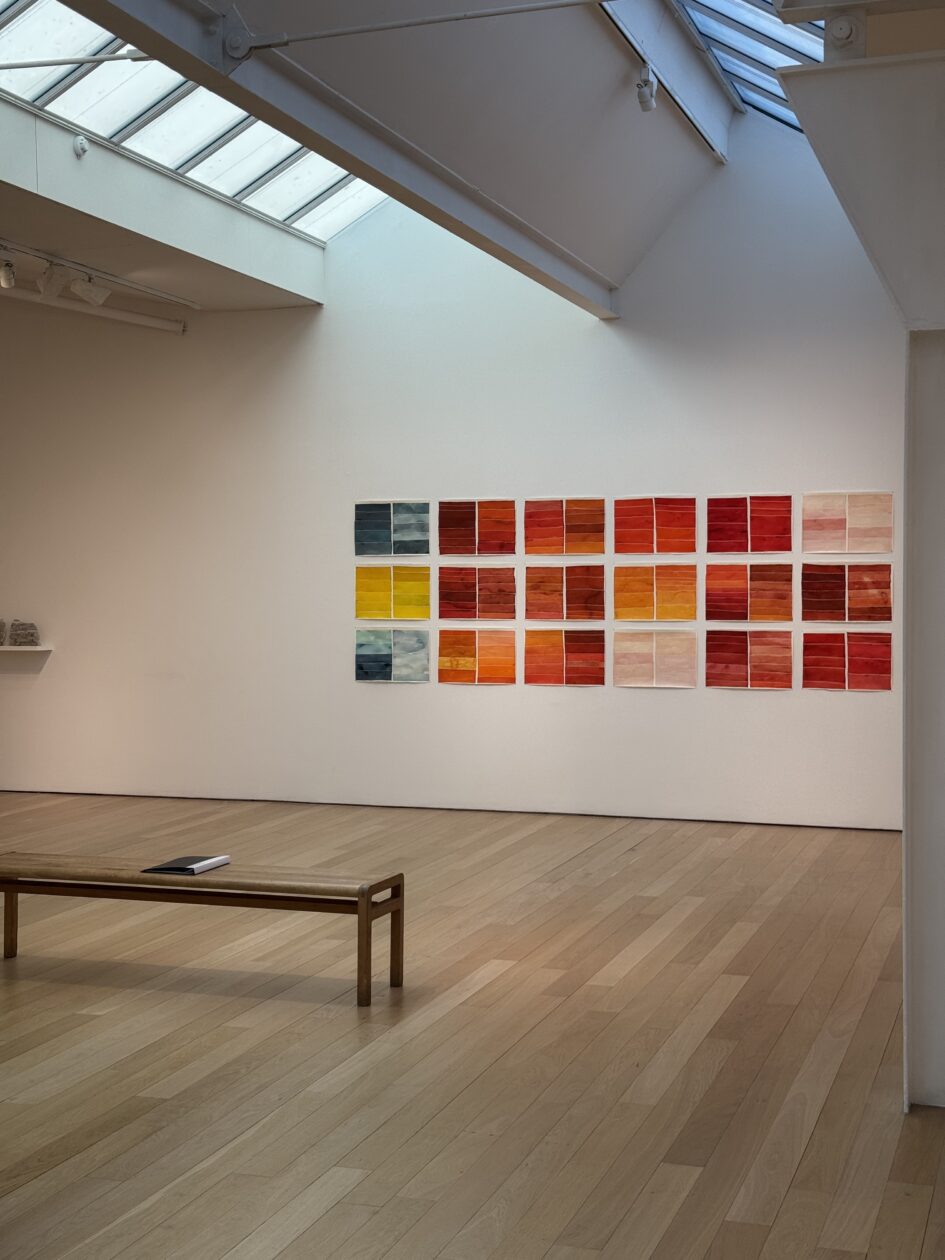
Exhibition Viewing—Ilana Halperin: What is Us and What is Earth
📍Gallery: Fruitmarket
This exhibition displays sculptures, paintings, and photographs by Glasgow-based artist Ilana Halperin. On her 30th birthday, Halperin realized she was born in the same year as a volcano near Iceland. She began to align the timeline of her life with that of the volcano’s eruptions, creating a significant body of work at key moments of volcanic activity. Through collaborations with scientific researchers, she has incorporated geological samples—such as volcanic rock, mineral deposits, and calcified structures—into her artistic practice.
Link:Ilana Halperin: What is Us and What is Earth
About Exhibition Space and Work Arrangement:
The exhibition does not rely on a visually-driven approach; there is no single focal point or collection of major works. Instead, the pieces are arranged in a decentralized manner, The works are distributed across different walls and display platforms, with each piece maintaining relative spatial independence. Through this non-linear structure, visitors are not required to follow a fixed viewing route; instead, they move freely, stopping to appreciate and understand the works, establishing their own connections with them. This shifts the experience from passive viewing to active engagement, emphasizing the process of the exhibition itself.
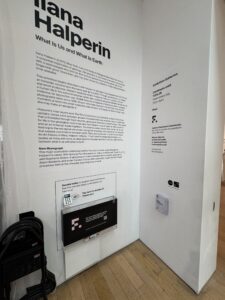
Fig 1:At the exhibition entrance
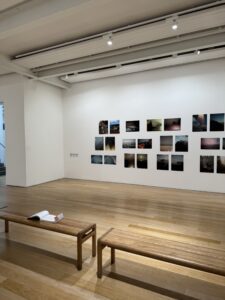
Fig 2 :Photographs on the first floor
The exhibition features a large number of geological specimens—such as minerals, rocks, and sediments—displayed at low levels on tabletops to facilitate close-up observation by visitors, accompanied by informational text labels. Here, the artworks are no longer merely visual presentations but serve as a form of popular science education on geology. By closely observing the patterns on these geological specimens, visitors can understand their changing states, These materials possess both temporal and natural attributes; understanding the significance of the works integrates the artistic space with the scientific exhibition space.
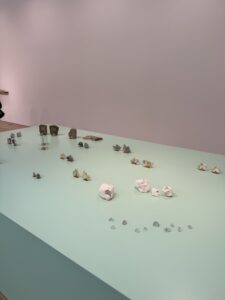
Fig 3 :Display of Related Geological Samples
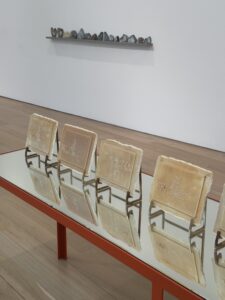
Fig 4 :The Work “Rock Cycle” (2026)
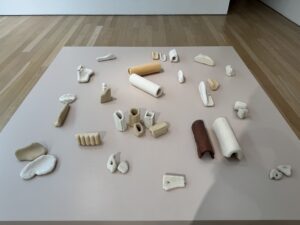
Fig 5 :Display of Related Geological Samples
Reflections on the Exhibition:
Through this visit, I realized that some of the artworks in the exhibition are not finished works, but rather records of time and the creative process. The core of these pieces lies not in their final artistic form, but in the process of their transformation.No matter the form of artistic expression, the goal is to create a process through which anyone can use art to express themselves and articulate their emotions. The inexpensive, ephemeral, and unintimidating nature of the conceptual mediums themselves—video, performance, photography, narrative, text, and actions—encouraged women to participate and to navigate this opening in the art world’s walls. (Lippard, 1997).This has led me to rethink the essence of art: it is not merely about showcasing the final result, but also about presenting and documenting the process. Through the artist’s interpretation of her work and the creation of pieces spanning different time periods, the dimension of time becomes prominent. This connects the temporal scales of nature with human life, offering a new perspective on the human body—not as a stable, unchanging individual, but as an entity that exists through constant interaction with the external world.
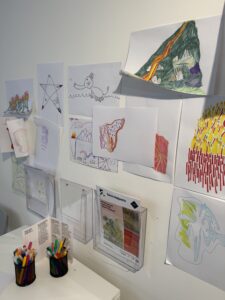
Fig 6 :Audience Interaction Area
In my personal curatorial project, the female body is a central theme, involving female anxiety, social conditioning, and the experience of being looked at.As Simone de Beauvoir pointed out: “One is not born, but rather becomes, a woman” (de Beauvoir, 2023).Halperin’s exhibition emphasizes its temporality and ongoing nature rather than visual impact. I can reinforce the temporal dimension through art installations in the exhibition that feature looping videos, slow-moving elements, and repetitive motions. In selecting artworks, rather than directly expressing emotions, I can use the slow accumulation of everyday elements to metaphorically represent pressure, and through material transformations and repetitive installations, give tangible form to this invisible state. In the gallery’s spatial design, I can incorporate accumulative materials, such as wrapped textiles, so that the space itself embodies a state of accumulated pressure; this approach transforms abstract emotions into perceptible physical entities. The Notes Zone at the end of the exhibition features stickers and visitor messages posted on a semi-transparent wall. The layering of paper reflects the accumulation of time, corresponding to Halperin’s concept of “accumulation” and transforming emotions into a tangible visual structure.
References:
Lippard, Lucy R., ed. Six years: the dematerialization of the art object from 1966 to 1972. Vol. 364. Univ of California Press, 1997.
De Beauvoir, Simone. “The second sex.” In Social theory re-wired, pp. 346-354. Routledge, 2023.



Leave a Reply