🧶 Appreciation of Ema Shin’s Artworks
Ema Shin grew up in a traditional Korean family. Her creation is inspired by gender bias in family culture and the “absence” of records of female family members. Ema Shin’s grandfather has always kept a family tree spanning 32 generations. However, in this genealogy, only the names of male descendants are recorded, and female relatives are completely ignored. Although her mother and grandmother poured countless efforts into the family, their place could not be found in the family tree, and their contribution and existence to the family were erased.“Sexism is perpetuated by institu-tional and social structures; by the individuals who dominate, ex- ploit, or oppress; and by the victims themselves who are socialized to behave in ways that make them act in complicity with the status quo. Male supremacist ideology encourages women to believe we are valueless and obtain value only by relating to or bonding with men(Hooks,2000).”Ema Shin realized the unfairness of it, so she decided to create her own “family tree books” for those unknown women who were not recognized by their families. She also used this artistic work to commemorate those women who were hidden by history.
Ema Shin usually takes the female body as the subject of her creations.“Feminist artists reclaimed sewing, weaving, and other so-called trivial women’s crafts as powerful forms of political and aesthetic resistance (Raven,2018) .”“Hearts of Absent Women” is a work of art created by her with sewing skills. She weaved many colorful heart-shaped models. She is based on thick felt, with bright red, pink, orange and purple embroidery threads and shiny beads as the main elements. She simulated veins like blood vessels and nerves with loose feathers, curly needles and small beads. Through embroidery and sewing, she built a lifelike heart-shaped model.During the exhibition, some models are directly displayed on the booth, and some are hung up, creating a visual effect of “collective” heartbeat. These “heartbeats”become the family tree of women, a history woven through sewing, and through these models, we commemorate those unknown and unrecognized women, as well as the rebellion against patriarchal families.
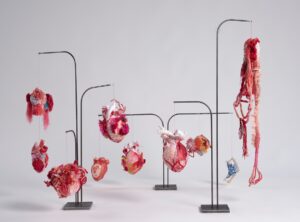
Fig 1 :Hearts of Absent Women | embroidery, glass, polyester, linen, cotton, wool, hanji paper, lokta paper 70 x 78 x 60 cm (installation) | Image courtesy of the artist | 2021
Shin did not portray a victimized image through her works to criticize this society and express her dissatisfaction with the unequal treatment of the society. Instead, she presented the vitality of women in an active way, transforming absence into existence, and speaking out for the suppressed female voices.
Through the study of Ema Shin’s artworks, I recognized how the artist incorporates traditional women’s crafts—such as sewing and weaving—into her practice, thereby infusing these crafts with new energy. This led me to reflect on my own curatorial work, prompting me to focus on artworks across various media—including traditional crafts, installation art, and video art—to showcase the diversity of women’s creative expression.
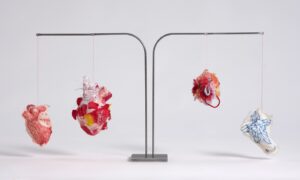
Fig 2 :Hearts of Absent Women | embroidery, glass, polyester, linen, cotton, wool, hanji paper, lokta paper 35.5 x 69 x 14cm | Image courtesy of the artist |2021
💻 Group Curatorial Practice and Discussion
This group conducted a site survey at Edinburgh’s Summer Hall and explored the feasibility of the curatorial content proposed by group members.
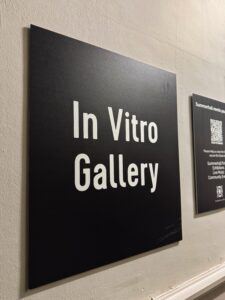
Fig 3 :Collective Curation Site Selection
Based on Summer Hall’s venue rental rates, the projected budget allows for a five-day exhibition period. If group members select the same exhibition hall, they should ensure their schedules do not overlap.
Considering installation art transportation costs, members whose selected works require special materials (including packing, protective materials, and related expenses) must include round-trip shipping costs in their budgets…
Regarding lighting expenses: If the selected gallery provides basic lighting, only professional lighting supplements are required. (Prioritize borrowing lighting equipment from the university; consider external rentals if insufficient.)
Forms of Artist Participation in Related Works:Artists may pre-record videos introducing their works and creative concepts for exhibition hall playback. This allows artists to avoid in-person attendance, reducing transportation and accommodation costs.
Allow one day for installation (venue cleanup and basic setup/lighting calibration/installation of artworks/testing of video playback equipment, etc.).
Allow one day for dismantling (deinstallation of artworks/venue restoration/return of equipment/summary of installation costs, etc.).
Our team also discussed risks and challenges: Related technical issues/Scheduling conflicts among members/Venue usage time constraints/Potential damage during artwork transportation
Countermeasures: Budget for testing relevant equipment/Develop timelines and backup plans/Reserve emergency funds
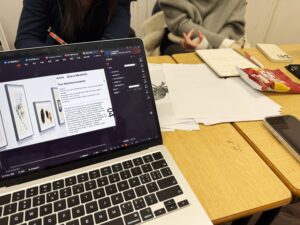
Fig 4 :Group discussion
References:
Hooks, Bell. Feminist theory: From margin to center. Pluto press, 2000.
Raven, Arlene, Cassandra Langer, and Joanna Frueh. Feminist art criticism: An anthology. Routledge, 2018.



Leave a Reply