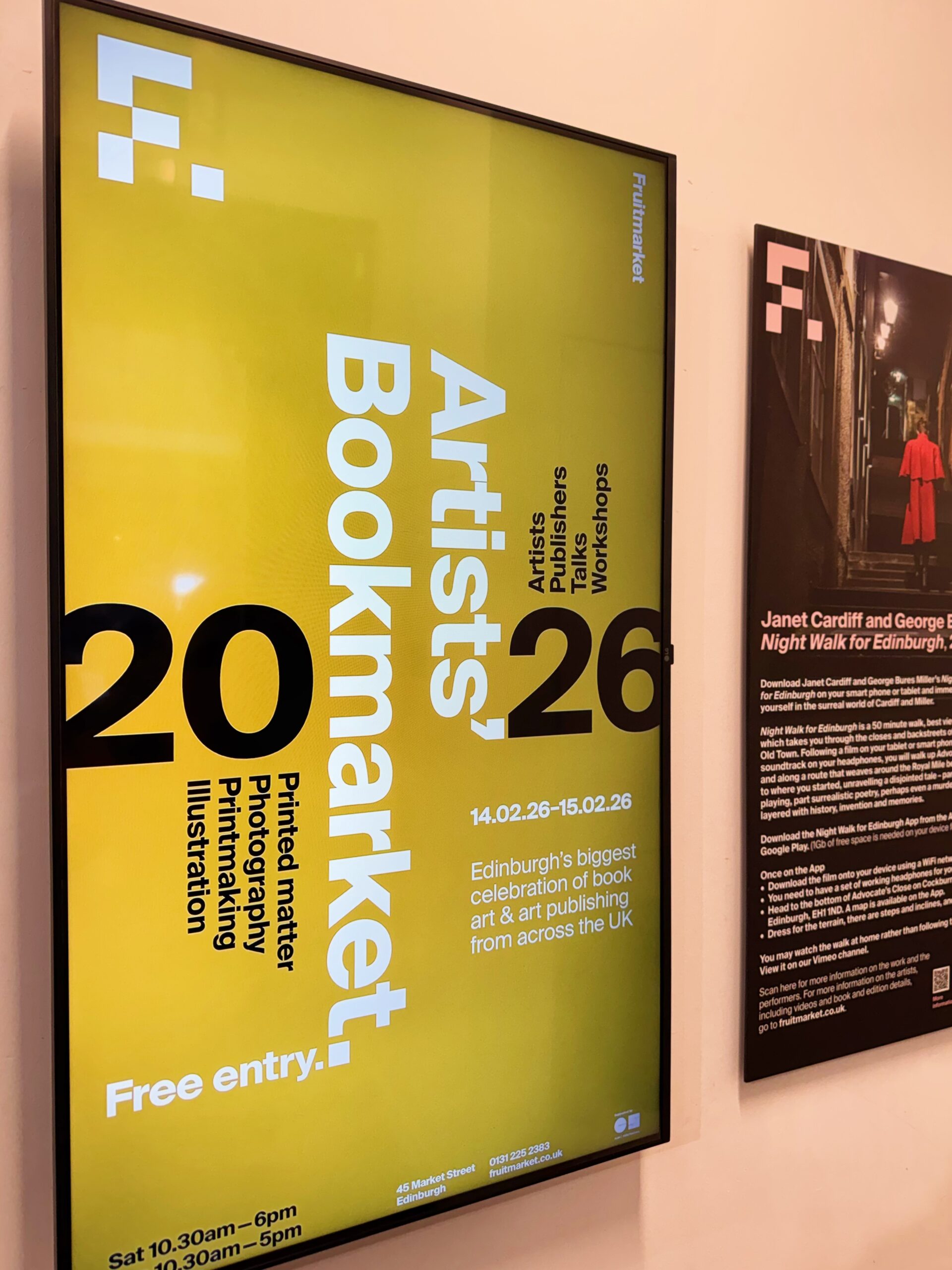
Exhibition Experience:Jaune Quick-to-See Smith
📍Gallery: Fruitmarket
American Native artist, activist, educator, and curator
Her primary motivation for each new work of art is to communicate an idea, a philosophy, or a history lesson. She is compelled to insert her viewpoint into the racialized discourse of American history and to demonstrate how it is important to the contemporary moment. Each work of art offers the viewer an active role as an interpreter reimagining history from her perspective (Kastner, 2013).
This exhibition marks the first time her works have been shown in Scotland, aiming to explore the history and politics of land management, with a focus on her criticism of colonial history and land appropriation. On display are her paintings and large-scale canoe sculptures. She often incorporates newspapers, commercial symbols, and advertisements into her paintings, making her works not only visual art but also political statements.
Link: Jaune Quick-to-See Smith Wilding
Fruit Market’s “Wilding” exhibition layout:
Divided into two main exhibition floors:
First floor:
The entrance provides exhibition catalogues and background information on the related works.
A large number of works on display are collages and large paintings of the American map series, exploring topics related to land and colonization.
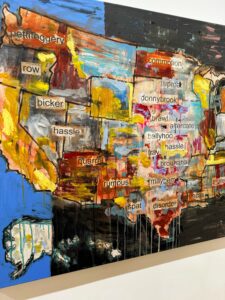
Fig 1 :Artwork Display on the First Floor
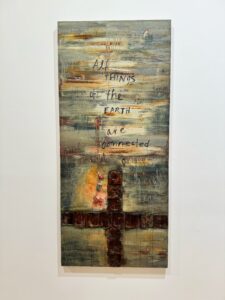
Fig 2 :Artwork Display on the First Floor
Second floor:
A canoe installation filled with animals is suspended above the central staircase, visually connecting the two floors. It not only saves floor space but also has a “leading line” visual effect.
Large-scale figure paintings and animal images are displayed, which are more delicate and spiritual.
In the public area on the second floor, a video of the artist’s son talking about the works and Smith is provided to enhance visitors’ understanding of the artist. Next to the viewing area, there are a reading area and a drawing area to enhance visitor interaction.As Smith suggests, contemporary curating often integrates multiple forms of mediation(Smith, 2017).
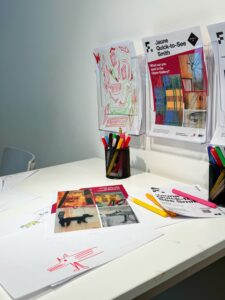
Fig 3 :Second-floor audience interaction area
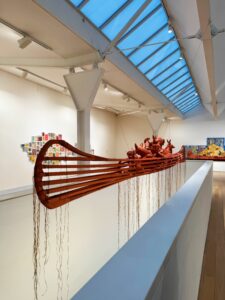
Fig 4 :All My Relations(2025)
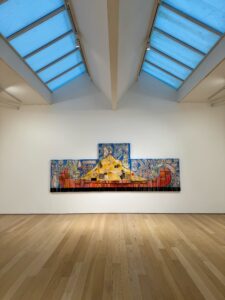
Fig 5 :Trade Canoe: Turtle Island(2024-25)
The design of exhibition spaces is not merely about displaying works, but about structuring visitor movement to create an immersive narrative experience, which aligns with museum theory emphasizing spatial storytelling. As Eilean Hooper-Greenhill suggests, museums are no longer neutral spaces for passive viewing, but places where meaning is actively constructed through the arrangement of objects and the experience of visitors. She argues that “meaning is not transmitted but constructed” through interpretive strategies (Hooper-Greenhill, 2020), highlighting the importance of spatial design in shaping how audiences engage with exhibitions.
Course Reflection: As a form of collective thinking and working
Advantages:
More diverse expertise and perspectives:
Collective work brings together people from different professional backgrounds, allowing them to share ideas and generate a wider range of perspectives.
Sharing the workload:
Tasks can be divided among members, which reduces individual pressure and helps save time.
Promotes learning:
Members can learn from one another, increase motivation, and use others’ strengths to make up for their own weaknesses.
Disadvantages:
Conflicts are more likely to occur:
Differences in opinions and a lack of communication can easily lead to conflicts.
Unequal distribution of responsibility:
Some members may contribute more work than others, which can create a sense of unfairness.
Overconsidering others’ opinions:
During group discussions, individuals may compromise too much in order to consider others’ ideas, which can weaken their own voice.
References:
Kastner, Carolyn. Jaune Quick-to-See Smith: An American Modernist. UNM Press, 2013.
Smith, Terry. “Mapping the Contexts of Contemporary Curating: The Visual Arts Exhibitionary Complex.” Journal of curatorial studies 6, no. 2 (2017): 170-180.
Hooper-Greenhill, Eilean. Museums and the interpretation of visual culture. Routledge, 2020



Leave a Reply