

Week 4 |Seeing Art Outside the White Cube


1. Parkview Green Beijing
During my visits to Parkview Green Beijing in 2023 and 2024, I observed art integrated into corridors and atriums. I was impressed by the curation here: works of art are scattered in corridors, atriums and public areas, not confined to closed galleries. This layout allows the audience to meet art naturally when shopping or socializing. This informal setting challenges the traditional idea that art must be watched in a specific institution and provides an important reference for my personal project.
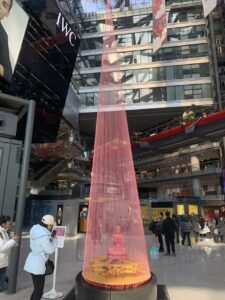
Figure 1. Art installation situated within the central circulation area of Parkview Green, Beijing, ca. 2023–2024. Photograph by the author.
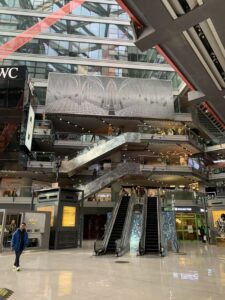
Figure 2. View of the multi-level commercial infrastructure and spatial layout at Parkview Green, Beijing, ca. 2023–2024. Photograph by the author.
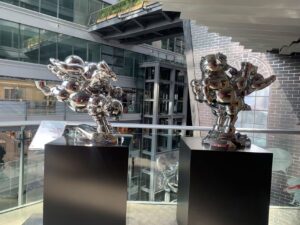
Figure 3. Abstract metallic sculptures displayed along a public walkway overlooking the atrium in Parkview Green, Beijing, ca. 2023–2024. Photograph by the author.
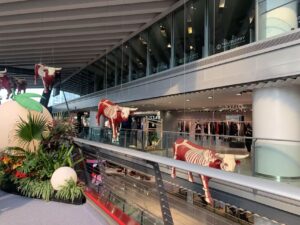
Figure 4. Animal-shaped sculptures integrated into the pedestrian pathways and landscaping of Parkview Green, Beijing, ca. 2023–2024. Photograph by the author.
Website: https://www.parkview.world/#/en/parkview-green-beijing/
2. Potential of Everyday Infrastructures
Bringing art into commercial space can break the barriers between institutions. As curator Stefanie Hessler stated in Julia Halperin’s article:
By bringing art inside local businesses, “I hope it doesn’t feel like art tourism only,” she says. Perhaps a student will unexpectedly encounter Piotrowska’s photographs on a shopping trip and become inspired to pop inside the vacant pharmacy nearby to view works by the French artist Pol Taburet.
This aligns with Miwon Kwon’s critique of the White Cube. Kwon explores how site-specific art redefines relations with the public by entering non-art sites, challenging detached exhibition spaces.
3. Ji Ju Collective
The Ji Ju collective began formal discussions this week. We first confirmed the name of our group this week.Given our collective identity centers on living away from home, we realized that artworks also function as sojourners in these environments. We discussed ethical issues in commercial spaces, especially exclusivity and who feels comfortable in these spaces.Therefore, the curation must be meticulous and flexible, rather than forcibly occupying space.
Notes
1.All photographs reproduced here were taken by the author at Parkview Green (侨福芳草地), Beijing, during visits in 2023 and 2024, and are used as documentary material to support curatorial analysis.
2.”Food courts and pharmacies are Basel’s hottest new art spaces,” Julia Halperin, accessed February 08, 2025, 1, dd37ae39-04b6-4719-9611-66b09c8614d0
3. Kwon, Miwon. One Place after Another : Site-Specific Art and Locational Identity. Cambridge, Mass. ; MIT Press, 2002, 3.