

Week 10 | Ji Ju Collective : Weaving “Our Shell” at Summerhall


The culmination of Week 10 saw the opening of Our Shell at Summerhall, Edinburgh, a group exhibition curated by and featuring the Ji Ju Collective. Moving beyond a mere display of objects, the project functioned as a critical inquiry into the hermit crab condition: the constant negotiation of identity, memory, and domesticity within the precarious shells of a migratory life.
1.Collective Action as Method: From Theory to Site
Our exhibition navigated the tension between cultural roots and the temporary shells we inhabit while living abroad. By using red threads to physically connect disparate works, from traditional Qipao to contemporary paintings, we transformed a static gallery room into a living, interconnected organism.
This approach resonates with Miwon Kwon’s discourse on the evolution of site-specificity. She argues that the site has shifted from a fixed physical location to a discursive, mobile network:
The final ‘site’ or frame for art reception and dissemination in this appraisal is no less than the artist–producer and the sometimes transitive and site-less communities of the early 21st century.
By framing our collective as a site-less community, we demonstrated that curatorial practice can create a sense of belonging that is not tied to a specific geography, but to shared experience and material as a way of thinking.
2.The Ethics of the “Ordered Appearance”
While the final exhibition presented a unified narrative of “belonging,” the behind-the-scenes reality involved intense negotiation. Reflecting on this, I found Jean-Paul Martinon’s perspective on curatorial ethics particularly grounding:
Curating is famous for an ordered appearance that on quick inspection is always flawed. Exhibitions always give the impression of cohesion when in fact what is exhibited is often the result of many compromises, concessions, and trade- offs between institutions,funders, lenders, contexts, and/or artists.
This flawed cohesion was evident in how we balanced individual artistic voices within the Ji Ju Collective. For my final project, I will embrace these compromises not as failures, but as an ethical method of sourcing and displaying artists, ensuring that the tension between different materialities remains visible rather than smoothed over.
3.Inspiration for My Personal Project
The success of Our Shell has deeply informed my final curatorial proposal. Specifically, the way we utilized red threadas a low-cost, high-impact spatial device demonstrated to me how publicness can be negotiated within economic constraints. For my personal project, I will further develop this relational materiality using physical connections to guide the audience’s gaze and bridge the gap between art jargon and lived reality. Seeing how viewers engaged with the “Sweetness within the Shell” (the candy installation) confirmed that accessibility is best achieved through familiar, tactile objects.
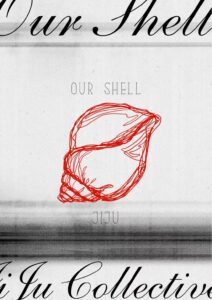
Figure 1. English visual identity and exhibition poster for Our Shell, designed by the Ji Ju Collective, 2026.
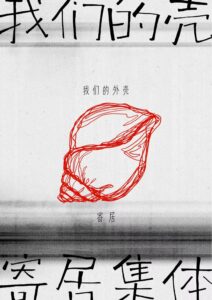
Figure 2. Chinese visual identity and exhibition poster for Our Shell, designed by the Ji Ju Collective, 2026.
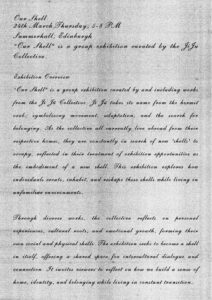
Figure 3. English exhibition statement outlining the curatorial narrative of Our Shell, Summerhall, Edinburgh, 2026. Photograph by the author.
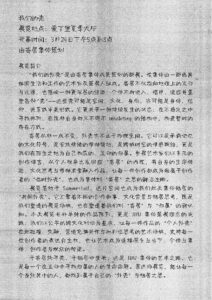
Figure 4. Chinese exhibition statement for Our Shell, Summerhall, Edinburgh, 2026. Photograph by the author.
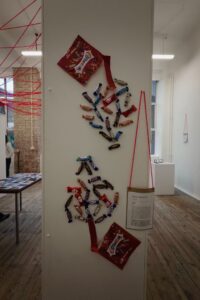
Figure 5. Siqi Xue. Candy Art Installation. Installation view demonstrating the use of red thread as a spatial connecting device to link fragmented narratives, Our Shell, Summerhall, Edinburgh, 2026. Photograph by the author.
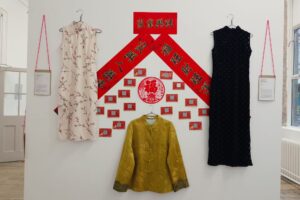
Figure 6. Installation view featuring cultural garments and traditional paper decorations integrated into the collective space, “Our Shell,” Summerhall, Edinburgh, 2026. Photograph by the author.
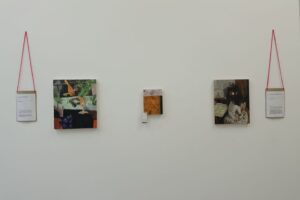
Figure 7. Installation view of 2D artworks connected via the collective’s curatorial red thread motif, “Our Shell,” Summerhall, Edinburgh, 2026. Photograph by the author.
Notes:
1.Kwon, Miwon, and Scott Townsend. Review of One Place after Another: Site-Specific Art and Locational Identity. Visual Communication (London, England) 4, no. 3 (October 2005): 372.
2.Martinon, Jean-Paul. 2020. Curating As Ethics. Minneapolis: University of Minnesota Press. Accessed March 30, 2026. ProQuest Ebook Central,xxii.


2 replies to “Week 10 | Ji Ju Collective : Weaving “Our Shell” at Summerhall”
Leave a reply to Julie Louise Bacon


interesting
Hi Siqi, good to see you are posting, and since I wrote this, you added more posts. Just Week 13 now 🙂 In terms of content, in Week 7 you have 2 headings but essentially deal with one set of content. Subheadings indicate clear shifts in focus on content, there should be links between them Review your formatting choices also (eg use of bold, length of subheadings), do they make it more readable, dynamic? There are no research references supporting your reflection: address gaps. Week 8 shows similar issues to address (again no research, subheadings that could be bullett points in a single subheading), and is very descriptive. Remember advice to make posts critically engaged. Week 9 has one reference but links to Wikipedia, this does not show research depth (or grasp of the contents you are using). There is a need to include more evidence of your research into exhibition/curating practices (there are no references to any texts, similar exhibitions). The Week 10 post is better as it contains work on both the Collective and the SICP (missing in others, it should be featuring consistently), and more integration of research. There is still scope for more evidence of engagement with all LOs, and attention to presentation details (eg labellng images). Does your Blog as a whole weave together to form a portfolio, that develops threads and lines of enquires, narratives/themes, from across your practice and research across the course and which adds new relevant content each week on the SICP and Collective? How are you consistently demonstrating you are engaging with course content from different weeks, and synthesising/connecting it to form new applications and insights?