

Reading Week | Awareness, a one-person show proposal that turns everyday objects into companionship and resistance (Guo Puyi)
1) Why Awareness, and why I am working with Guo Puyi
This week I decided to ground my individual curatorial project in a theme that is easy to understand and also realistic to deliver: awareness. For me, awareness is not something abstract. It is the moment when you suddenly notice how you have been looking at things in the same habitual way, and maybe treating yourself in the same way too.
I want to curate a one-person show with Guo Puyi because his work does something very clear. He takes objects that seem lifeless and without agency, and gradually makes them feel alive, spreading, and present. His practice makes me question whether my own way of living has become too utilitarian, too shaped by rules and efficiency. That reflection also connects to my background. I grew up in Shandong, where social norms shaped by ritual and propriety can feel heavy. Guo’s work is not loud, but it has a quiet force that suggests there are other ways to exist.
2) Three groups of works: from companionship to rupture, then beyond a human-centred gaze
To keep the project readable, I am organising Guo’s works into three groups. This helps audiences follow the exhibition without needing theory first.
Group 1: wood and ceramic works, a sense of companionship
These works include wooden figure-like building blocks and ceramic or hand-made objects. Although these materials often belong to domestic settings, Guo sees them as public-facing. His intention is to bring attention to small, easily ignored things in a fast urban life.
In our conversation, he described how giving non-agentic objects a sense of life can create a feeling of safety, as if he is surrounded by living presences. He sometimes treats everyday objects almost like pets. That idea matters for my theme, because it makes awareness practical. The way you relate to objects can reflect the way you relate to yourself.
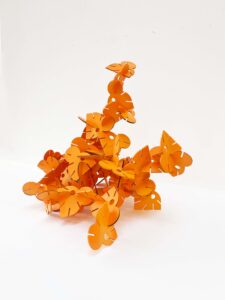
A cluster that looks like a soft plant but is built from rigid modules. It suggests how connection grows: not as one perfect form, but as many small contacts holding each other up.
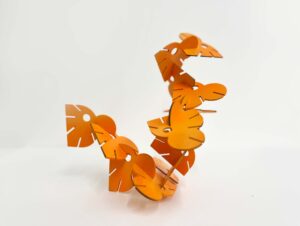
A smaller body, but the same logic: connection as a chain of decisions. The work reads like a creature mid-move, showing how objects can carry emotion without becoming “cute.”
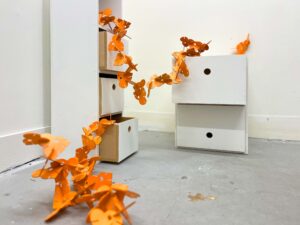
Placed among drawers and corners, the work behaves like something that escaped storage and began to travel. It turns the domestic into a site of agency, not just comfort.
Group 2: ironworks and hard materials, making softness sharp
Here, the key is the tension between familiar imagery and unexpected material. Guo often chooses forms that, in daily life, suggest softness and comfort. But he makes them in iron or sharp-edged materials. For him this is not an aesthetic trick. It is a refusal of social habits and fixed assumptions. We often project our expectations onto objects, and we do the same to people.
By using a material that resists comfort, he pushes viewers to notice the object’s actual properties, and to adopt a more critical gaze. It becomes a practice of awareness in itself: looking for possibilities beyond an object’s assigned function.
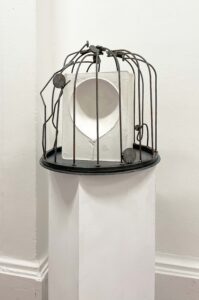
A balloon-like void held behind a metal cage. The work flips softness into restraint, asking how comfort can become surveillance when it is “protected” too tightly.
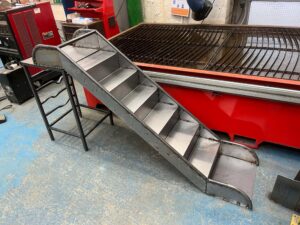
Not a finished artwork, but a key part of the practice: fabrication as thinking. The studio image foregrounds labour, tools, and risk—what gets erased when we only see the final display.
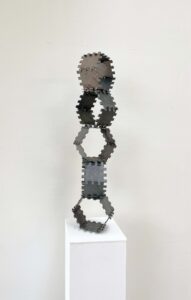
A stacked figure made of interlocking metal frames, like a toy turned stubborn. It keeps the language of play, but the material changes the mood: playful forms can carry pressure.
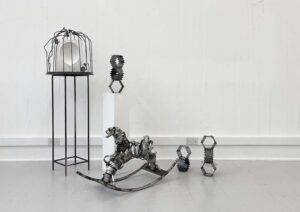
A small “family” of objects shares the same room but holds different degrees of freedom. A balloon-like void is kept inside a metal cage, while a rocking-horse body lies on the floor like a toy that has grown heavier than play. Nearby, modular steel figures stand upright, as if play has been reorganised into structure. In this scene, comfort, control, and companionship are negotiated through material weight and spatial distance.
Group 3: photography, works on paper, and leaf-based pieces, shifting attention outward
This group feels like a movement away from human-centred urgency. Leaves, paper, and photography pull attention back to nature and to something slightly beyond the material everyday. Guo mentioned Borges’s The Circular Ruins, which I see as a useful hinge for the later part of the exhibition: once you become aware of the weight of everyday objects, you may also realise you are not the centre of everything.
In Guo’s practice, the idea is materially built into the work. His piece titled Book is made from the English edition of The Circular Ruins, physically constructed so that the text becomes a continuous loop, with the beginning and the end connected. This matters because the book is no longer only something we read for meaning. It becomes an object with weight, density, edges, shadows, and a circular structure that you encounter through the body. The paper carries time. The form carries repetition. Meaning is not only in language, but in what the material does to language.
This shift brings awareness into a third layer. In earlier sections, awareness is about how we attach feelings to objects and how material reality interrupts our habits. Here, awareness becomes a small step away from the self. Borges’s story is already built around a loop: the dreamer creates a human through dreaming, only to realise he might also be someone else’s dream. By turning the story into a ring-shaped Book, Guo translates that narrative logic into tactile experience. You do not need to “understand the plot” to enter the concept. You simply face a structure with no clear starting point and no final destination, and you begin to feel—almost automatically—that you are not always the centre of everything.
For me, this group frames awareness as honesty. It is about trusting one’s own perception and touch, and staying close to the concrete world rather than turning awareness into a slogan.
A note on Mono-ha
I do not want to force this exhibition into Mono-ha, but Mono-ha gives me a clear curatorial lesson: treat material, weight, scale, and placement as part of meaning, and let viewers understand through bodily experience rather than over-explanation. Mono-ha, emerging in postwar Japan, foregrounded direct encounters with materials and the relationships between things and site. That approach helps me keep awareness grounded in how people look and move, not only in what they read.
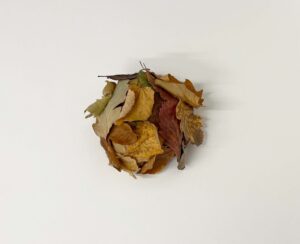
A compact bundle of fallen leaves: not decoration, but a record of time. It treats the “discarded” as something worth holding, like a small ritual of attention.
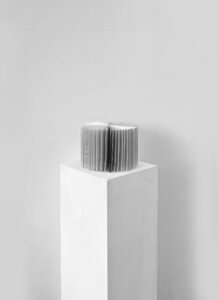
A book opened into a solid form: reading becomes architecture. It hints that knowledge is not only content, but also a physical habit we build around ourselves.
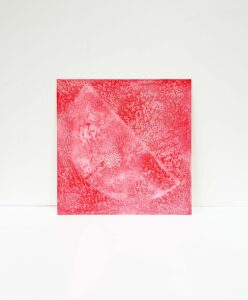
A surface that looks like a spill frozen in time. It plays with the border between accident and control: when does a stain become a decision.
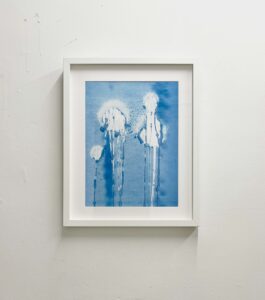
A “portrait” without faces: figures appear as washes and drips. The work suggests family as atmosphere—presence, distance, and emotional weather rather than fixed identities.
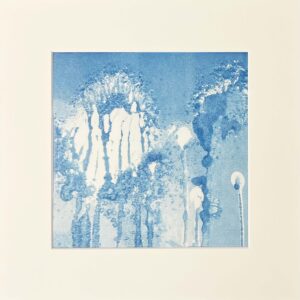
A quiet “firework”: the burst is slowed down into stains and drips. It holds a tension between celebration and residue—what remains after the moment ends.
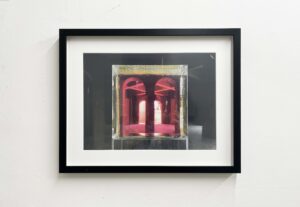
A view that feels like looking into a contained room. The frame acts like a boundary: protection and separation at the same time, asking what we keep “inside” when we say we are safe.
3) Curatorial plan: a workable online 3D solo show, with budget and ethics in view
To keep the project feasible and aligned with a not-for-profit curatorial context, I plan to build this as an online 3D exhibition. The reason is practical: it reduces venue costs, transport, and insurance risks, and it allows audiences to access the exhibition from home. At the same time, I want to take digital barriers seriously. Arts Council England highlights that digital delivery can also exclude people, so online does not automatically equal public.
Exhibition pathway
Part 1 entering and getting close: wood and ceramic works as quiet companions
Part 2 friction and rupture: ironworks that reframe familiar forms through material resistance
Part 3 widening the gaze: photography, paper, and leaf works that shift attention beyond the self
How the 3D space stays meaningful
short labels for each work: material, size, one key question
one small prompt per section: for example, choose one object that makes you feel safer
accessibility basics: alt text for images, clear text versions for any audio or video
transparency: a simple note listing any support, collaborations, and how labour is recognised
How this connects to the Jì Jū Collective
Our collective ethics around transparency and labour will shape how I work with Guo: clear permissions, clear fee structure where possible, respectful crediting, and a clear statement of my curatorial position. Our collective practice also reminds me to actively invite peer feedback, especially on representation and digital accessibility.