

Curatorial Pitch
Title: Awareness
Artist: Guo Puyi
1) What I’m making
This is a solo show of Guo Puyi titled Awareness. It’s not trying to teach people big theories. It’s about pulling our attention back to something basic: what we are actually seeing, touching, ignoring, and automatically accepting every day.
2) Why Guo
Guo’s work feels like “thunder in a quiet room.” It doesn’t rely on spectacle, but it hits hard. It makes me question how often I live in a practical, goal-driven mode.I grew up in Shandong, where social life often carries invisible rules about how to behave, how to fit in, how to be “proper.” Guo’s work opens a different possibility: objects don’t have to stay inside their assigned functions, and people don’t have to stay inside assigned roles. That sense of freedom is exactly why I chose him.
3) Three sections
A. Unnamed Companions (wood, small-scale constructions)
Some pieces carry a subtle Lovecraftian vibe: ordinary, “non-subject” things start to feel alive, spreading, almost breathing.
Many works are built from wooden components that resemble domestic building blocks. Even though this kind of object belongs to private spaces, Guo treats it as public-facing: a reminder to notice the small things we ignore in busy urban life.
For him, giving lifeless things a sense of “companionship” is a way to feel safely surrounded by life, like treating everyday objects as pets.
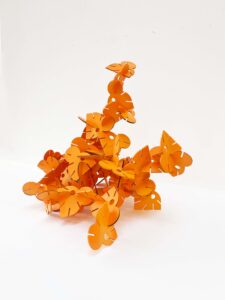
A cluster that looks like a soft plant but is built from rigid modules. It suggests how connection grows: not as one perfect form, but as many small contacts holding each other up.
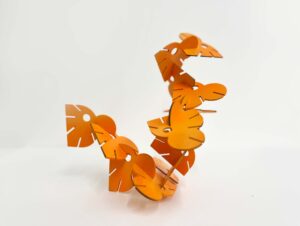
A smaller body, but the same logic: connection as a chain of decisions. The work reads like a creature mid-move, showing how objects can carry emotion without becoming “cute.”
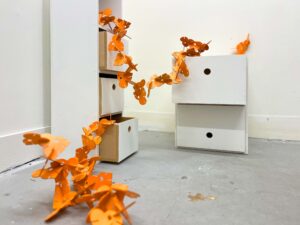
Placed among drawers and corners, the work behaves like something that escaped storage and began to travel. It turns the domestic into a site of agency, not just comfort.
B. Hard Comfort (iron works as protest against common sense)
Here, Guo uses imagery that usually signals softness and comfort, but he rebuilds it with iron, welding, sharp edges.
This isn’t just a material trick. It’s a refusal of social habit: we constantly project our assumptions onto objects (and people). By using “wrong” material, he forces a pause. The work becomes a practice of noticing what things really are, beyond their usual social function.
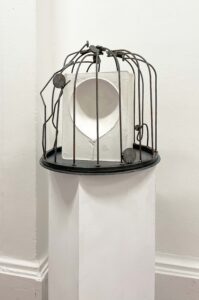
A balloon-like void held behind a metal cage. The work flips softness into restraint, asking how comfort can become surveillance when it is “protected” too tightly.
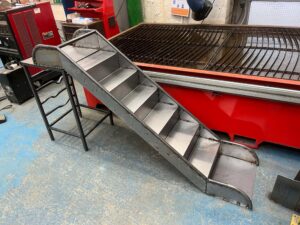
Not a finished artwork, but a key part of the practice: fabrication as thinking. The studio image foregrounds labour, tools, and risk—what gets erased when we only see the final display.
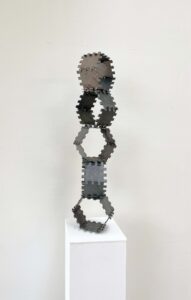
A stacked figure made of interlocking metal frames, like a toy turned stubborn. It keeps the language of play, but the material changes the mood: playful forms can carry pressure.
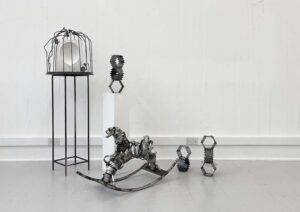
A small “family” of objects shares the same room but holds different degrees of freedom. A balloon-like void is kept inside a metal cage, while a rocking-horse body lies on the floor like a toy that has grown heavier than play. Nearby, modular steel figures stand upright, as if play has been reorganised into structure. In this scene, comfort, control, and companionship are negotiated through material weight and spatial distance.
C. Moving the human gaze aside (photography, paper, leaves, text)
This section shifts attention away from human-centered meaning and toward nature, traces, time, and the possibility of something “beyond.” Guo references Borges’ The Circular Ruins and creates a loop-like text work, suggesting that reality, dreaming, objects, and self may generate each other.
The keyword for me is honesty: staying loyal to one’s own perception and touch, and facing the concrete world with an active attitude.
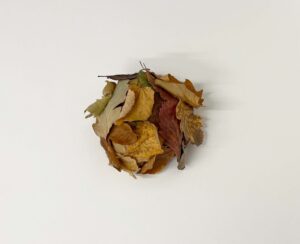
A compact bundle of fallen leaves: not decoration, but a record of time. It treats the “discarded” as something worth holding, like a small ritual of attention.
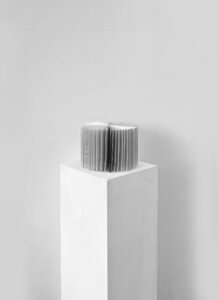
A book opened into a solid form: reading becomes architecture. It hints that knowledge is not only content, but also a physical habit we build around ourselves.
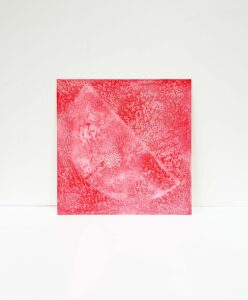
A surface that looks like a spill frozen in time. It plays with the border between accident and control: when does a stain become a decision.
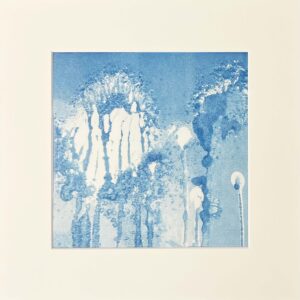
A quiet “firework”: the burst is slowed down into stains and drips. It holds a tension between celebration and residue—what remains after the moment ends.
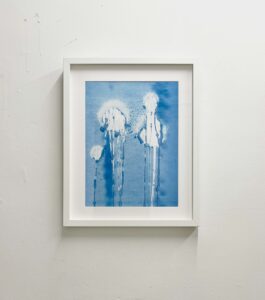
A “portrait” without faces: figures appear as washes and drips. The work suggests family as atmosphere—presence, distance, and emotional weather rather than fixed identities.
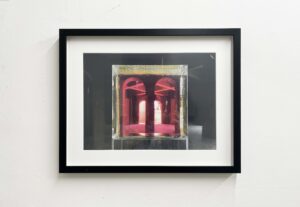
A view that feels like looking into a contained room. The frame acts like a boundary: protection and separation at the same time, asking what we keep “inside” when we say we are safe.
4) Link to Mono-ha
I see overlap with Mono-ha / object-centered thinking: objects are not props. They are active presences that shape how we feel and how we relate. This show is not “weird for the sake of weird.” It’s a way of training attention: materials, functions, and everyday objects have been shaping us all along.
5) Why a 3D online exhibition first
I’m proposing a 3D online gallery first, for practical reasons: it’s affordable, accessible, and easy to adjust. The 3D space will follow the same A/B/C structure, with short labels, material notes, and one-line “how to look” prompts to keep it welcoming.
6) Prompt: 3 questions for peer feedback
-
Does “Awareness” feel clear, or still too abstract? If you had to make the title more everyday, what would you change?
-
Which section feels strongest to you, and which one needs more explanation or different works?
-
For a 3D online gallery, what feature would make you stay: audio guide, zoomable details, or shorter text?
7)If It Needs to Become Physical Later: A Realistic On-Site Version
If this exhibition needs to be realised physically later, I would translate the same three-part structure into a small-scale, low-risk show in a school or not-for-profit space. The key is to control cost, transport, and installation complexity.
-
Works selection: prioritise portable works, photography/paper first, limit heavy ironworks for safety
-
Pathway: keep the same three parts, using light changes and short prompts to create pauses
-
Display: extremely short labels, plus a small viewer response wall where people write what object reminded them to slow down
-
Ethics and transparency: a one-page collaboration and labour note at the entrance stating crediting, permissions, budget, and support clearly
8)Connection to the Jì Jū Collective
Our collective ethics around transparency and labour will shape how I work with Guo: clear permissions, clear crediting, and a clear explanation of fees or exchanges (even if the budget is low). I will also actively invite peer feedback, especially on representation and digital accessibility.
3D exhibition hall link: https://metasteps.com/viewer/678486a4-78ff-4bdd-99fc-f2031e54f439?draft=true
Tip: Due to time constraints, we were unable to 3D scan the artists’ works. We will communicate with the artists later to select artworks for 3D scanning, build a more complete 3D exhibition hall, and enhance audience participation through VR technology.
Footnote
1.“Mono-ha,” Tate, accessed February 21, 2026, mono-ha .
Bibliography
Tate. “Mono-ha.” Accessed February 21, 2026, mono-ha .