

Week 3|From Ideas to Decisions


1.From Conceptual Framing to Operational Reality
Through James Clegg’s workshop this week, my curatoral perspective has shifted from purely conceptual conception to concrete operational thinking. Curation is not a simple translation of ideas, but a process of continuous weighing under the constraints of reality such as budget, collaboration and institutional environment. Clegg’s presentation highlighted the central role of decision-making: a curator must balance conceptual purity with practical feasibility. This made me realize that public nature, institutional context and visibility are not abstract academic words, but are jointly shaped by specific spatial and economic constraints.
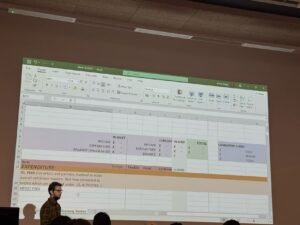
Figure 1. Presentation of a curatorial budget and planning spreadsheet during James Clegg’s workshop, Edinburgh, 2026. Photograph by the author.
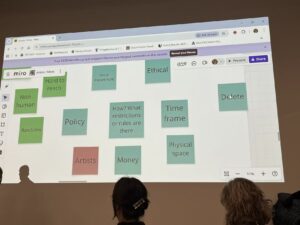
Figure 2. Digital mapping of curatorial constraints and operational factors during James Clegg’s workshop, Edinburgh, 2026. Photograph by the author.
2.Curating as a Methodology of Negotiation
From this perspective, curation is essentially a consultative process for multiple stakeholders and on-site conditions. This kind of negotiation is not a simple compromise on the concept, but a necessary means to make the project effective in a specific field.
As Jean-Paul Martinon describes in his writing on curatorial ethics:
“Curating is famous for an ordered appearance that on quick inspection is always flawed. Exhibitions always give the impression of cohesion when in fact what is exhibited is often the result of many compromises, concessions, and trade- offs between institutions,funders, lenders, contexts, and/or artists.”
This flawed cohesion accurately defines the complexity of curatorial practice, where temporary visual order is established by navigating contradictions.
3.Positioning Future Practice
The next work will focus on transforming these operational logics into specific steps, including identifying feasible sites and testing how the planning concept can operate under real constraints. I no longer pursue to finalize a perfect plan at the beginning of the project, but allow practical conditions to actively shape the form of curation.
Now, I am repositioning the project by identifying potential forms, describing stakeholders, and foreseeing consultation with the venue supervisor. I realize that public nature is not a fixed state, but actively constructed through spatial, economic and social restrictions. The adjustment of this method has shifted my project from theoretical conception to practical implementation.
Notes:
1.Martinon, Jean-Paul. Curating as Ethics. Minneapolis, Minnesota ; University of Minnesota Press, 2020, xxii-xxiii.




Hi Siqi, good to look at your Blog so far. Overall, more independent research is needed (both readings and examples of practice) and use of direct quotes and grouping/synthesis of ideas to give sharper focus.
Your headline for Week 1 (you don’t need to write Blog) is quite effective, and it is good to see you use subheadings to create structure in the post: but make sure the logic of the headline and the subheadings is clear, because 1 and 2 both seem to tqalk about scale and could likely be merged. Group ideas effectively. Good to see you draw in your reflection with past experiences of exhibitions: review the layout of images: could you add more annotation on them to show your analysis? You reference Week 1 course materials, good, but there is much more scope to develop this, with crucial quotes you found, woven into a perspective/argument that relates to your own project work for example. There is some very good reflection and independent research in point 3, and a good narrative flow from your own background: don’t break the paragraph up, as you are discussing the same idea. In point 4 you jump to your SICP: it is important to create narrative flow and critical connections between points/subheadings, and between separate posts: give extra quotes about for eg. “publicness can be negotiated and reconstructed within economic and spatial constraints. Give examples of further curatorial practices/case studies of exhibitions that interest you.
In Week 2 you do link back to W1 “Building on Week 1’s attention to institutional scale,” good. But you use different layout/formatting, avoid this, it becomes noisy/seems messy. You comment on fieldwork, but don’t develop it enough in relation to curatorial methods/practices/histories: more on curating and heritage, how does the Mound link to Smith’s models, where is the RSA in relation to W1 institutional models? Don’t use a new subheading (Collective Action as Method (Not Just Theme) when you are continuing the same section, ie discussion of the visit. The statement you make doesn’t link well with the Mound, that exhibition is not artist-run, or about collectivity, it is about establishment history.
The logic of your subheadings in W3 needs reworking. All the text discusses one thing, the relationship between the practical and conceptual. You say “Discussions about publicness, institutional context, and visibility didn’t remain purely theoretical”: in weeks 1 and 2 lots of examples of practice were given, to demonstrate ideas, so you need to clarify what you mean.
A key gap: you need to reference the Collective in your Blog, I know Week 1, and maybe 2, things were warming up, but definitely by Week 3 there is movement to discuss.