Opening Teaser:
What if the algorithms guiding our world today were not just tools—but ancestors?
This post dives into the recursive bloodlines of evolutionary algorithms, tracing how Darwinian logics still haunt contemporary AI systems. And yet, through the lens of symbiogenesis, a new speculative kinship emerges—where cooperation replaces competition, and life re-entangles with code.
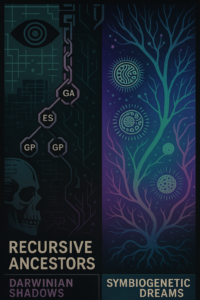
(Note: The theme image is generated by Chat GPT 4o.)
Prefrace:
As time has passed and after discussing my original KIPP Summative Assessment 1 with Ian and Dr. Rashné Limki, the instructor of ‘Coloniality of Data’ in semester two, I have undertaken substantial revisions and additions to the original version of my KIPP Summative Assessment 1. Here is the revised and updated version of my KIPP proposal, and it’s also the version I’d like to share and pitch to my peers.
Research Title: Symbiogenetic Evolution as a Posthuman Feminist Framework for AI Ethics: Beyond Anthropocentric and Patriarchal Paradigms in Algorithmic Design
Updated Version of my KIPP Proposal:
This dream research project builds upon the core ideas explored in my KIPP blog and proposes a posthuman feminist intervention into artificial intelligence (AI) ethics through Lynn Margulis’s evolutionary theory of symbiogenesis. It critically interrogates how Darwinian paradigms—embedded in a family of evolutionary algorithms including Genetic Algorithms (GA), Evolution Strategies (ES), Genetic Programming (GP), and, more broadly, nature-inspired algorithms—have perpetuated patriarchal and anthropocentric power structures from the very inception of AI development.
In contrast to these frameworks, which prioritise competition, optimisation, human supremacy, and hierarchical selection, Margulis’s theory of endosymbiosis and the symbiogenetic model foreground interdependence, multi-species collaboration, and co-evolution. This project explores how such a model and new paradigm can inspire alternative algorithmic imaginaries that resist existing AI assumptions rooted in exclusionary logics, amplify marginalised human and non-human voices, and open the design of AI to more entangled, caring, and reciprocal ethical relations.
Darwinian Paradigm
├── Genetic Algorithm (GA)
├── Evolution Strategies (ES)
├── Genetic Programming (GP)
├── Differential Evolution (DE)
├── Neuroevolution (e.g., NEAT)
└── Memetic Algorithm (MA)
Figure 1. A genealogical diagram of algorithms inspired by Darwinian paradigms, including Genetic Algorithms (GA), Evolution Strategies (ES), Genetic Programming (GP), and others. These algorithms share foundational principles of selection pressure, mutation, genetic recombination, and fitness competition, and are typically employed for optimisation tasks, reflecting an ontological commitment to individualism and optimisation. The aim of this research is to overcome the dominant Darwinian-inspired algorithmic frameworks, to critique the underlying ontological commitment to competition and individualism that informs evolutionary algorithm design more broadly, and to seek to challenge and reconfigure this dominant computational lineage through a symbiogenetic, posthuman feminist lens. A more detailed discussion of the ontological implications will be presented in a forthcoming blog post, based on my KIPP proposal conversation with Rashné at the end of Semester 2.
Contemporary AI systems, particularly GA, are shaped by Darwinian principles that mirror historical power structures, reinforcing social and ecological inequalities. This “patriarchal-anthropocentric recursion” promotes inequities in both algorithmic design and broader technological landscapes. By integrating Margulis’s theory, I aim to conceptualise new frameworks for AI systems that emphasise cooperation and inclusivity.
In this study, I propose a core presupposition: namely, that evolutionary algorithms (EA) are not merely a random specific kind of AI algorithm, but also serve as “proto-algorithms” and, metaphorically speaking, “algorithmic ancestors,” exerting deep structural influence through technogenetic inheritance (from techno– + genetic, indicating inheritance structures internal to technical systems) [1] on subsequent AI systems. The positive and negative influences of Darwinian algorithmic logic are not confined within the scope of those algorithmic families inspired by Darwinian evolutionary theory. Specifically, since many of these algorithmic family members—such as Genetic Algorithms (GA), Evolution Strategies (ES), and neuroevolutionary techniques (such as NEAT)—are frequently used to train other models—such as neural network architecture optimisation, parameter selection, and model generation—the architectural logic and ontological logic underlying EA, such as competitive logic, survival-of-the-fittest views, selection pressure, and single-directional optimisation goals, are also permeated into the judgement logic and ontological architecture of the next generation of AI systems they produce. This shows that the role played by the EA family is far from being merely an externally operational optimisation tool, but is more like a parental entity that “inherits” and “permeates” specific features (such as competition-first, efficiency-oriented, and exclusivist optimisation) into their algorithmic offspring. For instance, in meta-learning and AutoML systems, these features are delivered and reinforced in the design preferences of non-EA descendant algorithms, thereby expanding the scope of influence of Darwinian ontology within algorithmic systems. From this perspective, the role of evolutionary algorithms goes beyond that of a neutral training tool and is closer to a proto-origin capable of “reproducing” and delivering the values and ontologies of Darwinian algorithms to a broad array of downstream applications.
Furthermore, this process of technological reproduction carries strong normative and political implications, and may produce recursive amplification of bias within algorithmic systems. When these original algorithms—centred on competitive logic—are used to generate new model architectures—for example, designing neural networks using GA and then employing such networks for resource allocation or preference recommendation—these embedded biases are “inherited” and reinforced layer by layer, forming a deep “recursive loop of anthropocentric and patriarchal logic” through generational iteration of algorithmic design (Note to myself: I need to further consider whether the metaphor of “loop” or “chain” better captures this structure). When the fitness function is pre-configured to prioritise performance maximisation or market efficiency, subjects in marginal or heterogeneous positions—whether human or non-human—are often excluded from the model’s optimisation goals due to their “non-optimality,” suppressing the voices of disadvantaged groups and factors of relationality. This research proposal argues that such exclusion is not born of evil intent but represents an unconscious banality embedded in design (the mainstream and almost unquestionable value-neutral ontology and epistemology hold by developers, which their neutrality will be tested and examined in this research)—a banality that resonates with Hannah Arendt’s notion of “the banality of evil.” Designers and developers do not deliberately choose oppressive logics but, under the guise of instrumental rationality, unconsciously replicate the early bias embedded in prototype algorithms, resulting in systematic exclusion and inherited inequality. (In the course Ethical Data Futures, the instructor said: “No engineer sets out to build evil systems with bad intents”—this sentence profoundly impacted me and shaped my reflection on the deeper causes of inequality within AI systems.)
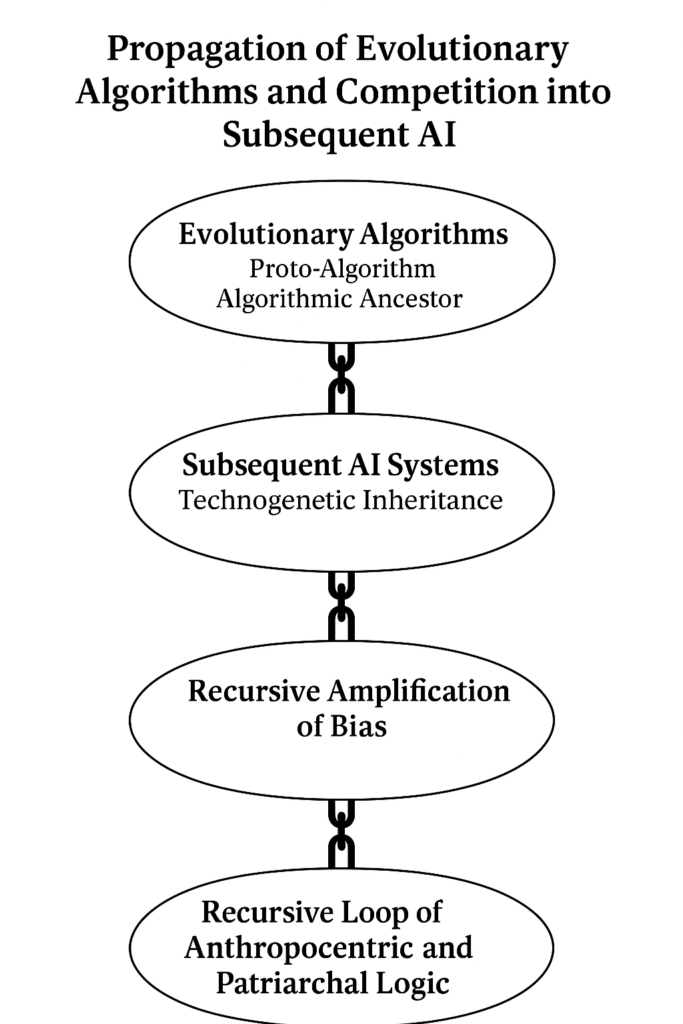
Figure 2. The AI technology propagation chain. The diagram is generated by the assistance of Chat GPT 4o, my companion species.
Therefore, if contemporary AI ethics limits itself to auditing fairness and transparency of outcomes—even though algorithmic audits as a method and tool to promote inclusion is undoubtedly vital in its tangibility and effectiveness—it still fails to reach the root of the problem: namely, the worldview and ontological structure upon which algorithms are built, the first cause of algorithms, in philosophical terms—that is, the ontological foundation upon which algorithmic logic is built. This study attempts to draw upon Lynn Margulis’s theory of symbiogenesis as a theoretical resource for a paradigm shift away from Darwinian evolution and the EA framework and proposes an algorithmic design perspective that is non-hereditary, non-competitive, and non-patriarchal. Within this alternative framework, AI is no longer a system that selects the strongest, the fittest, or the most optimal, but rather becomes a technological collective constituted by cooperation and co-construction among multiple species and multiple agents (actors? subjects? still considering which term is the most suitable one), guided by a more reciprocal rather than competitive logic.
Even if such a paradigm shift may not immediately replace the existing mainstream—or even if Margulis-inspired AI algorithms ultimately fail—this study’s attempt, as an ethical–technical deconstruction experiment of the “patriarchal–anthropocentric technogenealogy,” nonetheless holds indispensable political significance and imaginative potential for fundamentally challenging and dismantling the vicious recursive loop of the “life–technology genealogy” embedded in AI systems—one that encodes bios while systematically excluding zoē: raw, entangled, and more-than-human life,[2] and is rooted in unidirectional selection, competition, and individualism.
Compared to the earlier version (KIPP Summative Assessment 1), what did I revise after the feedback meeting with Ian and Rashné?
- In the original KIPP Summative Assessment 1 proposal, I limited the object of critique to GA (Genetic Algorithms) as a single algorithm. However, during this period, I have investigated more algorithms inspired by Darwinian evolutionary theory, all of which share, to varying degrees, certain ontological characteristics of Darwinian evolution. In other words, my object of critique has now expanded from GA to the entire family of Evolutionary Algorithms (EA). Moreover, I do not stop at critiquing the EA family themselves, but have also traced the subtle lines of influence that the EA family exerts on other non-EA algorithms. This deepens the critique by pointing out that the EA family may serve as a kind of “prototypical reproductive entity” in system design, potentially leading to recursive patterns of inequality. At the same time, in this revised proposal, the scope of the influence of Darwinian ontology has also expanded along with the extension of the research.
- I now have a clearer structure for my technical critique, or rather, a clearer logical chain of thinking for my project: “Ontology (and the corresponding epistemology and knowledge production that arise from it and remain to be elaborated and will be further developed in subsequent research) → Technical tools → Technological/ontological embedding → Structural delivery → Ethical issues.”
Teaser:
In my following blog posts, I will:
- Reflect on the discussion between Ian and me, regarding my KIPP Summative Assessment 1, and valuable insights he offered me. (Structured Blog Post 8)
- Reflect on the personal KIPP meeting between Dr. Rashné Limki, the instructor of ‘Coloniality of Data,’ and me and elaborate how her advice helped me broken the stifled bottlenecks of my research progress. (Structured Blog Post 10 and Structured Blog Post 11)
- Break down the issues I am still personally grappling with at this stage of the project. (Structured Blog Post 12)
Bibliography
Books
Thorne, K. (2014). The science of Interstellar. W. W. Norton & Company.
Tyson, N. D., & Mone, G. (2019). Astrophysics for young people in a hurry. National Geographic Books.
Tyson, N. D., Strauss, M. A., & Gott, J. R. (2016). Welcome to the universe: An Astrophysical Tour. Princeton University Press.
Barad, K. (2007). Meeting the universe halfway: Quantum physics and the entanglement of matter and meaning. Duke University Press.
Braidotti, R. (2013). The posthuman. Polity Press.
De Jong, K. A. (2006). Evolutionary computation: A unified approach. MIT Press.
Haraway, D. J. (2003). The companion species manifesto: Dogs, people, and significant otherness. http://ci.nii.ac.jp/ncid/BA65788953
Haraway, D. J. (2013). When species meet. University of Minnesota Press.
Haraway, D. J. (2015). Simians, cyborgs, and women: The reinvention of nature. Routledge.
Harding, S. (1986). The science question in feminism. Cornell University Press.
Hayles, N. K. (1999). How we became posthuman: Virtual bodies in cybernetics, literature, and informatics. University of Chicago Press.
Latour, B. (2012). We have never been modern. Harvard University Press.
Margulis, L., & Sagan, D. (2023). Microcosmos: Four billion years of evolution from our microbial ancestors. University of California Press.
Mitchell, M. (1998). An introduction to genetic algorithms. MIT Press.
Daston, L., & Galison, P. (2010). Objectivity. Zone Books.
Barocas, S., Hardt, M., & Narayanan, A. (2023). Fairness and machine learning: Limitations and opportunities. MIT Press.
Benjamin, R. (2019). Race after technology: Abolitionist tools for the new Jim Code. Polity.
Butler, O. E. (2014). Parable of the sower. Headline. (Original work published 1993)
Fanon, F. (2008). Black skin, white masks (C. L. Markmann, Trans.). Pluto Press. (Original work published 1968)
Césaire, A. (2000). Discourse on colonialism (J. Pinkham, Trans.). Monthly Review Press. (Original work published 1950)
McKittrick, K. (2021). Dear science and other stories. Duke University Press.
Césaire, A. (1990). Poetry and/as knowledge. In Césaire: The collected poetry (pp. xx–xx). University of Virginia Press.
Lorde, A. (2017). Your silence will not protect you. Silver Press.
Murphy, M. (2017). The economization of life. Duke University Press.
D’Ignazio, C., & Klein, L. F. (2020). Data feminism. MIT Press.
Vallor, S. (2024). The AI mirror: How to reclaim our humanity in an age of machine thinking. Oxford University Press.
Amoore, L. (2020). Cloud ethics: Algorithms and the attributes of ourselves and others. Duke University Press.
Koopman, C. (2019). How we became our data: A genealogy of the informational person. University of Chicago Press.
Cisney, V. W., & Morar, N. (Eds.). (2015). Biopower: Foucault and beyond. University of Chicago Press.
Wernimont, J. (2018). Numbered lives: Life and death in quantum media. MIT Press.
Robinson, D. G. (2022). Voices in the code: A story about people, their values, and the algorithm they made. Russell Sage Foundation.
Levitas, R. (1990). The concept of utopia. Syracuse University Press.
Levitas, R. (2013). Utopia as method: The imaginary reconstitution of society. Springer.
Grek, S. (2024). The new production of expert knowledge: Education, quantification and utopia (1st ed.). Springer International Publishing. https://doi.org/10.1007/978-3-031-54452-3
Repko, A. F., Szostak, R., & Buchberger, M. P. (2016). Introduction to interdisciplinary studies. SAGE Publications.
Dunne, A., & Raby, F. (2013). Speculative everything: Design, fiction, and social dreaming. MIT Press.
Tsing, A. L. (2015). The mushroom at the end of the world: On the possibility of life in capitalist ruins. Princeton University Press.
Albert, M. J. (2024). Navigating the polycrisis: Mapping the futures of capitalism and the Earth (1st ed.). MIT Press.
Yong, E. (2016). I contain multitudes: The microbes within us and a grander view of life. Random House.
Larson, E. J. (2006). Evolution: The remarkable history of a scientific theory. Modern Library.
Braidotti, R. (2018b). Posthuman feminism.
Grusin, R. A. (2017). Anthropocene feminism. 21st Century Studies.
Schlanger, Z. (2025). The light eaters: How the unseen world of plant intelligence offers a new understanding of life on Earth. Harper Perennial.
Irigaray, L., & Marder, M. (2016). Through vegetal being: Two philosophical perspectives. Columbia University Press.
Simondon, G. (2017). On the mode of existence of technical objects.
Hui, Y. (2016). On the existence of digital objects. University of Minnesota Press.
Hui, Y. (2016b). The question concerning technology in China: An essay in cosmotechnics. MIT Press.
Hui, Y. (2019). Recursivity and contingency. Rowman & Littlefield.
Hui, Y. (2024). Machine and sovereignty: For a planetary thinking. University of Minnesota Press.
Derrida, J. (2005). Paper machine. Stanford University Press.
Bassett, C. (2022). Anti-computing: Dissent and the machine. Manchester University Press.
Bassett, C., Kember, S., & O’Riordan, K. (2019). Furious: Technological feminism and digital futures.
巴諦斯特.莫席左. (2021). 生之奧義. 衛城出版.
阿甘本. (2019). 敞開: 人與動物.
eBooks
Feminist AI. (2023). In Oxford University Press eBooks. https://doi.org/10.1093/oso/9780192889898.001.0001
Gidley, J. M. (2017). The future: A very short introduction. In Oxford University Press eBooks. https://doi.org/10.1093/actrade/9780198735281.001.0001
Articles
Haraway, D. (2010). When species meet: Staying with the trouble. Environment and Planning D: Society and Space, 28(1), 53–55. https://doi.org/10.1068/d2706wsh
Spivak, G. C. (1988). Can the subaltern speak? Macmillan.
Wellner, G., & Rothman, T. (2019). Feminist AI: Can we expect our AI systems to become feminist? Philosophy & Technology, 33(2), 191–205. https://doi.org/10.1007/s13347-019-00352-z
Maggio, J. (2007). “Can the subaltern be heard?”: Political theory, translation, representation, and Gayatri Chakravorty Spivak. Alternatives: Global, Local, Political, 32(4), 419–443. https://doi.org/10.1177/030437540703200403
Blodgett, S. L., Barocas, S., Daumé, H., III, & Wallach, H. (2020). Language (technology) is power: A critical survey of “bias” in NLP. Proceedings of the 58th Annual Meeting of the Association for Computational Linguistics. https://doi.org/10.18653/v1/2020.acl-main.485
Binns, R. (2018). Fairness in machine learning: Lessons from political philosophy. Journal of Machine Learning Research. https://ora.ox.ac.uk/objects/uuid:2ff2785b-b0d4-447a-8326-a1fcc4c80840
Binns, R. (2020). On the apparent conflict between individual and group fairness. Patterns, 514–524. https://doi.org/10.1145/3351095.3372864
Winner, L. (2017). Do artifacts have politics? In Routledge eBooks (pp. 177–192). https://doi.org/10.4324/9781315259697-21
Haraway, D. (1988). Situated knowledges: The science question in feminism and the privilege of partial perspective. Feminist Studies, 14(3), 575. https://doi.org/10.2307/3178066
Shen, H., Knearem, T., Ghosh, R., Alkiek, K., Krishna, K., Liu, Y., … & Jurgens, D. (2024). Towards bidirectional human-AI alignment: A systematic review for clarifications, framework, and future directions. arXiv. https://arxiv.org/abs/2406.09264
Hemment, D., Murray-Rust, D., Belle, V., Aylett, R., Vidmar, M., & Broz, F. (2024). Experiential AI: Between arts and explainable AI. Leonardo, 57(3), 298–306. https://doi.org/10.1162/leon_a_02524
Long, D., & Magerko, B. (2020). What is AI literacy? Competencies and design considerations. Proceedings of the 2020 CHI Conference on Human Factors in Computing Systems, 1–16. https://doi.org/10.1145/3313831.3376727
Ferreira da Silva, D. (2016). On difference without separability. 32nd Bienal de São Paulo, 57–65.
Aguon, J. (2021, November 1). To hell with drowning. The Atlantic. https://www.theatlantic.com/ideas/archive/2021/11/to-hell-with-drowning/620589/
Maldonado-Torres, N. (2007). On the coloniality of being: Contributions to the development of a concept. Cultural Studies, 21(2–3), 240–270. https://doi.org/10.1080/09502380601162548
Wynter, S. (2003). Unsettling the coloniality of being/power/truth/freedom: Towards the human, after man, its overrepresentation—An argument. CR: The New Centennial Review, 3(3), 257–337. https://doi.org/10.1353/ncr.2004.0015
Barany, M. J. (2014). Savage numbers and the evolution of civilization in Victorian prehistory. The British Journal for the History of Science, 47(2), 239–255.
Green, B. (2021). Data science as political action: Grounding data science in a politics of justice. Journal of Social Computing, 2(3), 249–265.
Mohamed, S., Png, M.-T., & Isaac, W. (2020). Decolonial AI: Decolonial theory as sociotechnical foresight in artificial intelligence. Philosophy & Technology, 33(4), 659–684.
Phan, T., Goldenfein, J., Mann, M., & Kuch, D. (2022). Economies of virtue: The circulation of “ethics” in big tech. Science as Culture, 31(1), 121–135.
Bender, E. M., Gebru, T., McMillan-Major, A., & Schmitchell, S. (2021). On the dangers of stochastic parrots: Can language models be too big? FAccT ’21: Proceedings of the 2021 ACM Conference on Fairness, Accountability, and Transparency, 610–623.
Danaher, J. (2016). The threat of algocracy: Reality, resistance and accommodation. Philosophy & Technology, 29(3), 245–268.
Adams, R. (2021). Can artificial intelligence be decolonized? Interdisciplinary Science Reviews, 46(1–2), 176–197.
Hoffmann, A. L. (2021). Even when you are a solution you are a problem: An uncomfortable reflection on feminist data ethics. Global Perspectives, 2(1).
Charitsis, V., & Lehtiniemi, T. (2023). Data ableism: Ability expectations and marginalization in automated societies. Television & New Media, 24(1), 3–18.
Gabriel, I. (2020). Artificial intelligence, values, and alignment. Minds and Machines, 30(3), 411–437.
Gal, U., Jensen, T. B., & Stein, M.-K. (2020). Breaking the vicious cycle of algorithmic management: A virtue ethics approach to people analytics. Information and Organization, 30(2), 100301.
Mitchell, S., Potash, E., Barocas, S., D’Amour, A., & Lum, K. (2021). Algorithmic fairness: Choices, assumptions, and definitions. Annual Review of Statistics and Its Application, 8(1), 141–163.
Steyerl, H. (2023). Mean images. New Left Review, 140–141, 82–97.
Smith, A. K. J., Schermuly, A., Newman, C. E., Fitzgerald, L., & Davis, M. D. M. (2023). Empowering queer data justice. American Journal of Bioethics, 23(11), 56–58. https://doi.org/10.1080/15265161.2023.2245744
Mehrabi, N., Morstatter, F., Saxena, N., Lerman, K., & Galstyan, A. (2022, January 25). A survey on bias and fairness in machine learning. arXiv. https://arxiv.org/abs/1908.09635
Jordan, M. I., & Mitchell, T. M. (2015). Machine learning: Trends, perspectives, and prospects. Science, 349(6245), 255–260. https://doi.org/10.1126/science.aaa8415
Birhane, A. (2021). Algorithmic injustice: A relational ethics approach. Patterns, 2(2), 100205. https://doi.org/10.1016/j.patter.2021.100205
Stray, J. (2020). Aligning AI optimization to community well-being. International Journal of Community Well-Being, 3(4), 443–463. https://doi.org/10.1007/s42413-020-00089-w
Bandy, J. (2021). Problematic machine behavior: A systematic literature review of algorithm audits. Proceedings of the ACM on Human-Computer Interaction, 5(CSCW1), 1–34. https://doi.org/10.1145/3449148
Van Dermijnsbrugge, E., & Chatelier, S. (2022). Utopia as method: A response to education in crisis? Asia Pacific Journal of Education, 42(sup1), 6–19. https://doi.org/10.1080/02188791.2022.2031870
Grek, S., Tichenor, M., & Bandola-Gill, J. (2024). Numbers as utopia: Sustainable development goals and the making of quantified futures. The British Journal of Politics and International Relations, 26(3), 742–758. https://doi.org/10.1177/13691481231165043
Nicolescu, B. (2014). Methodology of transdisciplinarity. World Futures, 70(3–4), 186–199.
張君玫. (2020). 人類世中的女性主義:立足點、地方與實踐. 中外文學, 49(1), 13–60.
潘育正. (2020). 《天問》衛星計畫與未來遺跡. ACT藝術觀點, 80, 88–93.
Audio / Podcast / Multimedia / Website
Tippett, K. (Host), & Kimmerer, R. W. (Guest). (2016, February 25). The intelligence of plants [Audio podcast episode]. In On Being with Krista Tippett. On Being Studios. https://onbeing.org/programs/robin-wall-kimmerer-the-intelligence-of-plants/
Vuong, O. (2020, April 30). A life worthy of our breath (K. Tippett, Interviewer). On Being with Krista Tippett. https://onbeing.org/programs/ocean-vuong-a-life-worthy-of-our-breath/
Crawford, K., & Paglen, T. (2019). Excavating AI: The politics of images in machine learning training sets. The AI Now Institute. https://www.excavating.ai
Algorithm Watch & EPC. (2020, December 9). The EU Digital Services Act – Why data access matters [Audio podcast episode]. AlgorithmWatch.
Kantayya, S. (Director). (2020). Coded Bias [Documentary film]. Cinereach, Women Make Movies.
Algorithmic Justice League. (2022). Algorithmic Justice League. https://www.ajl.org
Feminist Data Manifest No. (n.d.). Manifest No. https://www.manifestno.com
[1] Technogenetic is a compound word derived from techno- (referring to the technical, mechanical, or artificially constructed) and -genetic (from genetics or genesis, indicating both generativity and inherited structures). The term technogenetic inheritance thus refers not to biological inheritance but to the reproduction and transmission of architectural logics, value systems, and ontological assumptions internal to technical systems. In this context, evolutionary algorithms are not merely tools for optimisation but function as reproductive agents of specific epistemic and ontological worldviews. Compared to broader terms like technical heritage or algorithmic influence,technogenetic inheritance more precisely captures the recursive and normative structure this project seeks to dismantle.
[2] In this paper, I refer to zoē rather than bios when discussing the kinds of life systematically excluded by dominant algorithmic logics. While bios refers to regulated, codified life—life that is made intelligible and governable within political and technical systems—zoē designates bare, unqualified, or more-than-human life. The recursive loop that this project aims to dismantle is not life itself, but the reduction of zoē to bios through the translation of plural, entangled, and relational life into competitive, optimisable, and exclusionary algorithmic formats.