1.Artist-Curator
⚫️Studying from the lecture by artist curator Fran Cottell
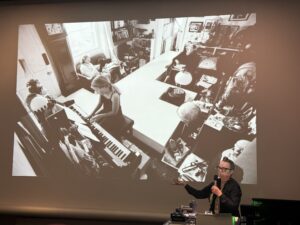
Artist curator Fran Cottell, lecture at the University of Edinburgh college of Art on January 29, 2025. Photo by Zhu Jiamin.
Art can create meaning by revealing the real state of life.
Fran Cottell’s lecture made me think more deeply about the relationship between art and personal space. She showed the vulnerability of people in her home projects, avoided artificial performances, and made her art practice more authentic and intimate. This approach made me realize that art is not just about constructing idealized images, but can generate meaning by exposing the real state of daily life. She also mentioned that she used surrealist techniques in her curatorial work, such as removing the windows of traditional houses, challenging the fixedness of space and bringing an absurd way of thinking. In addition, I was impressed by her attitude of transforming frustration and anger into creativity. Art in her practice has become a way of confrontation and exploration, not just an expression of beauty or order.
Reflection
This emotion-driven creative method made me re-examine the close connection between art and personal experience, and also inspired me to think about the role of sensory experience in curating. Therefore, I hope to emphasize how the senses shape our perception of space, emotions and social relations in my curatorial projects. In addition, Cottell confronts the audience with an unstable living environment in her practice, while my curatorial work will try to break the traditional visual-dominated experience and allow the audience to participate in the artwork through multiple sensory dimensions such as touch, sound, and smell. Most importantly, her use of emotions also reminds me that sensory experience is not just about physical stimulation, but also about the stimulation of emotions and memories. I hope to learn from her way of spatial intervention in curating, creating an environment that allows the audience to actively perceive, explore, and even feel uncomfortable or surprised, so as to break the boundary between art and daily experience.
⚫️Nalini Malani’s ‘video shadow plays’ combine video, shadow and sound to tell multiple stories.
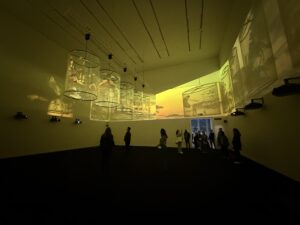
Installation photo, In Search of Vanished Blood, 2012–20, Nalini Malani. Photo by Zhu Jiamin, Tate, London, 2025.
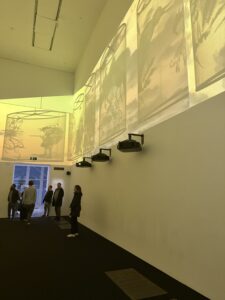
Installation photo, In Search of Vanished Blood, 2012–20, Nalini Malani. Photo by Zhu Jiamin, Tate, London, 2025
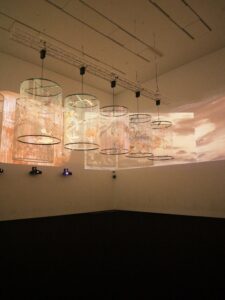
Installation photo, In Search of Vanished Blood, 2012–20, Nalini Malani. Photo by Zhu Jiamin, Tate, London, 2025
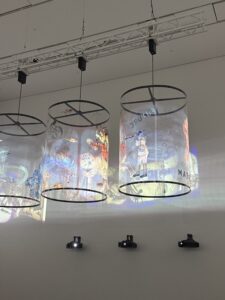
Installation photo, In Search of Vanished Blood, 2012–20, Nalini Malani. Photo by Zhu Jiamin, Tate, London, 2025
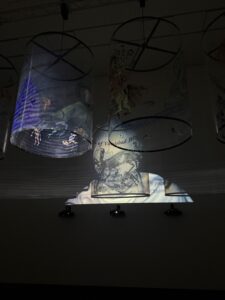
Installation photo, In Search of Vanished Blood, 2012–20, Nalini Malani. Photo by Zhu Jiamin, Tate, London, 2025
This week I went to Tate Modern in London for curatorial research and study. Nalini Malani’s work gave me a strong sensory impact and made me think about how to use multi-sensory interaction to deepen the audience’s experience in future curatorial practice. Her installation uses light and shadow, dynamic images and transparent cylinders to immerse viewers in a flowing visual narrative the moment they enter the exhibition space. The images are projected on the walls and hanging transparent cylinders, forming a layered visual effect, breaking the fixed viewing method. This dynamic viewing experience not only challenges the traditional way of displaying paintings and images, but also creates a constantly changing and unfixed narrative in the space.
Reflection
This experience reminds me of Fran Cottell’s concept of “spatial intervention” and “vulnerability” mentioned in the lecture. Cottell breaks the boundaries between the personal and public spheres by intervening in the living space, while Malani allows the audience to feel the fluidity of the image in the space through the interaction of projection and installation, which also makes me reflect: how does sensory experience affect our understanding of space? Malani’s work is not only a visual experiment, but also about how the audience interacts with the work in space, and how to create a multi-layered perceptual experience through the superposition of light and shadow, transparent materials and text.
For my future curatorial projects, this multi-dimensional sensory interaction method provides important inspiration: how to create “vulnerability” in curating – not only the fragility of physical space, but also the fragility of information and perception, so that the audience can actively discover and construct meaning in the interaction, rather than passively accept it.
Bibliography
Bruggeman, Jacob. 2018. “Art Can Change the World: A Review of Nato Thompson’s Seeing Power: Art and Activism in the 21st Century.” Community Change 2 (1). https://doi.org/10.21061/cc.v2i1.a.10.Graham, Beryl, and Sarah Cook. 2010. Rethinking Curating: Art after New Media. MIT Press.






Your first three blog posts offer some evidence of engagement with lecture and workshop content and your own personal research via exhibitions that interest you, well done. You begin to consider how these bear upon your own thinking and the development of your Speculative Independent Curatorial Project and this is a route you should continue to pursue following further research.
You note some interest in Ryiuchi Sakamoto and sound in your week 2 post and ‘sensory curation’ in your week 3 post. This is a promising direction and it’s helpful that this is related to specific examples, however, it is essential that you support and supply this understanding with appropriate theory and begin to incorporate expressly critical concepts within your thinking. What are the theories that are central to your interest and in what ways do they inform your speculative project? If you are particularly interested in sound, you might want to look at the writing of Pauline Oliveros.
As well as theoretical development, you should begin to research and consider smaller scale (non-institutional) projects which have tackled similar themes: how do they take large and unwieldy topics and produce something specific, localised and impactful? Listen Gallery in Glasgow may be of interest in this respect. Considering practicalities will also help to advance your thinking. Remember that the Speculative Independent Curatorial Project is pitched at an emerging curator stage. Where could it be held? Which artists might it involve? When these answers become clearer you should adjust your project accordingly.
Thank you for your valuable suggestions. I will present the missing parts in subsequent blogs and further think about the specific topic content.