Life, Decay, and Cycles in Material Form
This week’s visit to the Corpse Flower Pop-Up exhibition offered a visceral and materially rich exploration of life, death, decay, and regeneration. The Amorphophallus titanum—renowned for its stench of rot—served as a potent curatorial metaphor: alluring, grotesque, and transitory. This sensorial tension between attraction and repulsion opened a pathway for thinking about time and transformation beyond linear narratives.
Analysis of some works
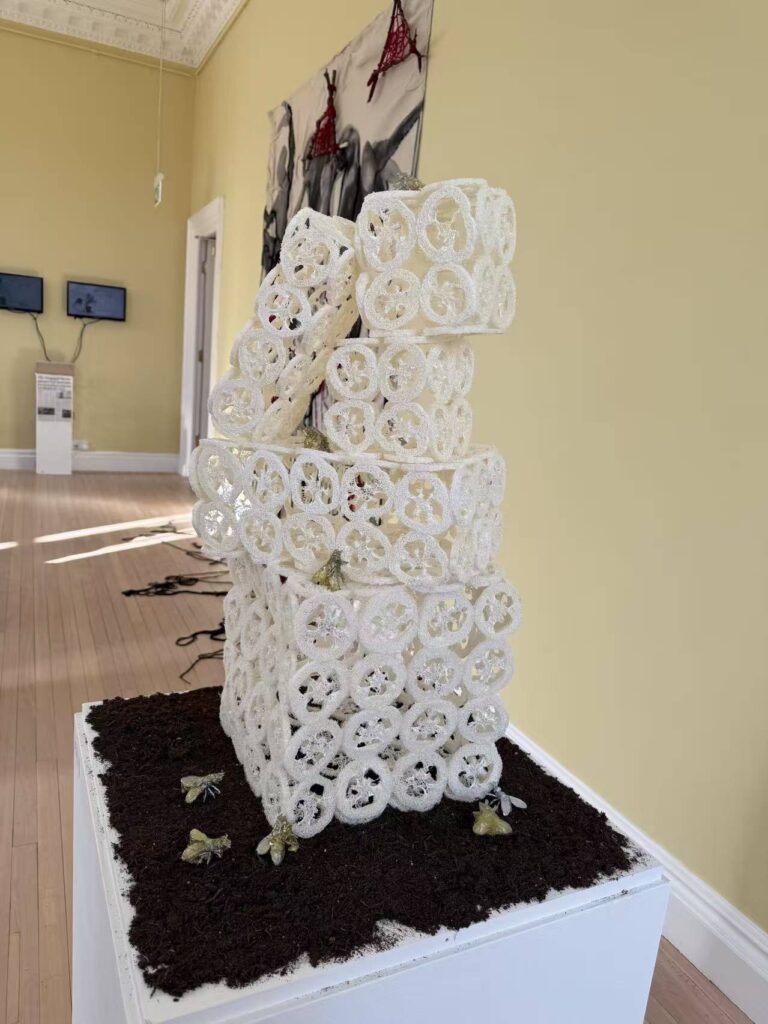
Jiayi Huang, The Last Harvest, 2025 Lootan. aluminum. soi. syruo
The work’s geometric, hollow forms evoke a sense of organic growth and fragility, which contrasts with the solidity of the soil, underscoring the cyclical interplay of death and rebirth.
The inclusion of flies—agents of decay—alludes to the corpse flower’s scent and symbolises time as a slow, erosive force. Here, decomposition is not portrayed as an end, but as a fertile process of temporal transformation.
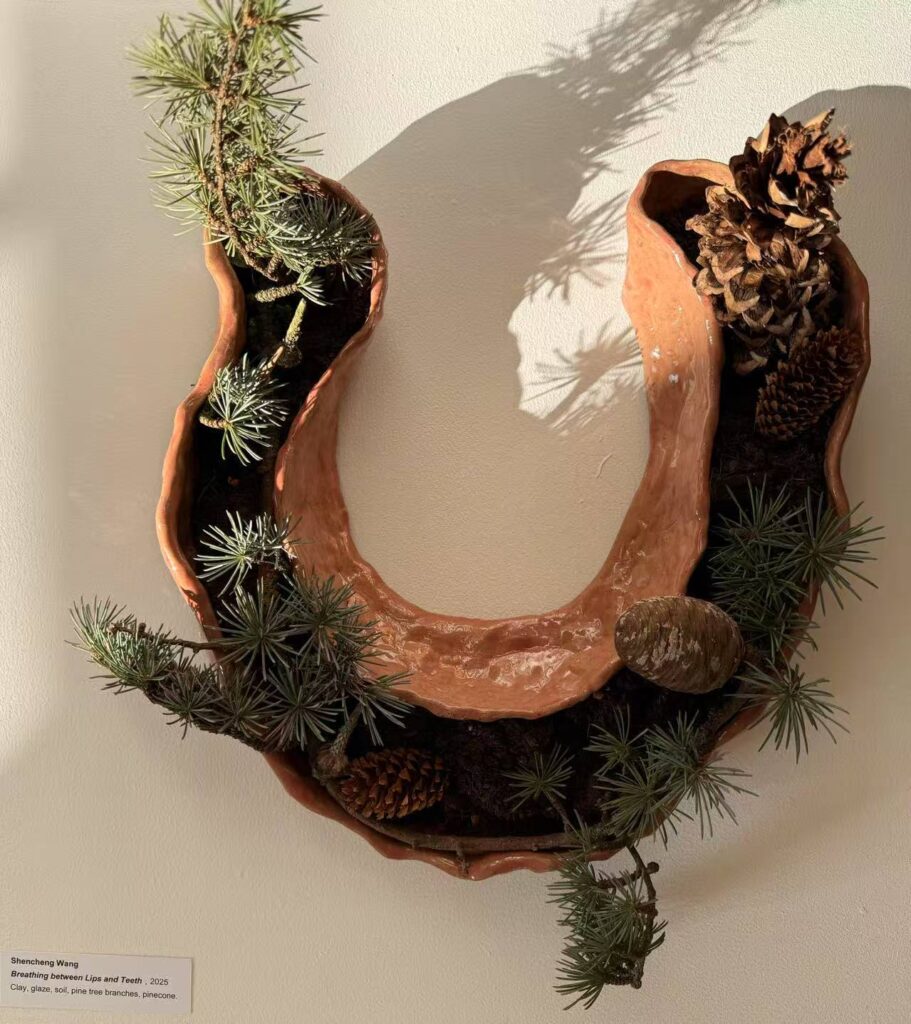
Shencheng Wang, Breathing between Lips and Teeth, 2025, Clay, glaze, soil, pine tree branches, pinecone.
Through its form, materials, and symbolic elements, the work simulates an oral ecosystem, examining the intricate interplay between bacteria, food, decay, and regeneration.
By integrating soil and living plants, it expands this exploration beyond the microscopic, inviting the audience to reflect on the parallels between nature and the human body, decomposition and renewal, and the cyclical processes of life on both macro and micro scales.
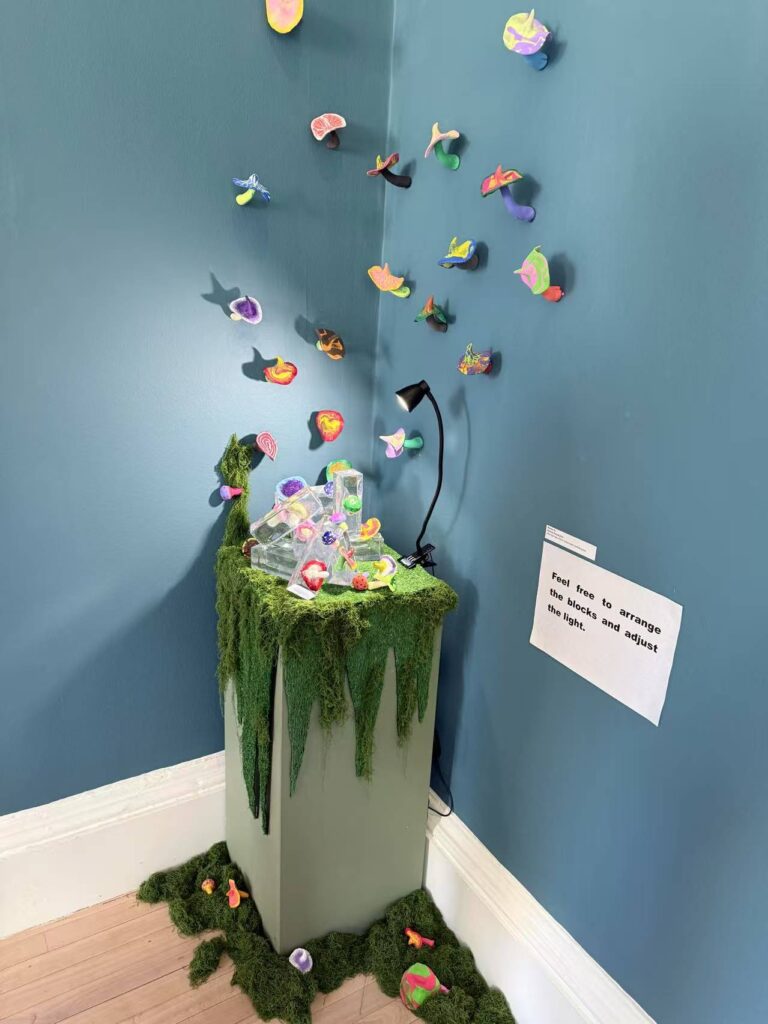
Wenke Xu, Illusory Puzzle 2025, Ultra-light clay, Resin, Acrylic paint, Artificial grass
Colorful, mushroom-shaped sculptures, adorned with moss, are accompanied by interactive signage that encourages visitors to engage with the installation. By rearranging light sources and objects, they can explore dynamic shifts in light and shadow, thereby deepening their sensory and spatial perception.
Curatorial Reflections: Slow Time, Living Systems
The Corpse Flower exhibition reshaped my understanding of time—not as linear, but as tactile, relational, and ecological. Its use of organic metaphors, such as spores and decay, revealed temporality as a circulating force rather than an endpoint.
I was particularly struck by how the spatial design choreographed slowness, prompting visitors to linger and engage sensorially.
Inspired by this, I’m considering how my own exhibition can guide the audience’s rhythm—through dim lighting, ambient sound, and touchable elements—to resist extractive viewing and cultivate an experience of embodied, ethical witnessing.



10 March 2025 at 09:03
Hi Shumiao, you present a very strong post on the impact of the Talbot Rice Gallery on your thinking and planning, good work. You state “Instead of reducing individuals to mere “victims,” it positions silence itself as a form of resistance” yes. You cross-reference this with extra independent research when you discuss Sandra Teitge: this is exactly the type of weaving together, revisiting, and expanding, we are asking for. You offer an in-depth review of 24/7’s time theme, well done, and begin to show how this informs your own curatorial thinking, which as you say considers the gender dimension that 24/7 did not always address. You could go much further with this, and critical reading will help shape the clarity of the sub-themes you identify, as well as further exhibition models, which you combine and adapt to your own. So, for example https://wellcomecollection.org/exhibitions/the-cult-of-beauty focused on beauty but did not look at time. Doing a map of curatorial thematics like James Clegg discussed (and also Harry’s example is really good from your Collective) could really help here. It’s good to see your report of Corpse Flower, however there is scope to show how this applies to your own work in more detail, or to include more fieldwork examples if there are other exhibitions that were more stimulating. There is still a lot more scope to engage with course materials and to include a wider range of critical/curatorial content to enrich your Blog.
Your peer review of Haonan shows you have engaged with the core concept of the project, and your suggestion to expand on digital mourning as an idea is a really useful one. I can see how this relates to your own topic of time because grief, trauma and mourning profundly shape our experience of time. Perhaps because of this, it would useful to engage with more specific examples of research or ideas to help Haonon, applying what you have learned to them (be careful of the pronoun, it’s she for a woman). Similiarly, your peer review of Chuni shows you can identify key components to comment on but you need to add more research/creative suggestions as well as commentaries on points.
CURATORIAL PITCH SLIDES
In terms of your project slides, there is a need to think much more about where this project will happen, and specifics of how you will engage audiences, publics, communities. While it is great to have aspirations to do longer term things, the resources required in creating communities are substantial as are the ethics considerations: you could identify this in your proposal as a future possibility but keep it out of the main project unless you can show how it would realistically happen. The idea of time-management model is maybe more feasible, because some of these exist eg Time banks, which you could look at. Collaboration with womens groups seems like a real opportunity. While it is entirely possible and valid to focus on East Asian women, it would be potentially empowering for all to consider cross-connections with women in other geographies: strength in commons and connectivity? A project like this could show you a wider model of working (though the theme is care not time it could be adapted): https://contemporaryartandfeminism.com/care
It is important to work more on curatorial narratives for your sub-themes/sections of the project and for this you need more critical content from curatorial methods and relevant discourse on feminism and time. In addition, start to sketch ideas for layout, beginning a rough draft of a budget can help feed back into project design. We also discussed the important of thinking how you will include different genders in this, and which areas may be for women only, if any?