
Last week, I finished making all of the PowerPoint presentations for my 5 lessons, the accompanying resources, and lesson plans. I go to Liberton High School in two weeks’ time to put my work into practice. Therefore, I thought it would be an appropriate time to reflect on the challenges that I have faced whilst planning the lessons. I will detail how I am overcoming these challenges, so I can be fully prepared for delivering my lessons later this month.
Keeping to time
The main challenge I have had has been lesson timings. Due to the school’s timetable, the lessons I have planned have had to be 40-50 minutes long. With these relatively short timings, it has been difficult to fit everything into the lessons that I would ideally have wanted, especially with the lessons involving practical activities outside the classroom. As a result, I have tried hard to ensure that the practical activities will run as quickly and smoothly as possible by making instruction handouts, with short, concise descriptions, and clear diagrams for those who have more difficulty reading or understanding.
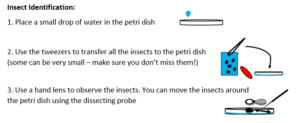
A screenshot of a section of the lesson 3 practical instruction handout
I have also had to shorten some activities, and think of ways to prevent unnecessary time from being taken up. For example, I have decided to hand out certain worksheets at the beginning of the lesson, and pre-cut activity cards (such as those for the diamond ranking), so that they can be handed out in envelopes, ready to be used straight away. I have also found it difficult to gauge how long to plan for verbal discussion of topics, as I am unsure how confident the class will be in feeding back their answers to me. If necessary, I can adjust my timings after delivering the first lesson, once I have a better idea of how the class will respond to discussion activities.
Catering for different abilities
Another challenge has been ensuring my lessons are aimed at the correct level for students’ ability. I have been using the Scottish Curriculum for Excellence to identify concepts that students should already know. In doing so, I have been able to include refresher activities for certain concepts which I think students may need reminding of. For example, in my fourth lesson, I have included a starter activity on distinguishing between independent and dependent variables, by getting students to decide which variables in our experiment were independent, and which were dependent. This will hopefully set a strong foundation for the students’ learning. I have tried to make the lessons accessible to students of all abilities, not only by using a mixture of text and diagrams in instructions (as mentioned above), but also by providing supporting resources to those who may benefit. I will discuss potential students for these resources with the teachers. For example, in the lesson where we analyse the data, I will produce template graphs with pre-made axis titles, labels and scales for students who may otherwise struggle with this activity. I hope that by trying to cater for a full range of abilities, I will keep the students engaged as they will not feel unable to complete any activities. This will hopefully maximise their learning.
Minimising uncertainties
A final challenge that I have faced is the unpredictability of how many insects we will sample. I expect that there will not be many insects active in mid-March compared to the optimum time for sampling in summer months. I am also uncertain as to whether traps may be tampered with, or affected by weather conditions. I am going to try and reduce this uncertainty by bringing in pots of insects that I collected from two different habitats for my dissertation, for students to identify. This will ensure that students can still practise their insect identification skills, and meet the learning outcomes of the lesson. It may be exciting for them to see a sample of my own research. I have also produced a dummy dataset, with data that I have made up, that reflects differences in insect abundance, diversity, and plant diversity between two habitats. This will mean students can still practise their data analysis and presentation skills, even if we collect insufficient data ourselves.
Adapting
By trying to foresee potential challenges, and minimise uncertainties, I have ensured that I am as prepared as possible for delivering my lessons. As I progress through delivering my lessons, I will continue to reflect. I have allocated time for me to adapt my lesson planning accordingly should any new issues or challenges arise, as I see how quickly the students learn, how they react to me, and how effective my resources and delivery are.



Leave a Reply