

Throughout this project, graphic novel artists Solomon Enos and Simon Grennan have been working on their adaptations of Robert Louis Stevenson’s Island Nights’ Entertainments. Though both have worked closely during the project, visiting the same locations relevant to Stevenson’s life in Scotland and Samoa, their approaches to the adaptation process have been very different.
Simon Grennan’s ‘Shadow Play’
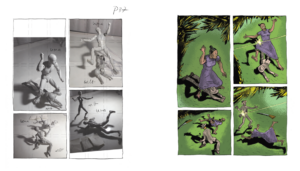
Grennan has used a metatextual frame device in ‘Shadow Play’, his adaptation of Stevenson’s ‘The Beach of Falasá’, so that the story playing out emulates a shadow puppet theatre. He used mannequins and small models of the characters to stage the action sequences throughout the story, as his initial draft of page 38 of ‘Shadow Play’ attests. In the final version, this creates a sense of perpetual movement and reactivity, highlighting Uma’s dominance and power.
Exploring the gender politics and racial tensions of Stevenson’s novella, Simon Grennan has been playing with depictions of character, culture and storytelling in his graphic adaptation. From the recovery and repositioning of the Kiribati bride, Uma, to the invocation of shadow theatre and nineteenth century melodrama, Grennan is examining how variations in character portrayals – imagining characters at different ages, in different clothing, as having different body shapes and sizes – can affect the power relations inherent in the narrative itself.


Bringing these ideas about character, representation and culture into his participatory art workshops with schoolchildren in Honolulu, Apia and Edinburgh, Grennan is encouraging learners and workshop participants to consider their relationship to past traditions, ideologies and artifacts, in ways that make space for perspectives and voices typically unheard in the Western canon of imperial-era texts.
Participants’ work is informing Simon’s thinking about past and present (re)readings of The Beach at Falesá, articulated according to readers’ and participants’ different experiences of Sāmoa, Scotland and Hawai’i.
Solomon Enos’s ‘The Isle of Voices’ and ‘The Bottle Imp’
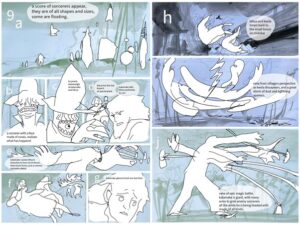
Solomon Enos focused initially on backgrounds, structure and colour schemes in his early drafts. This helped him work through the challenges of depicting the multiple temporalities and locations throughout ‘The Bottle Imp’ and ‘The Isle of Voices’. Character development came later, with his versions of Stevenson’s female characters, particularly, taking more and more prominence in his drafts.

Solomon Enos is adapting both Stevenson’s ‘The Bottle Imp’ and ‘Isle of Voices’ to emphasise Polynesian cultural heritage and traditions, in line with his vision to produce modern fantasy visual materials that celebrate Hawaiian identity. In his reworking of both stories, Enos elevates the role of the wahine women depicted in the original tales, with the magical potential of Lehua of ‘Isle of Voices’ and the practical wisdom, knowledge and courage of Kokua ‘The Bottle Imp’ repositioned at the centre of each narrative. Experimenting with colour, costume, place and story-structure, Enos’s creative adaptations both update these stories for contemporary youth audiences in the Pacific andin Scotland, and honour Stevenson’s connection to the communities he was writing about in these stories. From his extensive travels across the many sites of this project, Enos has drawn on diverse the material cultures of Hawaii, Samoa, Tahiti and the UK to accurately depict clothing, money and other objects (such as bottles, most notably in the case of ‘The Bottle Imp’) in his graphic adaptations.


