Any views expressed within media held on this service are those of the contributors, should not be taken as approved or endorsed by the University, and do not necessarily reflect the views of the University in respect of any particular issue.
Here you can find the news from the project team, learn more about our research, and stay informed about our upcoming events. We are excited to have you here!
Our project offers a critical intervention in the conceptualisation, role and function of Knowledge Exchange and Impact (KEI), problematising an approach that uncritically instrumentalises ‘benefit’ from research outputs. In the upcoming months we will be interviewing and surveying academic research staff, GLAM (Galleries, Libraries, Archives and Museums) staff, and research support staff members in order to produce a comprehensive set of recommendations and guidelines on steps towards creating a more fair and equitable KEI framework. You can read more about the aims of our project here.
As the materials we produce will be aimed at three broad, but distinct, groups of professionals, we will make sure to separate them into streams, so you can tailor the contents of the website to your needs. You can find the links to the materials most relevant to you on the right-hand side panel.
Throughout the next several months we will be hosting a number of events. While we will notify about them separately, you can always find the list of upcoming and past events as well as all the relevant information here.
We hosted our first roundtable event on February 4th which critically engaged with the knowledge exchange and impact (KEI) landscape within the UK Higher Education Institutions. The event was an opportunity for HEI colleagues to explore and address structural issues impacting KEI and research cultures.
After PIs Dr Hephzibah Israel, Dr Stanislava Dikova and Dr Annie Sorbie welcomed all guests and speakers, they presented a brief overview of our project aims, its stages, and future outputs. They summarised how the project developed in response to long-standing concerns about what “impact” means, and the systemic and structural issues related to KEI. Within the project, decolonial approaches play a key role in addressing and challenging the effects of historic colonial structures in contemporary impact agendas such as the UK’s Research Excellence Framework (REF). The project asks whether alternative definitions of impact and benefit are possible, and looks at ways to influence institutional practices at the University of Edinburgh.
For the event, we invited three guest speakers from different disciplinary backgrounds and institutions to share their knowledge and experience of doing KEI work.
Dr Jessica Hope was our first guest speaker. Jess is a critical human geographer and interdisciplinary researcher in the field of Political Ecology at the University of St Andrews. She introduced us to one of her recent projects “Roads to Sustainability”. The project team comprisedJess, two post-doctoral associates, and 16 Indigenous researchers, investigates road building in the Western Amazon and the emancipatory possibilities of alternative infrastructures. As it tackles the clash between profit-driven corporation plans and the constitutional land rights of Indigenous people, the project applies decolonial concepts for the development of equitable collaborative practices.
Thinking about KEI, Jess pointed out, the impact agenda can seem quite de-politicised: their project contested the distinctions between nature and politics. To combat extractive research methods, Jess argued that we need to re-define expertise and include opportunities for local collaborators to co-produce projects’ aims and being able to use research findings in their own campaigns. While impact, at the moment, is mostly understood as “making a change outside of academia”, Jess argued that it is equally crucial to feed back into our own institutions and advocate for easier and more equitable administrative practices (e.g. fair reimbursement for external collaborators) and co-authorship practices.
Our second speaker, Dr Katucha Bento, is the founder of the Free Afro-Brazilian University and lecturer on Race and Decolonial Studies at the University of Edinburgh. Katucha described the event as an important opportunity to foster conversations around disobedient practices and creative approaches to understand what makes colonial, racist, and inaccessible practices of knowledge exchange.
Through discussing her project “R-Existence and Healing in Brazilian rural community: Weaving solidarity during the pandemic”, Katucha challenged the concept of benefit and its roots in colonial structures which continue to define what counts as knowledge and perpetuate competitive models of research. In her projects, communities determine what benefit meant for them, co-designing the project aims and defining what impact looks like in their own terms. This encompassed philosophical reflections on addressing racism, moving beyond historical violence and nurture present-day healing through spiritual practices, especially in contexts with limited access to food and healthcare.
Katucha helped us reflect on how researchers are still complicit in perpetuating colonial extraction, and how we can support meaningful exchanges that lead to concrete benefits for Indigenous communities. KEI, she emphasised, needs to be re-imagined through decolonial, ethical, and community-centred frameworks.
Our third guest speaker, Dr Giovanna Vitelli, is Head of Collections and Curation at the Hunterian Museum of the University of Glasgow. As a practice-based researcher who does community participatory work on a daily basis, she pointed out the limitations imposed by the language of REF. While inclusivity and collaboration have become part of academic culture on paper, their current use still fails to meaningfully tackle the historical hierarchies of power around expertise and knowledge production. Truly collaborative and inclusive research, she argued, needs to devolving such power.
As REF language revolves around issues of “robustness”, “high quality standards” and “expendable academic outputs”, it builds competition into the research funding process, which fundamentally goes against the values of inclusivity and collaboration. In recent participatory projects, Giovanna discussed the language of funding applications and institutional policies directly with the participant communities. Taking their critiques on board, she worked towards changing the Hunterian Museum’s policy language.
She pointed out how essential it is to re-define expertise. “Lived experience”, while important, should not be the only thing researchers and institutions seek from communities: they have professional expertise and academic knowledge in their own fields. Recognising the professional and academic expertise that grows outside of our own academic environment presents us with opportunities for profound growth.
To conclude the event, we opened the floor to questions from all participants, who provided us with rich food for thought. From the recognition that we still very much operate in colonial hierarchies which affect how we think and do research, to how to tackle the practical barriers imposed by our reliance on funding, and funding bodies’ colonial structures. Participants’ questions prompted us to think about our own project, its potential legacies, and the challenges of bringing forth change, especially within the limitations of short-term research projects.
While these discussions can be difficult, they also create space for solidarity, and we are grateful to all our participants for such an open and meaningful discussion.
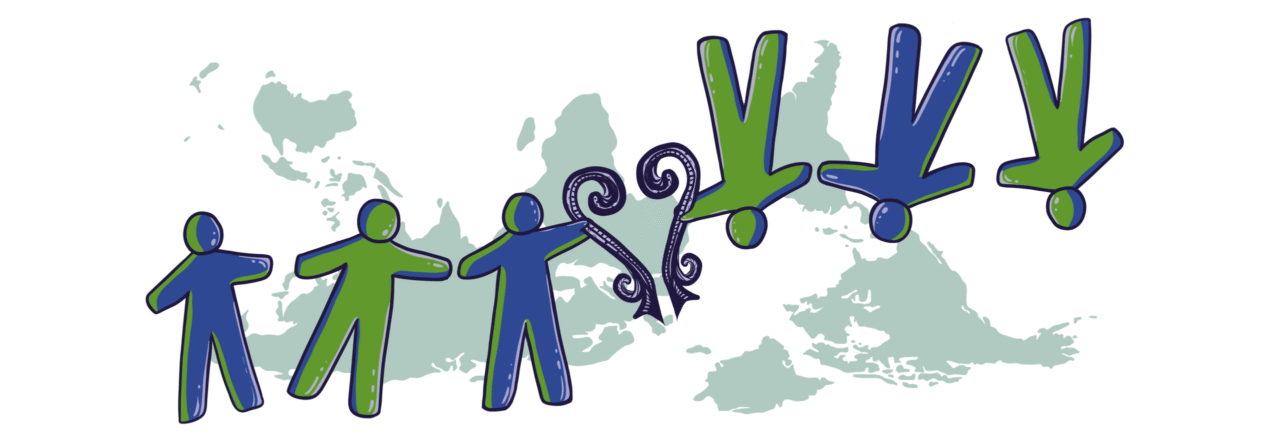
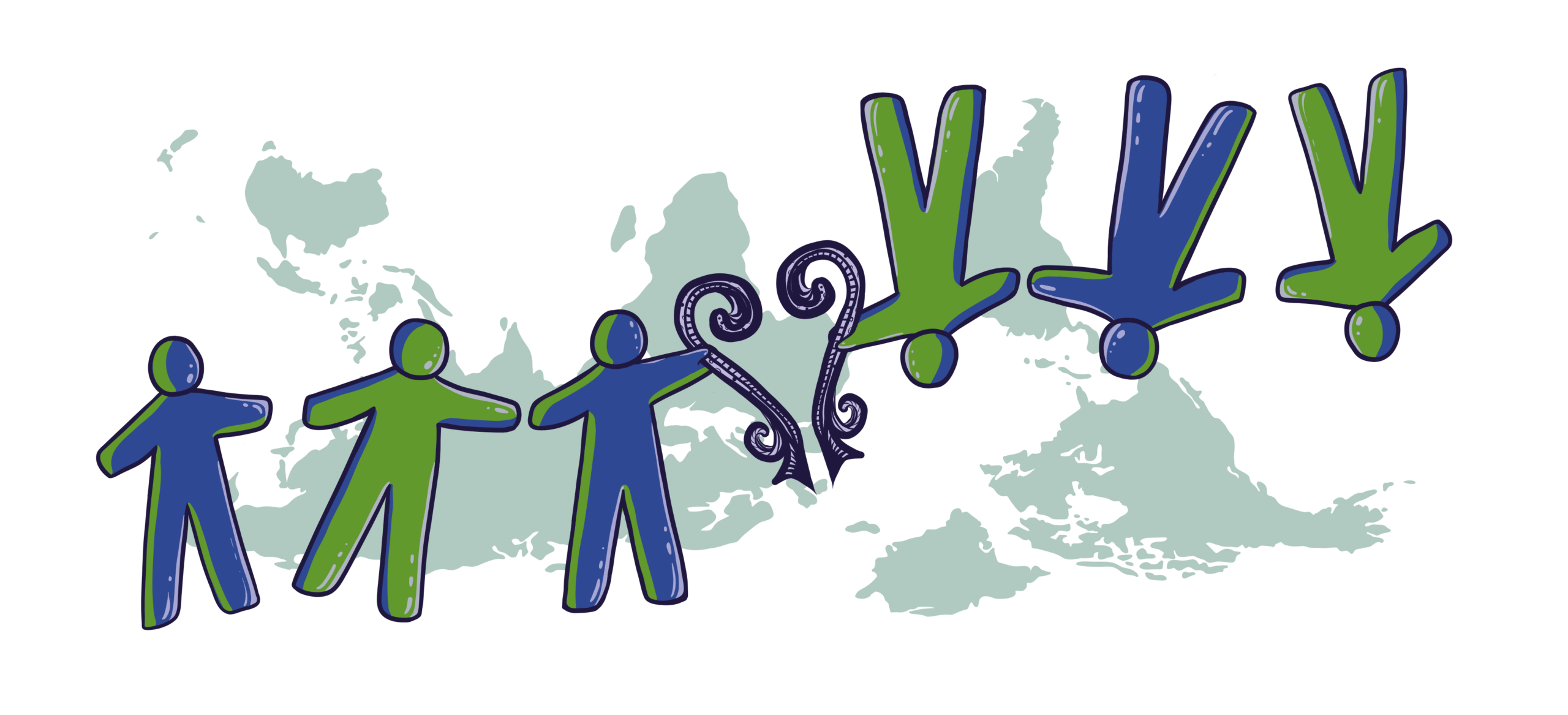
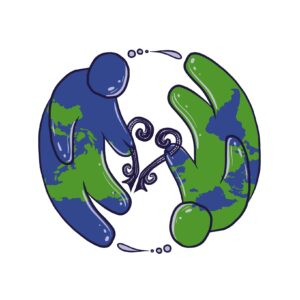
This first blog is an exercise in introducing the themes of the project through its banner and logo. If you are reading this blog, you are probably interested in the research and impact landscape at our universities. Our aim in taking you through our visuals is to open up a critical conversation around deconstructing, de-linking and re-thinking current conceptualisations of Knowledge exchange and Impact (or KEI in short).
The project team were aware early on that we would need visuals that speak to the themes that we intended to focus on. But how might one effectively visualise abstract categories such as ‘knowledge exchange,’ ‘engagement’ or ‘impact,’ especially when the project aims to draw critical attention to these categories? And how could a ‘decolonial approach’ to KEI be visualised? We realised we needed an illustrator with creative vision and an understanding of the themes and categories we were planning to engage with. We found one in Alice Kaye, art student at Edinburgh College of Art, who showed a good understanding of the issues that the project explores. Having never commissioned an illustrator before, it took us a few attempts to give Alice a steer on what we were looking to convey! It’s been a fantastic collaboration in visualising our ideas: Alice brought to our notice symbols and images, a few of which we were unfamiliar with, and at other points, we tweaked her suggestions to convey a bit more sharply what we are doing in the project.
One key image that we wanted Alice to bring into our project logo and banner design was a visual reference to Uruguayan artist, Joaquin Torres Garcias,’ America Invertida (1943). As the title suggests, it is an inverted map of South America that works as a critique of European colonization of the Americas and the cultural suppression and silencing of indigenous epistemologies, expressions and art forms. His pen and ink drawing has been treated as a kind of visual manifesto for his proposition of ‘The School of the South’ where he advocated the notion of ‘the South’ as the ‘new North’ for Latin American artists. We asked if Alice could take a cue from Torres Garcias’ inversion of traditional hierarchy and critique of imperial cartography that mapped the globe north as the centre of the world. This visual challenge to historic eurocentric representations of the global north as the centre and the rest as its periphery worked well as an idea we could borrow to represent the decolonial approach we wished to introduce to the KEI landscape. The upside-down map of the world speaks of the possibility of inverting the centre or ‘source’ of knowledge construction through research and impact activities. And such a re-mapping helps to articulate questions around whose knowledge gains traction as universally applicable and valued knowledge?; global progress on whose terms?; and who benefits from the supposed advantages of a modernity birthed by coloniality in the global north?
Alice introduced the linked human figures to indicate a sense of community across the globe. Does the globe ‘produce’ certain forms of community or do communities create the world? Alice was keen “to draw on symbols of knowledge from across the globe, harmonising them…[with] the focus to be on community – hence the figures.” Yet these figures that are not identical, with some figures on their feet and others not, indicating the plurality and diversity of knowledges, lived experiences and values. We asked if she could alternate the blue and green figures, to suggest that we not just recognize difference but actively find ways of working with each other.
What is it that the two sets of figures hold, connecting them? Alice introduced to us the figure of the Sankofa “a symbol from the Akan people of Ghana, symbolising learning from the past,” which she felt “fitted well with the project’s ethos.” The Sankofa we agreed helps to move us beyond stock images of ‘enlightenment’ and the ‘rational’ as defined in the global north.
The banner and the logo share this core imagery: the yin-yan figures curving into a circle that suggest a globe, with the image of the world map, again ‘inverted’, superimposed on the figures. We agreed with her that the repetition of the visual tropes between the banner and the logo helped to reinforce our emphases on care, critical thinking and change—for communities, for partners and for researchers.
To view other artworks by Alice, please visit Alice Kaye@onesmallalice