

PlanArt Overview
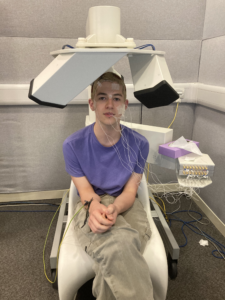
Carstens AG501 articulograph with participant
PlanArt is an ERC-funded Advanced Grant project, awarded to A. Turk. This project has received funding from the European Research Council (ERC) under the European Union’s Horizon 2020 research and innovation programme (Grant agreement No. 101019847)
It addresses the nature of phonological representations, output goals, and processes used in planning and producing speech.
The project involves
- Experiments to test predictions of alternative theories for patterns of speech articulation
- Computational modeling based on particular sets of core theoretical assumptions.
The experiments provide tests of
- symbolic vs. spatiotemporal phonological representations,
- separate phonological and phonetic planning processing components,
- acoustic vs. articulatory goals
- the nature of speech movement coordination
- separate representation of spatial vs. temporal information vs. integrated spatiotemporal representations
- Lee’s General Tau theory of movement planning, coordination, and generation
The computational modeling work includes
- the development of a flexible, modular platform allowing for parallel implementation, testing, and comparison of competing theoretical assumptions in terms of
model outputs, and - the development of a computational implementation of new approach to speech articulation planning based on symbolic phonological representations, phonology-extrinsic timing, as well as separate Phonological Planning, Phonetic Planning, and Motor-Sensory Implementation components, proposed by Turk & Shattuck-Hufnagel in their Phonology-Extrinsic Timing, 3 Component approach (XT/3C). Key features of Phonetic Planning in this new approach are 1) the use of General Tau Theory in modeling the time-course of articulatory movements, which presents a departure from alternative state-of-the art dynamic models based on mass-spring systems, and 2) the reliance on Optimal Control Theory for accounting for systematic phonetic variability due to competing task demands.
Team Members
- Alice Turk (PI), The University of Edinburgh
- Benjamin Elie, The University of Edinburgh
- Marisa Flecha-Garcia, The University of Edinburgh
- James Kirby, University of Munich
- Dave Lee, Emeritus Professor, The University of Edinburgh
- Cedric Macmartin, The University of Edinburgh
- Satsuki Nakai, The University of Edinburgh
- Stefanie Shattuck-Hufnagel, MIT
- Jim Scobbie, Queen Margaret University
- Juraj Šimko, University of Helsinki
