

Polycystic Ovary Syndrome (PCOS) is now called Polyendocrine Metabolic Ovarian Syndrome (PMOS)
There are many reasons why words have power and the names of health conditions are no exception.
As of May 2026 the name Polycystic Ovary Syndrome (PCOS) will be replaced by the name Polyendocrine Metabolic Ovarian Syndrome, or short PMOS. This name change is not a small feat, as PMOS advocates have long criticised the term “PCOS” for being inaccurate and misleading. While changing the name of a health condition might cause some confusion in the transitioning phase, the term PMOS is hoped to provide more “scientific accuracy, clarity, stigma avoidance, cultural appropriateness, and implementation feasibility” (Teede et al., 2026, p.1).
As pointed out by the leading researchers and advocates who were driving this name change (Teede et al., 2026), cumulative evidence had highlighted that the term PCOS was:
- Inaccurate by implying the presence of “cysts” as part of the medical picture. In fact, what has commonly been called “cysts” are actually arrested (under-developed) follicles
- Reductive by implying the clinical picture is limited to one organ (the reproductive system), which neglects to acknowledge that PMOS is also an endocrinological and metabolic health condition that can impact psychological and dermatological outcomes
- Stigmatizing by implying the main (or only) concern associated with it is infertility
- Too Undifferentiated, thus hindering the classification of the disorder, which in turn impacts how the disorder is researched, treated, and talked about
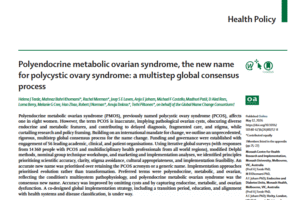
While a name change is only the beginning, there are other exciting developments in this field to look forward to, including the revision of UK PMOS guidelines by the National Institute for Health and Care Excellence (NICE), which are expected to be published in December 2026 (https://www.nice.org.uk/guidance/indevelopment/gid-ng10436).
If you’d like to read more about PMOS priorites, you can already have a look at a recent publication from the James Lind Alliance: https://www.jla.nihr.ac.uk/priority-setting-partnerships/polycystic-ovary-syndrome.
References:
D. A., Berry, L., Cree, M. G., Zhao, H., Norman, R. J., Dokras, A., & Piltonen, T. Polyendocrine metabolic ovarian syndrome, the new name for polycystic ovary syndrome: a multistep global consensus process. The Lancet. https://doi.org/10.1016/S0140-6736(26)00717-8