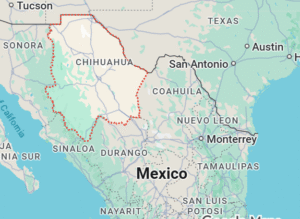
Chihuahua is a state in the North of Mexico on the border with the USA. It is home to around 106,000 indigenous Raramuri peoples who live mostly in the rural and remote mountainous areas of the state. The Raramuri have their own language, and don’t commonly speak Spanish. Within their communities they have their own cultural and governance systems. The healthcare systems in Mexico operate in Spanish and maternal care is obstetrically focused with institutional birth being encouraged. Indigenous women have much poorer maternal health and neonatal outcomes than their non-indigenous counterparts, and many are aged between 15-19 years, raising their risk of poorer outcomes. Our project is focused on understanding indigenous communities’ beliefs and experiences around pregnancy and antenatal care, understanding barriers and facilitators of engagement with antenatal care, and working with communities and care providers to identify the components of a culturally safe antenatal care service. This work is community focused and co-productive, focused on using methods that decolonise our research relationships and so engagement with the indigenous communities, getting to know them and their culture, is central to this work. In this blog I discuss some of the activities and learning that we gained from a week-long visit to Chihuahua, and how this is supporting the development of a bid for ESRC funding.
Designing a Strategy
One of the key practicalities when designing a research project is working out a strategy to engage the participants you need to answer your research questions. Whilst designing the project we spent a lot of time in our team meetings talking about the context (sociopolitical and geographic) of the indigenous communities we wanted to work with, and the current provision of antenatal care for indigenous women in order to think about how we might best gain access to the communities to speak with participants. We envisaged that the community health workers who visit the communities regularly to support antenatal care would probably be a good way in, as they would be known to people living in the communities, and there would be some level of trust. We successfully applied for a small grant from the Sir Halley Stewart Trust. This meant we were able to undertake some preliminary work with our colleagues in Chihuahua to find out whether this was a feasible strategy, gain an understanding of the role of these community health workers and their relationship with pregnant women and their families, and understand how they thought they might be able to support the research.
Workshop Activities and Approach
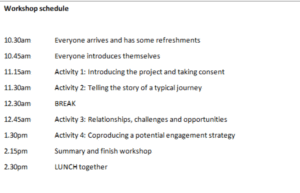
The work centred around a workshop with eight participants (2 male community health workers; 1 female professionally trained midwife; 1 female medic, 1 male clinical psychologist; 1 community coordinator whose role spanned medic and health promoter; 1 male director of regional maternal health services; 1 female cultural coordinator who sits at state ministry of health level). Our colleagues, Marielo Terrazas and Tonatiuh Magos, from the Centro para el Fortalecimiento de la Sociedad Civil (Centre for Strengthening Civil Society) arranged and facilitated (including translation) the workshop.
The workshop was held on our second day in Chihuahua at the Centro para el Fortalecimiento de la Sociedad Civil (Centre for strengthening civil society) (CFSC) offices in the Tecnologico de Monterrey. The format and activities for the workshop had been developed by the whole team and involved asking participants to get into small groups and draw the journey that they might experience with a pregnant woman from the indigenous communities. Prompts included thinking about timing and nature of engagement, available services, who attended appointments with the women. Then to think about challenges in this work before thinking about how they used their skills to engage the women. Finally we focused on how they might be able to help us with our research project by supporting access in communities.
Key Insights and Learning
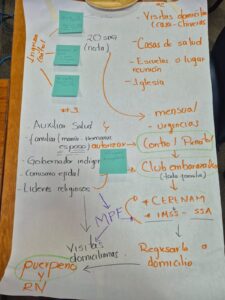
With all discussion in Spanish, we had planned meticulously to ensure that we all understood what we were trying to achieve. Skilled facilitation from our Mexican colleagues, and simultaneous, in-person translation for me (my colleague Jay Evans is fluent in Spanish) meant that we had rich conversations and gained deep understanding. The key findings related to the impact of cultural marginalisation on the indigenous women’s willingness to engage with the community health workers; the extensive and committed attempts by these healthworkers to engage them for the purposes of antenatal care; and the challenges created by the remote and often dangerous areas in which the indigenous communities exist. We also learned about the incredible workload of the community health workers who had no capacity to consider involvement as a main part of our access and recruitment strategy.
Engaging with Key Stakeholders
The rest of the trip was focused on meetings with a variety of key stakeholder groups. We met with FECHAC, a consortium of business people focused on supporting the social and health welfare of the population of Chihuahua state; policy makers from the Chihuahua Ministry for Health; representatives of NGOs working in the indigenous communities; and nurses whose focus was on the under-nutrition of pregnant mothers and their children.
Discussions with FECHAC, the board of the CFSC, and the ministry helped us understand the policy context and gain a sense of the level of support for the proposed project. Our proposed co-productive, community-based approach to the research was well received as there was recognition that previous top-down approaches to trying to improve maternal health in indigenous communities had had limited success. Taking a relational approach, meeting with these key people and groups, has enabled us to develop our funding bid with support of key partners.
A morning of meetings with NGOs working in the Raramuri communities allowed us to deepen our understanding of the living context of the communities. The work of these NGOs focused on a range of issues including working to make clean water available. Their stories about experiences of working in the communities were particularly informative when thinking about how we develop relationships with community members.
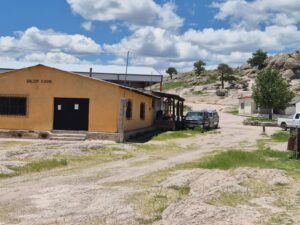
We also visited Creel where there is a local hospital and CERENAM maternity home where indigenous women who are waiting to give birth/ have given birth, can stay. Finally, we visited San Ignacio, an indigenous community close to Creel.
Reflections on Remoteness and Access to Care
The visit to Creel and San Ignacio brought to life the concept of remoteness and distance that had been discussed so much by the workshop participants who talked about sometimes walking for five hours to reach a remote community. It also enabled us to get a sense of the kinds of care facilities available for pregnant women, and on visiting the CERANAM, witnessing how young some of these new mothers were. Again, what we saw helped us make sense of the stories we had heard in the workshop where the participants talked about the range of ways through which antenatal and maternal care is delivered.
As I write we are also, as a team, writing the funding bid. In our meetings following the visit to Chihuahua we reflected on the wealth of knowledge we had gained and revisited our proposed research design. We thought again about how best to access and work with the communities, this time with a deeper, more contextually situated, understanding of the relational challenges and awareness of the power dynamics. These new sensitivities, led us to develop a new strategy, centring people from within the communities as those best placed to support the research and using our connections with CAPTAR, the water NGO who already employ people from the communities. Our new approach, where two indigenous community workers from CAPTAR will work with us as community embedded researchers offers a strategy which we hope is feasible, and will support us to carry out research in a way that values indigenous ways of knowing and reduces power disparities.
This small piece of preparatory fieldwork has had a huge impact on our proposed project. It really brings home the value of taking time to really get to know the context of the research you are developing, even if you think you are already familiar, and building relationships with key people and organisations.
Acknowledgements
Thanks go to the Sir Halley Stewart Trust for funding this piece of work. Thankyou also to all of the people who gave their time, energy and wisdom to support our work.