

NESSIE at the JBI European Symposium
NESSIE staff recently had the opportunity to showcase some of our evidence synthesis reviews at the European Symposium of the Joanna Briggs Institute held at the Scottish Centre for Evidence-Based Practice at Robert Gordon University.
The Joanna Briggs Institute is based at the University of Adelaide and focuses on supporting evidence-based decision-making for healthcare. The symposium aimed to bring together those working and using evidence to inform healthcare from across Europe.
Dr Pauline Campbell, (a senior research fellow at Glasgow Caledonian University and one of our NESSIE co-investigators) delivered a platform presentation on our recent reviews on the health impacts of mandatory non-custodial drug and alcohol treatment orders. We are delighted to announce that this was awarded the Best Platform Presentation at the symposium!
NESSIE also presented three posters.
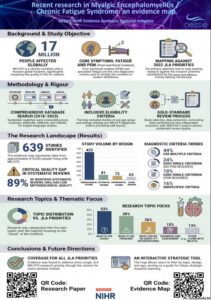
Myalgic Encephalomyelitis/Chronic Fatigue Syndrome
The first poster focused on the Evidence Gap Map NESSIE produced on Myalgic Encephalomyelitis/Chronic Fatigue Syndrome.
This map illustrated the research evidence available on this topic and highlighted gaps in evidence.
Here is a link to the Research Paper and Map.
More details (and a larger poster!) can be seen on our webpages.
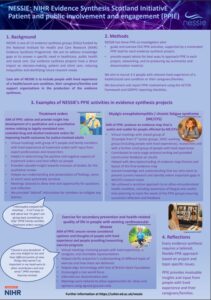
Patient and public involvement and engagement (PPIE)
The focus of our second poster was on our Patient and public involvement and engagement (PPIE) activity within three of our NESSIE reviews. We highlighted how we involve people with lived experience, families/caregivers and support organisations when conducting our reviews. This can lead to invaluable insights and help us to make sure our reviews address what is important to those who use health services.
More details (and larger posters!)can be seen on our webpages.
Interest holder involvement and knowledge mobilisation
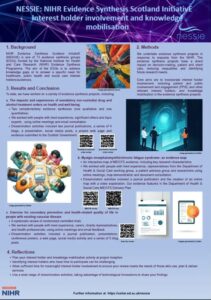
Our final poster focused on how we also involve those who plan and deliver health services in our reviews as well as highlighting the need to share our review findings widely, using a range of formats to reach different audiences. In addition to the Treatment Orders and ME/CFS reviews mentioned above we also included our Exercise for Secondary Prevention review, you can find a link to how we shared these findings here.
Blog by Dr Katie Thomson



Recent comments