

Alumni Stories: Victoria Sun
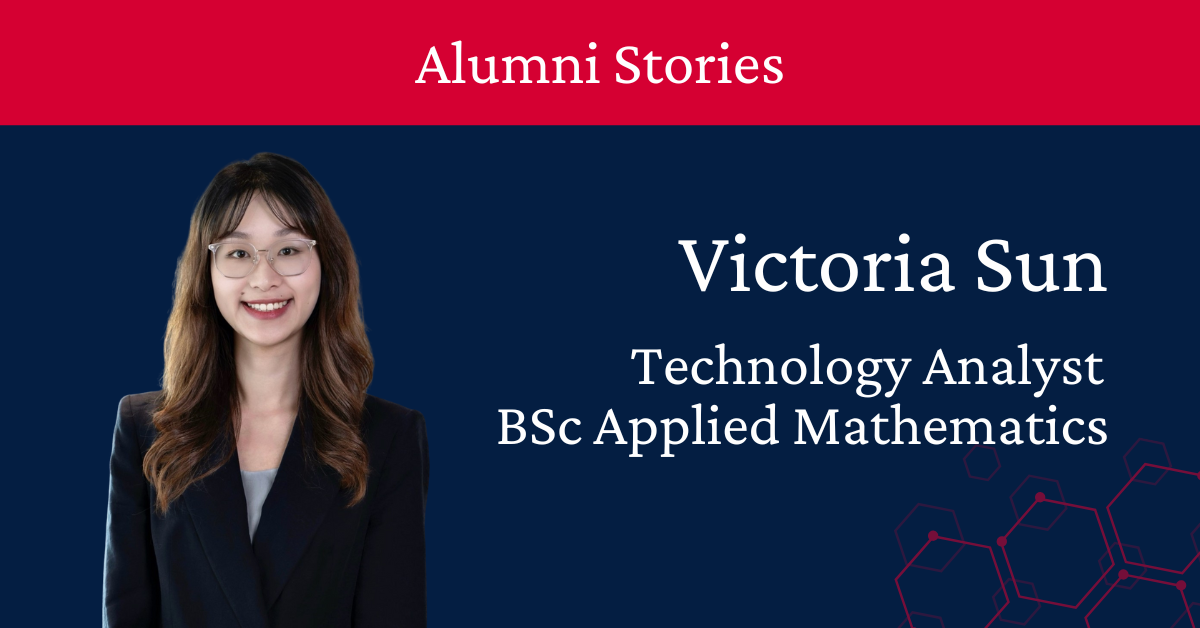
Victoria shares why she chose Edinburgh for applied maths, how she explored different internship paths, and what she enjoys most about Barclays’ Technology Analyst Graduate Programme.
Programme: BSc (Hons) Applied Mathematics
Year of graduation: 2024
Job title: Technology Analyst
Organisation: Barclays
Home country: China
- Why did you decide to study at the University of Edinburgh, and why did you choose mathematics?
I chose Edinburgh mainly because of the course structure. At the time I knew I wanted to study maths, so I compared the different programmes I was applying to. The area of mathematical biology in Edinburgh really interested me, and Edinburgh was the only university I found that offered applied maths alongside just two sciences. I didn’t want to do pure maths, and at other universities the focus tended to be only maths, or maths and stats.
I’d also heard a lot of good things about the University and about the city. I’d never been to Scotland, so I thought, ‘Why don’t I try it and see what it’s like?’.
The reason I picked maths is that I’ve always been interested in it, and I’ve always been good at it. When I was a kid, I noticed I had a strong interest in numbers. I started playing number-based card games and I quickly got really good at them.
Then, when I learned about the concept of pi, I became fascinated by it. When I saw the digits after the decimal point, they just stayed in my mind, and I could easily recite around one hundred digits. I was also very good at computations like multiplication and addition, and I knew the squares of numbers up to around 30 or 40.
Some of that came from primary school, because we were trained to do mental arithmetic quickly, but beyond that it was something that just came to me naturally.
In high school, I realised I wanted to explore more maths, so I started entering maths contests, which were really different from what we learned in class. I won a lot of medals, and I found it so interesting that I wanted to focus on maths at university. At the same time, I wanted to apply it to biology as well. The programme appealed to me because it allowed me to learn both.
- Can you tell us about your career journey so far?
I started applying for internships from first year. Between first and second year, I did three internships in China. They were in three totally different areas – finance, operations, and AI research – and they helped me build experience in different aspects of work.
When I did those internships, I realised those areas weren’t really for me, but I learned a lot and it helped me figure out what I enjoyed. In third year, I applied for an internship at Barclays (the company I work for now). I got the role with a placement in technology. I found it really enjoyable and I received a return offer, so after graduation I joined Barclays.
- What do you enjoy most about your current role?
The exposure to different areas. I’m on a rotational graduate programme, so I move between three different placements. I’m currently in my second role, in cybersecurity, which is very different from my first role in big data.
Within my current placement, I also get exposure to lots of different projects – some involve data analysis, some coding, some quality assurance, and some broader cyber work. They’re all quite different and they develop different skills. I also get to learn about different business areas, and I work with different people all the time. I get to talk to them, understand what they do, and collaborate with them, which helps me work out what I’d like to focus on in the future.
- What did you gain from your time at Edinburgh, and were there any experiences that helped prepare you for life after graduation?
I gained a lot of important skills that I use now. That includes technical skills like data analysis, numerical skills, and programming. I also gained soft skills – for example, communication and leadership. These were very important for internships and for work, because they come up a lot in different roles and they align well with my career goals.
I also benefited from the Careers Service. Before I applied for internships in the UK, I spoke to them about my CV and they suggested ways to improve it. They also gave me ideas about which companies to apply to and where to look. That support was really helpful.

- What outside subjects did you take and why?
In first and second year, I studied economics because I knew it would be useful, and because maths can be applied to economics. I also studied French simply because I was interested in it.
I took a couple of biology courses as well, because I knew I wanted to apply maths to biology later in the degree. I wanted to build that foundation early. In those years, my studying was roughly split between maths and my outside subjects.
Taking outside subjects didn’t really help with my internship applications, but it definitely strengthened my degree. In the end, I wrote my dissertation on cancer modelling, which brought maths and biology together.
- You also worked with the School’s outreach team. What did you do, and what did you learn from that experience?
I worked with the outreach team for two years. We organised different events – for example, maths circles and other activities – for children and teenagers of different ages who came to the University to explore what maths really is.
We wanted to show them that maths isn’t only what you learn at school, or the stereotypes people sometimes have. We wanted to show the fun side and the different aspects of maths. The participants weren’t necessarily students who were very maths-driven, so we used very accessible ideas, often connected to real life, and designed fun activities like puzzles and games that they could do and enjoy.
We helped design the sessions, coordinated things on the day, supported participants through each activity, and helped them if they got stuck. We tried to guide their thinking process rather than give them answers.
What motivated me was that if I only focused on studying maths, it could feel quite limited and I could get tired of doing the same thing. I wanted to do something extracurricular. Outreach felt like a new concept to me because it involved working with kids, working with external resources, and running fun activities. I also really liked the idea of helping people understand what maths is.
I’m happy with the maths background I had before university, but I know many people don’t get that early exposure. A lot of kids are scared of maths because what they learn can feel intimidating, but that isn’t all maths is.
- Do you have any highlights or favourite memories from your time at the University?
One highlight was joining the Harry Potter Society in third year. It had just been re-established after being inactive for a while, and it felt very unique. When I think of Edinburgh, it already has that Harry Potter atmosphere, so I was especially looking for that kind of experience while I was here.
- What advice would you give to future students who are considering studying maths at Edinburgh?
First, think about the city, because you need to adapt well to where you live. Edinburgh can feel like a big city. It’s great, because there’s a lot going beyond the university community. But it can be quite busy and expensive sometimes. I loved it but it’s worth thinking about whether that atmosphere will suit you.
Second, think carefully about what you want from university, because it’s something you’ll do for four years and it becomes a major source of knowledge before you start your career. Look closely at the course: think about what you want to learn, whether you genuinely enjoy it, and what it might lead to in the future. I’d also recommend starting internships early, so you have an opportunity to explore what you like, what you don’t, and how you want to shape your career.