

Canadian cringe, cottages and liminal highways in Heated Rivalry

Heated Rivalry is now officially a cultural phenomenon in Canada and abroad. It feels like the entire world has locked into Shane Hollander and Ilya Rozanov’s story, and I want to highlight some of the defining symbols in the story, particularly the Canadian highway, as well as our cultural reaction to the show. I break it down below but fair warning – there are spoilers ahead.
If you haven’t been swept up in the frenzy yet, Heated Rivalry is a Canadian television series, scripted, directed and produced by Jacob Tierney, and based on the novel by writer Rachel Reid. It launched on Crave, and was picked up by HBO in the US. The ‘Game Changer’ novel series is published by Harlequin, a Toronto-based publisher known for its romance novels.
The series has gained a new life of its own, escaping the creative confinement of Rachel and Jacob’s creative universe. Fandoms have started. There are group chats, play lists and live reactions on hockey podcasts.
The show is heavily loaded with Canadian symbolism, cultural motifs, and visual metaphors which can produce an odd reaction for many Canadian viewers.
Canadian cringe and “who to be”
“Canadian cringe” is a media response that occurs when Canadian viewers see their own national identity on-screen and are momentarily unsettled by it.
The cringe I’m talking about isn’t a negative feeling, like gross or yuck, but more like an awkward shiver. It’s like jumping into a cold lake and being shocked, unsettled, and then fine once you acclimatize. It happens when we see a new projection of ourselves in media.
I personally experienced this reaction when watching episode one, “Rookies” of Heated Rivalry. The opening scene where Shane Hollander (Hudson Williams) introduces himself to Ilya (who is nonchalantly smoking in an alleyway) is so Canadian that it produces “the Canadian cringe”. Shane is channelling his inner Sidney Crosby vibes in the scene, walking up unprompted to a player he doesn’t really know, to introduce himself. To non-Canadians, this might be a very ordinary and un-interesting interaction. But the cringe it produces is almost unbearable at the start. It might explain why some early commentary said it takes awhile to get into the show because it does for us. American audiences don’t seem to pick-up on it.

Opening scene, “Rookies” in Episode One, Heated Rivalry
Shane’s Canadian cringe is manifested in the clothing he is wearing (hoodie, with a jacket, and a toque), his tight observation of the rules that Ilya is breaking when he says, “I’m not sure you’re supposed to smoke here,” and his overly eager sportsman-like conduct as he compliments a rival with, “you’re an awesome player to watch.”
It’s so heavily-charged with Canadian cultural identity markers, that to see so much of our own culture in the first few minutes was basically like being struck by a meteor with a maple leaf on it.
Contrasted with Ilya Rozanov’s (Connor Storrie) Russian indifference, Hollander’s mannerisms are such a stark reflection of the Canadian identity that it made me want to get launched into outer space. It took a minute to acclimatize to this new world.
I had to turn the episode off, and pick it up again a few days later. I wasn’t sure I could survive seeing so much Canadian nuance all at once. Eventually, the feeling passed and I pushed through it. I was totally fine. But this is a completely normal phenomenon that happens when Canadians perceive themselves in their own art, film, literature, television, and music.
Sometimes it’s exciting, like when Death Cab for Cutie sang “From Bangkok to Calgary” in I Will Follow You into the Dark. It can be funny, like when Deadpool says, “You’re welcome, Canada” or does an interpretive dance with Celine Dion as she sings Ashes and when he asks Celine to dial it down, she shouts back that she only goes to 11. But it can also be very unsettling and disorienting, which was the case for me in episode one of Heated Rivalry.
One of the explanations for this feeling comes from Margaret Atwood. When she wanted to assess the current state of Canadian literature in the 1970s, both her and Northrop Frye kept asking “Where is here?” which was a query aimed at Canada’s relationship to other places. Essentially, they were asking about our cultural orientation to the United States. And this is because Canadian-ness is difficult to locate internally, which Justin D. Edwards says, is because the Canadian identity produces anxiety. We don’t ask ourselves who we are — we ask ourselves who we want to be. And the answer often manifests in our artistic productions.
Jacob Tierney asked, “How can I be true to the romance genre in a Canadian context?” and Rachel Reid asked, “What would it look like for two male hockey players to fall in love in the NHL?” What results isn’t a subtle search for Canadian-ness, it is a full on firework display of our utopian ideals.
Symbolic meaning of the Canadian highway in Heated Rivalry
I am particularly interested in two scenes in the final episode titled “The Cottage” because this is where the Canadian highway appears, and this is where Heated Rivalry and my PhD research intersect. You are on my academic blog, after all, so you can read more about Highways and liminal spaces in Canadian crime writing
At the start of episode six, Shane waits for Ilya in his practical Range Rover, and has made arrangements for the two of them at his cottage, about two hours north of Ottawa. It’s the off-season, and they are free from the psychological fortress of their professions (MHL), their teammates, and the cities they’re from (particularly Moscow, in Ilya’s case). The cottage is a space that makes a promise: they can finally be themselves.
My PhD research specifically examines the visual motif and symbolic meaning of the Canadian highway, and I did this research because the highway (as a symbol) is fucking everywhere in Canadian film, tv, music, and books (including my own novel) and I wanted to understand why.
Why is this symbol so pervasive? As a producer, Jacob could have easily skipped the long driving scenes but he doesn’t, and I argue, this is because the highway embodies the internalized anxiety and fears of both Ilya and Shane.

Shane picks up Ilya at the Ottawa International Airport
Driving north to the cottage
When Ilya arrives in Ottawa, after deciding to accept Shane’s offer to spend the summer at his cottage, he arrives discreetly. Ilya isn’t in bold clothing like a tropical shirt, instead he is in all black, with a backwards hat, headphones, sunglasses, and sleeveless tank. He could be anyone. Shane asks if he was recognized in the airport, which Ilya responds, “No, no, not that I noticed,” suggesting his disguise didn’t tip anyone off. After all, why would an all-star Russian player be in Ottawa for the summer?
Rather than meeting him at the terminal, Shane is waiting for Ilya in the airport parking lot, also in a semi-disguise of dark sunglasses. Ilya is pictured arriving alone in the side-view mirror, and quickly tosses his luggage in the trunk, and ducks into the vehicle. It is a Canadian act of endearment to pick someone up from the airport, but normally, this is done inside the airport, not at the parking garage. It would also be customary to help someone with their luggage, and not wait inside the vehicle like a weirdo, but this is a covert operation. However, to chose another method of transport would not be reflective of Canadian cultural endearment, like asking Rosanov to take a taxi or hire a car himself.
We see a brief clip of Shane thrumming his fingers on the steering wheel, and glancing in the rear-view mirror, suggesting he has been nervously waiting in his car for awhile. He is on a mission to extract Ilya as quickly as possible, and then hit the open road.

Ilya arrives to Ottawa discreetly, Episode Six
Now together, with a long drive ahead of them, the music kicks in with L’anarchie des jours heureux (chanson thème Le chalet)” by La Bronze. Perhaps the muted volume suggests the song is playing in the car, when Shane breaks the silence and asks, “Are you hungry?”
Even inside the vehicle, neither player takes off their ‘disguise’ as if to continue the pre-tense that they are just two dudes on a road trip somewhere. Nothing unusual to see here. The highway stretches ahead, with few cars, but even as the scenery becomes more remote, Ilya doesn’t want to stop for food even though Shane offers.
Russia and Canada are both expansive countries with geography that includes plenty of open space, and many Russian NHL players have dacha’s (country estates), yet Shane gives Ilya reassurance on what to expect in this new liminal landscape. Russia’s intolerance of same-sex relationships is explored in earlier episodes, but Shane doesn’t share the diplomatic fears and persecution that Ilya does, his fears are family-oriented, not political.
Rosanov doesn’t want to be seen publicly. Hollander doesn’t want to be seen personally.
The suppression of these fears is evidenced as Shane has stocked the cottage with plenty of food, ensuring their seclusion in this space, allowing them to relax with no reason to leave. Ilya wants to have sex, but it’s unclear if he knows how to relax in this new Canadian environment, as he admits on the drive he is, “also like, terrified, yes.”
What Ilya and Shane experience on the drive is called the garrison mentality – a feeling that is rooted in paranoia. The garrison mentality produces fears and anxieties which begin after leaving the safety of a community (Ottawa or Moscow). And those fears persist until a new community or garrison (The Cottage) is reached. Many Canadians experience similar feelings of anxiety or unease on the highway, which is why I was curious to see how Jacob used this liminal space in this final episode. Culturally, the highway is a significant symbol and it is normal to spend long hours on open roads.
The cottage unburdens their fears.
Access to Shane’s multi-million dollar cottage is restricted, likely difficult to find, and would probably have no signage. It is reached by a rural highway, so the only real threat to their rendez-vous is Shane’s parents who believe he is on a silent retreat and have agreed to give him space. The highway becomes a gatekeeper — only someone who knows where it is can gain entry, so it ensures Shane and Ilya’s anonymity and safety. There is palpable relief when they arrive, and Ilya’s sensuality and dry humour return.
Privacy and the Canadian wilderness
Once inside the cottage, any pre-tenses of ‘friends’ or ‘rivals’ drops immediately. Both players are safely secluded, and the rugged Canadian wilderness offers them both privacy and freedom. They can swim, laugh, have sex, and doom-scroll without the risk of getting caught or being exposed.
And even when that exposure does come, it’s not from the media, a curious on-looker or a nosy neighbour. The exposure is not persecution, but fear of the unknown. Shane is terrified of being known by the people who know him, and these fears correlate to our national identity because we often fear “what is not there” (like a wolf bird).

Ilya and Shane relaxing at the firepit
The landscape has been protecting them from outsiders. Threats are only environmental now, and Ilya jump scares when he hears a strange sound, which Shane laughs at because it’s a loon. To Canadian viewers, the scene is viewed as humorous rather than cringe. Atwood says that the Canadian identity is oriented around survival, and Ilya still has a lot to learn in this regard. The loon is harmless.
Fears on the liminal highway
I argue in my thesis that the Canadian highway is a site of liminality, which can be interpreted as a boundary, threshold, or a place that evokes fear.
It’s all fun and games at the cottage until Shane experiences his worst nightmare — his father catches him not only with another man, but his long-time sports rival.
However, co-producer Rachel Reid and writer-director Jacob Tierney, do not employ the trope of the angry, conversion-therapy, anti-gay parent, which many expect to see coming.
The live reaction from the empty-netter podcasters prove that audiences did not want to see Shane’s parents become the villains here. And even though this level of shame might be acceptable in the romance genre, it would not fit the trope of the Canadian utopian ideal.
Shane’s worst fear has manifested in his safe place. He did all the right things to protect Ilya, fulfill their happiness, safeguard their relationship, and those guardrails have failed. It doesn’t make sense to punish him.

Ilya and Shane drive to his parents cottage down the road
Ilya accompanies Shane to his parent’s neighbouring property, but the drive there is silent. In the car, the song Unravel by Ellisa Sun plays, and the road that takes them to Shane’s parents cottage is signified by fear. Shane is visibly shaken, and Ilya puts his hand over reassuringly. The fear of the unknown is at its highest point, and the long quiet drive signifies the potential loss of Shane’s career, his family, and his identity. He is terrified his father may disown him, or his mother may reject who he is. These emotions are reflective of reality and Shane is right to feel this way.
However, Ilya doesn’t share these familial worries. He doesn’t give a shit what his brother thinks of him, and with both of his parents dead, he is unburdened from the home he “fucking hates”. But Shane cares very deeply about his country, and what his parents think, and he is sick inside. The lyrics playing over the radio say, “Please, oh please, make the sirens stop. Oh watch for the dust to settle.”
The dust settles as a family
What happens at Shane’s parents cottage is not a condemnation and this is because the show is projecting the Canadian utopian ideal — we imagine the world as how we want it to be, which is more tolerant. Rather than reacting with rejection, Shane’s mother feels heartbroken that she may have created an environment where Shane didn’t feel he could be honest, or be himself.
The realization that Shane has spent his entire MHL career in a situationship with Ilya Rosanov is jarring, but confirms many of their own existing suspicions that their son might be gay.
Viewers with other nationalities may find this parental reaction comforting, or perhaps assume this is normal in Canada — it’s not.
This is a projection of how we want our society to function.
In the context of the NHL and minor hockey, parents are excessively involved in their children’s hockey abilities to the point of intrusive, and many fathers put significant pressure on their sons to compete, comply and do whatever it takes to become a professional athlete. Even kids who have no chance at the NHL are regularly subjected to intense pressure and aggressive parenting.
At the table, while Ilya shovels spaghetti into his mouth, Shane gets to experience his own Canadian cringe. Lacking a better word, Ilya explains that their relationship began as lovers, and the term makes Shane deeply uncomfortable. He is in the cold lake now, acclimatizing to the new normal. As Shane buries his head in his hands, visibly having a cringe-out, Ilya comforts him. He leans over and says, “Your family is here, your boyfriend is here” and the wobbly picture comes back into focus. Shane’s nightmare didn’t manifest. The cringe is passing.
The fears that had erupted along the highway drive have dissipated, and Ilya reassures him: “you’re good here, okay?”

Players, rivals and family
Shane leaves his parents house a different man.
The domesticity he feared, perhaps even believed could never be part of his life, is now staring at him in his face. A family dinner with his boyfriend, and his parents sitting across the table, is the image of the Canadian utopia realized. The vomit-inducing panic is gone. The remote Ontario highway has facilitated his journey through fear and into a new world where acceptance was always going to be the case.
Ilya sees this recovery, and kisses him in front of his parents who now understand that this relationship is not a phase, or even a new love — this is an old love that took hold during their “rookie season.” The silent retreat is never mentioned again. Everyone is talking.
As the boys prepare to leave, Shane’s mother, Yuna, offers to bring over chicken and salad. In response, Shane asks casually if they can go pick up beer in town and bring it over. Ilya’s character is re-framed instantly to that of son-in-law, not casual boyfriend. He says, “Thank you for pasta” and both players chime in with, “please text!” as Yuna reminds them to drive safely.
There are no more sunglasses and no more disguises on the drive back to the cottage. Both players are fully seen as part of Shane’s family in this Canadian ideal social world, and now a new adventure awaits. The lyrics in the car change. There is no siren. The dust settles. Jacob gives the audience a hint of things to come, as Bad Things by Cailin Russo plays with the lyrics, “I said, Saddle up, cowboy, I’m waitin’ for you.”
The utopia is waiting.
Canadian writing and utopian ideals
If you have stuck with me so far, then you might be interested in why utopian ideals manifest in Canadian film, tv and books. This is not just a Heated Rivalry thing.
Dan Levy, when talking about Schitt’s Creek, said when it came to sexual identity, “the town was going to be unbelievably supportive” and it was going to be “a safe haven.” These were intentional choices.
Going back to 1989, Degrassi High gave teenagers an outlet to visibly see teens discussing sex, drugs, suicide, HIV, and pregnancy in an environment that didn’t attach stigma or shame to those conversations. Peers spoke candidly with each other in the hallway of a fictional Canadian high school to examine social problems they were facing.
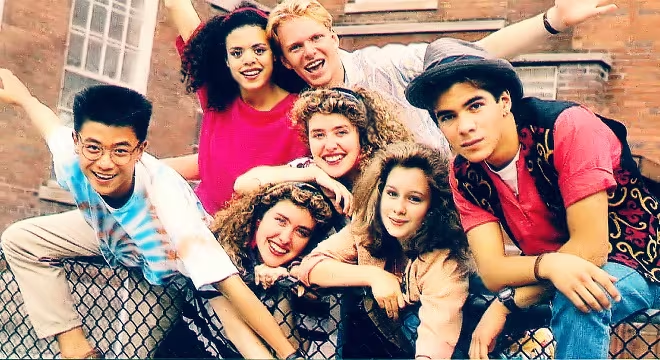
The cast from the original Degrassi High (source: CBC)
In my threads post, other Canadians have brought up shows like Workin’ Moms, that approached abortion from the angle of a couple in a happy marriage now dealing with an unplanned pregnancy. The show brought nuance into the discussion of the type of woman who gets an abortion. Canadian television has been doing this for decades. What Heated Rivalry explores (to me) feels no different than what Canadian television has been doing since I was a kid — putting big topics into fiction, so we can try them on for ourselves and see how they fit.
Scott Hunter and Kip kiss in Episode Five (source: Out Magazine)
That said, queer, gay and bisexual relationships are still under-represented. Heated Rivalry builds on what Dan Levy created with Schitt’s Creek, in the sense that this is a show with utopian ideals rooted in a Canadian place. The literary setting of Canada is important here because it is our mindset, our identity, and our geography that allow us to re-imagine our society.
Scott Hunter breaks the ultimate Canadian hockey barrier, showing that in a fictional NHL, the captain of a team can openly kiss his male partner (even though it hasn’t happened in real life). The audience doesn’t boo, or attack the two men. The kiss is accepted by the fans, and the cultural environment changes to become openly accepting. Jacob and Rachel did not debate whether this scene was realistic, or if it could happen or not — it does happen. This is the utopian ideal that Canadian creators are often playing with. What do we want to see in our world? And when we occupy that world, who do we want to be?
Why am I interested in this?
I started writing a crime novel set against the aftermath of the Freedom Convoy, and just like Dan, Jacob and Rachel, I also had to ask myself: “Is this the Canada I know? What do I want to see in our world? And who do we want to be?”
In the wake of Black Lives Matter, the Missing and Murdered Indigenous Women, and the Freedom Convoy where images circulating online suggested police were practically guarding a white supremacy group, I had to ask myself what the future of crime fiction even looked like and I blogged about it here Lewis Hamilton and all the weird things that happened when I finished my novel
If Heated Rivalry asks Canadians, “do we want to dismantle the stigma of homophobia in hockey?” then my novel asks, “do we want to dismantle systems of white supremacy in policing?”
I found myself writing an opening chapter set on a Canadian highway, using that same liminal space to evoke fear, as neo-colonial violence reasserted itself on the landscape (this time at the Canada-US border). I wanted to know why so many other Canadian crime writers, like Amy Stuart, Kelley Armstrong, and Carole Rose Goldeneagle also used highways in their narratives too. What is it about this liminal site that finds its way into our stories?
Through the writing process, I had to examine myself and my own identity, which led to my PhD in creative writing (which I am defending next week). Should I be studying for that right now, instead of writing this massive blog post that no one asked for? Yes. But, Heated Rivalry has reinforced why I wrote what I wrote, and why I’m so interested in the Canadian identity and its relationship to our geography and landscape.
I had to go through my own cringe process and surface my own emotions about writing a crime novel set in Alberta, what I wanted to say about systemic racism in Canada, and whether or not I felt cops could be heroes in a crime narrative (spoiler: I don’t believe they can).
As a Canadian, I am so overwhelmed at the global response to Heated Rivalry. I think many Canadians feel the same, and why we are often protective of our cultural outputs. But, I don’t want to overlook the uphill battle to get Canadian content out into the world regardless of it being a film, tv series, or novel. It is not easy.
It’s a bit too raw to talk about my own novel’s journey into the world because there have been some recent big “yes’s” that have suddenly turned into “no’s” – and this kind of heartbreak happened literally two days ago.
Having those high’s turn to low’s made me question if I made the right artistic choices, but watching Jacob needle-drop Feist in a Canadian romance, gives me renewed energy to keep going because I am determined to get Dark Saturday by Metric into an adaptation of my own work.
I mean, what is the point of being a Canadian millennial if we can’t put our culturally significant indie music into a Crave Original and give the world a little dose of Canadian cringe with a side of utopia?

Share



Interesting read and one which will have me, coming from a land of twisty, narrow lanes and houses dotted throughout the enclosed landscape, going back and re-reading Canadian crime novels in a new light.
And good luck in your viva! I’ll look out for your thesis when it appears in the institutional repository.
Nice essay — it resonated with this Canadian gay dude – I definitely felt that Canadian cringe . One slight correction – in universe, it’s not an Ontario highway, it’s a Quebec highway (I know it was filmed in Ontario.)