Any views expressed within media held on this service are those of the contributors, should not be taken as approved or endorsed by the University, and do not necessarily reflect the views of the University in respect of any particular issue.

28. Michael

Today is the first day of this year’s wonderfully long Christmas holiday, so I should be feeling relaxed and jovial. But I have had to return my car to the garage after some very expensive repairs have failed to do the job. So I am feeling stressed as I return to Lenzie by train, just in time to meet Michael outside Billington’s. A friendly introduction soon settles my mood, and we set off to join the Moss through the station carpark. We are accompanied by Lucy, Michael’s old red labrador, who very calmly wanders along beside us. I will talk and walk myself into better spirits.

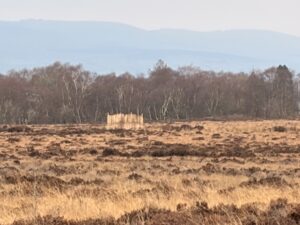
Michael is in his fifties and has very recently moved back to Lenzie with his family, after many decades living elsewhere. He first moved to the town at the age of seven and lived here until he left to study. His memories of growing up here are not entirely positive, but he talks about returning home and doing so on his own terms. For Michael, the view of the Campsies across the bog represents a lifelong connection to this place. It is the image that comes to mind when he thinks of home.

Michael tells me that a lot has changed here while he has been away. There is more to do now, with a lively high-street and improved transport links. As I also learnt from Alison, the Moss has been developed a great deal too, with new pathways and conservation of the woodland and the bog, and careful management of the relationship between the two. Michael has changed, too. He moved here after living in different cities – London, Edinburgh and Brussels – and then settling in the nearby new town of Cumbernauld. As he enjoyed a career change from public relations to academia, he reached a slower, quieter phase of life that would be nurtured by living next to the Moss. Michael also tells me that Lucy has never been happier than on her walks here.

As a teenager in the eighties, the Moss was there for Michael in a different way. He would come here on his own as an escape from the cloying insularism of small-town Scotland, with all its sectarianism and conservatism. The Moss was also a good place for a sneaky cigarette. As a catholic, Michael went to school at St. Ninian’s in Kirkintilloch, beyond the predominantly protestant area of Lenzie. Michael and his school friends typically played together in Peel Park, so Lenzie Moss was often his private domain. At other times, Michael would visit the Moss with friends. He says that there must be evidence of this: countless lost shoes, claimed by the bog.

Michael’s memories of growing up here lead me to reminisce about my own childhood in rural Derbyshire, and we soon discover a connection. The nearest town to my village was Matlock, where I went to secondary school. It turns out that Michael’s wife is from Matlock as well. Michael moved to Lenzie in the early eighties, in the year that I was born. I suppose that his wife would also have been growing up in Derbyshire back then. Walking this route with so many people has revealed several unexpected connections like this: Steve attending a wedding in my garden; Sophie and Cathy knowing each other from university. It is always pleasing to be reminded of how entangled we all are.

We find another connection around my work in theatre, and I learn that Michael is from a family of actors, including the well-known couple, Barbara Rafferty and Sean Scanlan, both of whom appeared in the popular Scottish sitcom, Rab C. Nesbitt. Michael’s fifteen-year-old also acts and has had roles in award-winning films. After my walk with Nalini, I have been thinking of developing a performance project about Lenzie, so it is useful to know that there are more actors living here. I think I have now met enough to form a small theatre company!

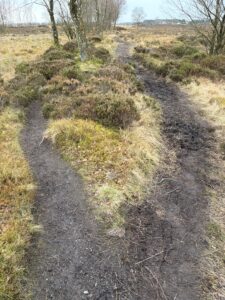
We reach the bottom of the boardwalk and Michael opts for the less muddy path along the railway, which is also Lucy’s preference. I suggest a detour, and we wander along the edge of the bog a short way to look out towards the Campsies. The sun shines through the clouds, casting shifting light onto the hills. Michael enjoys how remote this place can feel, even though Glasgow is only a few short miles southwest. He likens it to Rannoch Moor, a large area of wetlands to the south of Lochaber, which I traversed years ago when I walked the West Highland Way. Once again, I find myself imagining a longer walk that starts here and takes me over the hills and far to the north. Maybe I could chart a route that connects all the peatbogs from home to the Hebrides (from where Jill has just emailed me).

We double back on ourselves, and Michael says that this is something he always tries to avoid on the Moss. If he veers off the main path and ends up somewhere new, he always looks for an alternative route. I like this rule and I share my own for this project: always anticlockwise; only one person at a time; no predetermined questions or topics. I am discovering that everyone who regularly walks round the Moss falls into their own patterns and habits. Walking with Michael shows me that some of these can endure over time, lying dormant for decades but easily reestablished when we return to the places of our childhood.

It seems that Michael is very happy to be back in Lenzie. Looking back to his earlier life here, he even wonders whether it was really the town that was the problem. Maybe some sixteen-year-olds would have a tough time wherever they were. At any rate, it suits him here now and he is where he wants to be. As we reach the station car park, we chat for a bit longer about work, before we go our separate ways. We agree to stay in touch. It is good to be slowly getting to know more people in the community through these walks and while I am much newer to Lenzie than many of the people I have walked with, each time I complete a circle of the Moss, I feel that I know this place a little better.

27. Phil

I am becoming a bit of a peat geek and have started attending the Peat Café – a series of online lunchtime seminars featuring interdisciplinary perspectives on wetlands. The latest of these included a presentation by Phil Gould, who is now based at the University of Stirling. He presented on his postgraduate research into pollen analysis at Glen Devon in Perthshire, where there is a large-scale peatland restoration project underway. As I have been hoping to walk with someone who takes a more empirical approach to investigating sites like Lenzie Moss, I am pleased when he accepts an invitation to walk with me.

I meet Phil from the train and even though I recently watched his talk, I don’t immediately recognise him. He spots me straight away though and we quickly start our walk. I fire question after question at Phil. He is an archaeologist and a paleoecologist. He has recently completed a Master’s degree at the University of Glasgow and is embarking on a PhD at Stirling as part of the Centre for the Sciences of Place and Memory. He is currently selecting his sites and hopes to spend more time in the field that he has so far been able to. He uses core sampling to build a picture of the layers of history that comprise a peat bog. Phil tells me that he is interested in telling stories of change.

During Phil’s talk, he had shared the results of his analysis of pollen, which offers a precisely datable record of the species of flora present in the landscape at any given time. This helps to inform our understanding of shifting agricultural practices and other uses of the land. Phil talks me through the process, which is surprisingly analogue and manual. It starts with a ‘Russian corer’ – a rudimentary metal device that captures peat within a metal cylinder that turns around an axis to hold the sample in place as it is removed. This means that the peat is left undisturbed and can easily be divided into subsamples for analysis back at the lab. Phil then separates the pollen from other organic matter by sifting, floating and using chemical purification. When he has what he is after, he uses a microscope to identify species.

While Phil has been looking for pollen, there are other ‘proxies’ that can be used to build a picture of changing environments. These include charcoal and also diatoms, which I haven’t heard of before. Phil explains that these are single-celled microscopic algae that exist in almost all watery environments. He now realises that I know very little, but continues to patiently respond to my questions. He tells me that all these indicators are useful for different things, but analysing pollen can reveal a great deal about changing vegetation, which helps us to understand how peatland environments have been used and inhabited.

As we reach the noticeboard at the far end of the northern pathway, we come across Paul, the chair of Friends of Lenzie Moss, who is busy replacing posters. I am pleased to be able to report that I have been on more than twenty walks since he joined me back in July. The more I complete these circles of the Moss, the more likely it becomes that I will bump into people I know. Phil is also interested in the social and cultural stories of the places that he researches, which enhance and expand scientific insight. I ask him about the human side of his practice, and he tells me that negotiating permissions from landowners is an important part of his research.

I ask Phil how he would select a place to take a sample. Looking out across the Moss, he notices the lines of heather crossing the bog. The heather indicates that it might be too dry to get a good sample. Conversely, it can’t be too wet. After a lot of rain, the bog is looking particularly saturated today. In some places, the peat layer can float above bodies of water.

We walk along the path across the bog and follow the old railway embankment a short way so that we are standing in the centre of the Moss. Phil tells me that the deepest (and oldest) core he knows of in Scotland went 9 meters deep and reached back to the end of the last ice age. His have been much shallower but the anoxic bog preserves centuries of slowly accumulating history, which are often close to the surface after peat cutting has taken place.

Phil picks up some sphagnum moss and talks about its properties. He holds a vibrant green clump in his hand and squeezes it to show me how much water it holds (apparently three times its size). Phil says that sphagnum is a ‘bog builder’ and notes its lack of roots.

As we walk through the woodland to return to the train station, Phil talks about the way that the natural world is often forgotten and left out of heritage research. This is partly because a lot has been lost and I see that Phil’s work is about searching for what has been left behind. He tells me about the ways in which moss has been used as a material by humans. In Aberdeen’s Maritime Museum, there is a section of moss rope on display. It was found in an early medieval pit and may have been used for binding thatch on to roofs and for mooring boats. I wonder what traces of human presence at Lenzie Moss might still be discoverable using Phil’s methods.

We return to the station just as a train arrives at the other side of the track. Phil makes the call to try to get that one home, so we say a very quick goodbye. I watch him cross the bridge and step onto the train just in time. This has been a brief but fascinating lesson in a more technical, scientific approach to knowing a place like this. It has been quite different to the slow, meandering wanders that I have shared with artists this year, but this walk has revealed new depths and layers to my understanding of the Moss.

26. Iona

I am walking with my eleven-year-old daughter, Iona. We have been waiting for a good time to do this for a while and today it is just the two of us at home, so it is the perfect opportunity. It is a foggy Saturday morning at the start of December and some of the houses on our street – ours included – have their Christmas lights on already. It feels like one of those mornings in the holidays when everyone puts on their wellies and treks out into the countryside. It is good to be outside together.

Iona instinctively gets the idea behind this project and she walks slowly, taking everything in. She says that I go too fast and makes me match her pace. We examine trees heavy with lichen, deep red hawthorn berries, mosses and heather. Iona says that she wants to roll around in the grass, but it has been raining so she settles for jumping up and down at the top of a raised bank. She says that she likes being surrounded by so much nature and that she appreciates being able to spend time outside the city, where she stays for the half of the week that she is not with me. Iona feels that she has the best of both worlds, living between Lenzie and Glasgow.

Iona recently went on a residential trip with her class to Blairvadach Outdoor Education Centre on the shores of the Gare Loch to the west of Glasgow. They saw seals, had a day canoeing on Loch Ard, went gorge walking, and climbed Lime Craig, where they looked out to the Carse of Stirling and the Highland Boundary Fault. Iona returned full of stories and a renewed love of the outdoors. On their way up the hill, the instructors told them about ‘old man’s beard’, a shrubby lichen so called because it was packed into the neckline of farm workers and shepherds’ jackets, to keep them warm in the winter months. Iona thinks that the lichen we have found today might be what they were talking about.

At the far end of the north path, we reach one of the stacks (Toby Paterson, Dug Macleod and Simon Whatley’s peat stack sculptures that punctuate the route). Iona can’t resist climbing up and standing on top of it. Then we move on to the climbing tree, which neither of my children seem able to pass without ascending. Today, without her little brother Ruairidh following her into perilous situations, Iona climbs higher and higher. She shouts down from the top branches, saying that I look very small. When I eventually persuade her to come down, she descends too quickly and slips on a wet branch. I catch my breath and she is unharmed, but a passing couple express their concern. Iona jumps onto my shoulders from one of the lower branches and she clings on tightly, but I eventually manage to struggle free of her strong grip and lower her to the ground.

As we follow the boardwalk, we pass countless dog walkers and joggers – one wearing a fetching Santa hat. We step onto one of the resting areas to the side of the walkway and look out over the fields towards Bishopbriggs. I tell Iona that there is a continuous urban area from there to her other home in the southside. Only a thin strip of greenbelt separates us from the city. In the other direction, we can only just make out the vague shapes of the Campsies – a dark line visible through the fog. It would be possible to walk through the clouds, over the hills, and northwards to the Highlands, without passing through a built-up area. We are at the edge of something – standing on a threshold. I say that this is a liminal place, and Iona says she doesn’t know what that means and that I should stop being so philosophical.

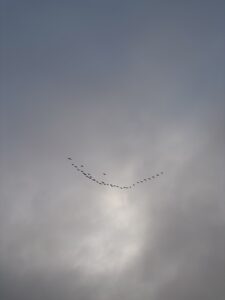
We can hear geese flying overhead, but the cloud is too thick for us to see them. A woman and her tiny poodle stop to chat. I have met them before on my walks with Clyde. She says that the geese go to the Gadloch to the south of the railway line and she talks about seeing the pink-footed geese at the Montrose basin – another Local Nature Reserve. I will remember this and will plan to visit one day.

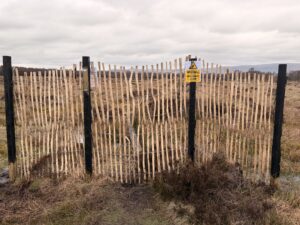
We wander along the pathway that borders the bog and I show Iona the new pond, where the fencing I saw on my walk with Chris has now been removed. Given the ongoing tensions around this area, I am not comfortable to cross it to reach the tree swing, which Iona is keen to visit. We go back on ourselves, following the boardwalk to the bottom. We reach the second stack, which Iona pauses to stand on, then we take the muddy path into the woods.

After a quick swing, we follow the meandering pathway through the birchwood. I show Iona the bracket fungi, and we see more lichen growing in big clumps on the branches. Looking up at the canopy, Iona spots clusters of sticks resembling untidy birds’ nests. These are ‘witches brooms’, abnormal growths that are sometimes caused by fungal infections. My parents used to tell me and my siblings that these were naughty boys and girls, who had been transformed into these twiggy bundles by witches. Iona is alarmed by this, and I agree with her that this was a rather cruel thing to tell us!

We emerge by the ruined peat stacking shed on the main path by the railway line. At the other side is the third and final stack, and Iona leaps onto it before stepping over onto the foundations of the building. She has jumped, climbed, balanced and bounced around the Moss this morning and I am reminded that she is still a little girl, despite her maturity and self-confidence. I hope that she will stay in this place for a while yet – a liminal zone between childhood and adolescence, where I get the best of both worlds.

25. Chris

The speed and scale of change is now a matter of scientific fact that in turn generates matters of shared concern for how to imagine and organise a common future. (Anne Douglas and Chris Fremantle, Thinking with the Harrisons)

Chris finds me in my garden, where I have just moved a beech sapling that had taken root too close to my house, and re-planted it in the hollowed stump of a great ash that had to be felled when I first moved here. I will be delighted if this works and I tell Chris to check back in a few years. Since I first met Chris around fifteen years ago, there have been long periods when we have not been in touch, but our paths sometimes cross in the overlapping space between art and academia, and it is always a pleasure to reconnect. When he heard about this project, Chris got in touch to tell me he had recently moved up to Glasgow from Ayr, and as he was now nearby, he offered to walk with me.

After walking with so many artists recently (Kyriaki, Deirdre, Ellie), this is a great opportunity to talk with someone who researches, teaches and produces EcoArt – an art of connections and relationships with place and environment, which often suggests new ways of being in and engaging with the world around us. Chris convenes ecoartscotland – an online resource on art and ecology – and is a Lecturer in Art at Gray’s School of Art in Aberdeen (part of Robert Gordon University). We met in Ayr during my first academic job at the University of the West of Scotland, when we were involved in a partnership project with South Ayrshire Council and some of the main arts organisations in the region. At the time, Chris wrote favourably about a performance I directed at the Robert Burns Birthplace museum in Alloway. We have been following each other’s work since then, and I am currently enjoying his recently published book about ‘thinking with’ the environmental artists known as the Harrisons.

It is raining heavily as we start our walk and I photograph the concentric circles created in the woodland pools – an appropriate image for the 100 circles that I am making here. That this place seems to invite artistic representation and interpretation perhaps partly explains why my project has attracted so many artists to walk with me. I have certainly found it harder to connect with scientists and others who take a more empirical approach to understanding ecosystems.

Chris offers a different take on this: he suggests that the way that science is funded, taught and carried out in the modern university is conditioned by ‘technocratic’ structures that demand measurable outputs and quantifiable impact. This means that it can be difficult for some to justify spending time outside their typical work processes to go on adventures without clearly defined endpoints. I feel this tension, too. Both Chris and I are in the midst of marking and moderation and endless meetings in the final weeks of the year. To carve out over an hour for a walk around a peatbog with little sense of what this might reveal or lead to, is a leap of faith. Chris suggests that artists might be more able to meet opportunities like this with a willing spirit and open mind. I think there may be some truth in this, but I am also sure that I will find some hard scientists who have a similar curiosity and disregard of institutional expectations.

The Harrisons paid careful attention to the complexities of the environments that they worked within. Their art, which often involved large scale plans and interventions in landscapes and across entire regions, was developed through deep immersion in places and the careful building of relationships with the people who lived and worked there. Chris’s book tells us that the Harrisons ‘position themselves as generalists in conversation with whoever can support their learning of the issues of a place’. I am also seeking a ‘growing ecological awareness’ of this place that I have chosen to live beside. And it is this practice of walking and talking that is making this happen. My conversations with artists over the last few weeks and months have helped me to realise that this slow meandering process is itself the work, and that measurable outputs and impact are not the point of doing this.

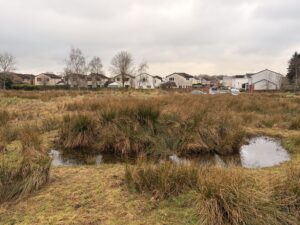
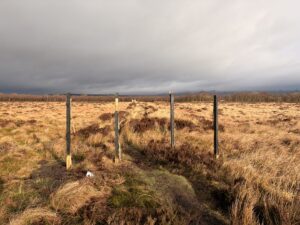
We reach the place that I previously visited with Ruairidh, Jill and James and see the latest move in an ongoing war of attrition. The land between the path and the trees, where my children often play on the swing, was originally becoming damaged with an exposed peat layer that became very muddy after wet weather. When I walked with Jill, we found that a section of fencing had been placed over the ground as a makeshift boardwalk. During my more recent walk with James, we saw a pond being created in the middle of this area, which I surmised at the time was to prevent access as much as it was to diversify habitats. Today, I notice that the fencing has been replaced in a curve around the pond. I am fairly sure that it is the original section, but it looks like another part of the exclosure by the boardwalk has also been removed. I wonder what the next move will be in this battle, which only seems to subject the bog to futile one-upmanship. My growing awareness of the ecology of this place is also a deeper understanding of the human politics and social dynamics of the site.

We stand and look out over the bog as the rain gives way to a gentle glow. Chris wonders how we can get people to value a place like this and invest in its future. We talk about community ownership and how much easier it is to bring people into a relationship with woodland sites. The Moss is complex and may be harder to understand and appreciate.

Lenzie Moss is subject to the scale and speed of change that defines the current ecological crisis. Scientists can measure this and evidence it, and when I eventually manage to persuade some to walk with me, I hope I will learn something about how sites like this are impacted by wider environmental forces. But the Harrisons understood that a scientific knowledge of a place like this only becomes meaningful when the state of things brings us together, and leads us to imagine what the future might be. Chris has helped me understand how powerful art can be in that project. And if that doesn’t justify an hour trudging round a bog in the rain, then I don’t know what does.

24. Kyriaki

I am walking with Kyriaki, an artist and researcher who also goes by the name of Sandy. We haven’t met before, but she got in touch after I shared this project on the mailing list for the Edinburgh Environmental Humanities Network – a busy and supportive community of researchers that we are both part of. Sandy is using walking methods in her own work, and she is interested to explore artistic processes and ways of doing creative research. It is a nice coincidence that I walked with Deirdre – another artist – yesterday, and we talked about the same topics (which in turn connected to the walk I did with Ellie a few weeks before). I am seeing my walk with Sandy as a continuation of those conversations, even though Sandy, Ellie and Deirdre don’t know each other.

In stark contrast to yesterday’s walk in the crisp, clear air, a thick fog has now materialised. We won’t be looking out to the Campsies on this walk, but we enjoy the otherworldly atmosphere, and we peer into the trees, which are shrouded in greyness. Sandy asks me if I always walk with other people or whether I use solo walking as a way of exploring the sites where I work. I reflect that while I sometimes enjoy walking on my own (I am currently half way through a very drawn out journey along the different stages of the John Muir Way, for example), in my research, I tend to favour shared experiences. In different ways, all my work is about bringing people together in places to collaborate and create together.

This is a timely conversation as I have just been reading an essay by another Deirdre – my old PhD supervisor Dee Heddon, whose 40 Walks blog was a key inspiration for my Lenzie Moss project. Dee reminds us that some of the early proponents of solo walking – William Hazlitt and Henry David Thoreau – in fact walked often with companions. Dee also writes of ‘the art of companioning’ and notes the etymology of that word: Companion is formed from com and pain, meaning with bread. So, companions are ‘breadfellows’, who share sustenance. Walking projects like this often feel like they are sustaining me and building relationships with people and places.

Sandy and I walk through the birchwood, and I ask her about her work. Like me, she is a multi-disciplinary artist who works at specific field sites. Her current project, which, like Ellie, is part of a PhD at Edinburgh College of Art, is an exploration of post-industrial places in Europe. At the moment, Sandy is working at two sites: Malls Mire Park in in the Toryglen district to the south of Glasgow, which includes a community woodland and gardens, along with the remnants of a wetland environment; and urban areas of the Greek city of Eleusis in the in Athens metropolitan area, where Sandy once lived. She is also interested in finding a third site in Eastern Europe.

Sandy talks about the materiality of these places and tells me about an artistic process in which she collected discarded drinks cans from the Glasgow site. These were cleaned, sand-blasted, melted and cast, using moulds made from the shapes of discarded wrappers and paper, which had been coated in wax. Sandy says that she tries to avoid making work that is ‘on the nose’, so she tends towards abstract shapes and exploratory formations. Her work sounds fascinating and I look forward to seeing these objects that have been crafted from the waste products of the places where she has worked.

While Sandy is drawn to the objects and textures of her field sites, she is also concerned with the ‘dematerialisation of art’. We talk about walking, recording, and conversing, and think with Ellie and Deirdre’s invitation to recognise the inherent value of the exploratory, meandering routes that we might take, without always driving towards a finished product or output. It seems appropriate to talk about materiality as we walk through this strange foggy landscape. Sandy says that she feels like she is in the middle of nowhere, and without the usual reference points on the horizon, I share this feeling of dislocation.

Walking down the boardwalk, I spot a glint of metal in the heather a few yards into the bog. The ground is hard enough to hold my weight, and I venture out to retrieve an energy drink can, which I empty of its contents and pass to Sandy, who is pleased to have gathered something that can be used in her artworks. Apparently, there are many more such materials at Toryglen. Sandy tells me she has turned to Google’s aggregated location data to discover that the park there is particularly busy during weekend nighttime hours. This is a reminder that Lenzie Moss, too, is used by all sorts of people at different times of the day, and that the smashed glass, discarded cans and fire pits evidence human activity that takes place long after the hours that I am typically out here.

We turn from the boardwalk and head out across the bog. Sandy asks me about the Moss, and I offer a guided tour. Once again I find myself telling the history of peat extraction and the present-day tensions around access and site management. As I deliver my increasingly honed tour script, we pass by the spot that I had previously visited with Jill, and where James and I had recently encountered some workers digging ponds. The work has now been completed and it is clear that these new pools have been deliberately placed in an area that was being used as a regular pathway. This is to protect the fragile peat layer and to create diverse habitats, but I suspect it won’t be well received by all the people who walk here.

Sandy talks about the entanglements of people, places and practices in her work. That word – entanglements – has been mentioned a few times on these walks, and it is a concept that I have also explored elsewhere. I have walked enough times now for connections and resonances to emerge between walks and walkers. My walk with Sandy has brought this into focus for me. The project is creating its own networks, layering meanings and experiences together, just like the peat that builds the bog.

We are at the end of our journey now and Sandy gets the train back west, joining a different type of network and making more connections as she travels.

23. Deirdre

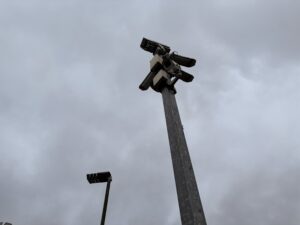
At the far end of the station car park, marking the entrance to the Moss, an old signpost is hidden by the trees. The metal surface has dulled and the information it displays can only be seen from certain angles. The sign points walkers to the canal and tells them how far away it is. Halfway up the pole, two brackets are attached, but whatever they once secured has long since been removed. These empty fixtures are a trace of something that happened here several years ago.

In 2017, an arts organisation called Art Walk Projects worked with East Dunbartonshire Council and the transport charity Sustrans (now known as Walk Wheel Cycle Trust) to develop artworks for the Lenzie area. Inside Lane brought several artists together to develop interventions that would bring the community into a dialogue about routes, links, transport and places. The project was part of a wider exploration of ways to develop the connection between the town’s roads, carparks and pedestrian areas.

One of the artists was Deirdre Macleod and I am walking with her today. I know Deirdre through her work at the University of Edinburgh, where she is a Lecturer in Art at the Centre for Open Learning. Like Ali, she is also a PhD candidate in geography. When I advised on her research at an early stage, I was impressed by Deirdre’s exploratory drawing and urban fieldwork, through which she works with the unknown and cultivates an openness to unexpected events. Our walk today will be framed by these concerns and will help me to think about what I am discovering, as I continue to walk these 100 circles.

I meet Deirdre at the train station and as we join the Moss, we stop to notice the signpost. Deirdre’s contribution to the Inside Lane project was Common Ground, a collection of 50 colourful paintings on aluminium plaques, which were placed around the town and on the Moss. These were conceived as a playful game of spotting the designs in various places, making connections between them and with their surrounding environment, and attending differently to the town and the Moss. It is interesting that almost a decade later, they still have a kind of agency here. Now I will look out for any that are still present, and I will seek out other evidence of their past presence.

We walk slowly, talking about noticing and attending carefully to the environment as we go. It has been freezing overnight and there is now a sharp chill in the air. We look at strange formations of ice on the pools that cover the woodland floor. A submerged branch is surrounded by spikey needles, reaching out across the surface of the water. We enjoy the crunch of our footsteps as we tread on frozen ground.

As we make our slow, chilly way along the northern path, we pass a smartly dressed woman, fixated on her phone and dragging a wheeled suitcase. She is in a rush and looks like she has been transported from an airport concourse. It is a moment of dissonance with the surroundings and the pace of our own journey, but it shows that the Moss hosts many different types of people, all of whom have their own needs and intentions.

We turn onto the boardwalk and enjoy an encounter with a flock of long-tailed tits, bouncing from tree to tree and filling the air with high-pitched shrills and playful flight. These sounds and movements are made all the more noticeable by the stillness of the wintery atmosphere, which also amplifies the traffic sounds from the nearby roads. There are lots of people walking their dogs today, taking in the sights and sounds of a beautiful cold day.

As we walk, Deirdre reflects on walking, slowing down, and the making of time and space. In her work, she spends a lot of time in the places she is responding to. Through sketches, diagrams, photos and text, Deirdre connects her own rhythms and actions to those of the site. Slowly and tentatively, these lead to gentle interventions in the landscape, which sometimes involve inviting people to come together in a movement or gathering. The work is unassuming and sensitive to existing patterns and connections. We talk about artistic process, and we are both convinced that the considered, patient methods that Deirdre uses have value in and of themselves. When I walked with Ellie, we talked about this as well. Sometimes it is difficult to resist the expectation that artists’ work will lead to specific outcomes. What artists can also do is encourage different ways of relating to the world.

Deirdre has taken some time away from work recently and she took the opportunity to focus on her allotment. She visited regularly and immersed herself in reorganising, creating meandering paths and taking the apparently controversial decision to plant flowers – cornflowers, marigolds and nasturtiums. Deirdre talks about the value of tending to a plot in this way. She says it is sometimes important to take the long way round.

We turn onto the path across the bog. An exposed root system offers a metaphor for the kind of meandering, entangled ways of being that Deirdre is promoting. We examine bracket fungus on the trees and different types of moss. We crouch down and use our phones (a technological accompaniment that I now feel much more relaxed about using so often, thanks to James) to identify haircap and plait mosses. Our conversation about noticing has shifted us into a different way of being here (an effect that I also experienced with David, some months ago). Past walks entangle with this one and I imagine a complex root structure, holding it all together.

We return to the station a few minutes before the next train departs. After I say farewell to Deirdre and thank her for making time and space to return to Lenzie for this walk, I turn and head up the hill towards home. I check every lamppost and fence for signs of the artworks, but I don’t see anything. I will keep looking though. I will keep noticing.

22. James

I am walking with a colleague from the University. James is a Lecturer in Digital Education, and I have learned a lot from him about the relationship between the physical and digital classroom. When I told him about this project, he was interested in visiting a place that might seem to be separated from the technologies, networks and media that are so present in our everyday lives, but that would actually turn out to be entangled with digital experiences in multiple ways. I am looking forward to an encounter with the digital bog.

As we walk, we cannot avoid the elephant in the Moss. Our university is undergoing a period of instability and a close colleague of mine is fighting for her job this week. Our union has called strike action next week and we are all worried about which departments and courses will be closed, and which of us will be made redundant. James and I are active researchers and are kept very busy with full teaching loads, and so we hope that makes us more secure in our jobs, but nobody can be completely relaxed at the moment. We allow ourselves to talk about this for a while, before we turn to the Moss.

Both of us are enjoying a day off work today (although we note that this walk is part of a research project and the fact that we are doing it on a day of leave says something about the way academics tend to blur the boundaries between work and leisure). James has travelled to Lenzie by train, and this is his first visit. A walk round the Moss will be good for both of us – an opportunity to take a break from the marking and the teaching and the stress of industrial action. It has been raining heavily overnight but now the sun shines low through the bare branches, causing the waterlogged woodland to shimmer as the light is dispersed by the trees. This place invites us to slow down, breathe in and be present.

We discuss the assemblages of digital objects that facilitate and determine our encounter with the site. I replaced my phone this week and I am constantly testing the camera; it is much better than my old one and it captures moments of our walk in 48 megapixels (four times the resolution of the old camera). Our phones are always in our pockets, close to hand and ready to search for information. And the organisation of this walk – the email exchanges, the checking of timetables and booking of tickets – took place online. More than that, the way we think about places, the cultural references we bring to our interpretation of the site, the things we think about and care about, are all shaped by digital media. There is a word for this interconnected, intermedial world that we now live in: postdigital. James and I are working on a co-edited book together that will explore the relationship between postdigital thinking, education, and journeys.

As a lecturer in digital education, James does a lot of his teaching online, so his students are always on computers as they learn. In the physical classroom, students usually have laptops open and often use their phones during lectures and discussions. James suggests that attempts to create tech-free learning spaces could actually have the unintended effect of making our phones and computers have an even bigger impact on our learning, as their absence makes them powerful distractions. He says that we often have a ‘matter-of-fact’ approach to digital technologies, as they are now an established part of how we experience and understand the world.

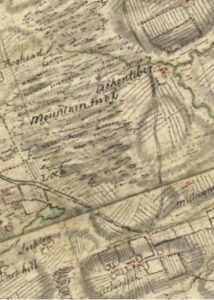
Despite embracing all these digital elements, James nevertheless tells me that he resisted the urge to read up about Lenzie Moss prior to his visit. He knows very little and I therefore offer a bit of context. I tell him about the history of peat extraction at the site: the Royal Charter of 1226 that allowed monks to remove peat; the Kirkintilloch burgesses, or Peat Lords, who increased the scale of the operation; the industrialisation of the site and the commercial peatworks that continued until the 1960s.

James is very interested in the human exploitation (and later, protection) of the Moss. He tells me that he loves places like this, but that they really come to life for him through these details. It is significant that he hears all this directly from me, as we walk around the site, but then I reflect that I first learnt of this history through online research, and have studied the site on Google Maps to see where the peat industry has left its mark. My own understanding of Lenzie Moss is certainly emerging through an entanglement of physical and digital information and experiences. And I am sharing this blog online. Many of the people I have walked with – Steve, Alison, Andy and others – got in touch because they had heard about the project on social media.

As we talk about these digital connections, a woman and her dog walk towards us, following the boardwalk in the other direction. I recognise them. I have, in fact, been looking out for them. I am a member of the Lenziechat Facebook group and have been enjoying the many beautiful photographs of Lenzie and Kirkintilloch that are regularly posted there. I am pleased to meet one of the site’s top contributors! I tell her about my project, and she seems up for joining me for a walk one day. She tells us about her macular degeneration, and we talk about our cameras. Cameras are a way of extending her vision, reaching things that she otherwise couldn’t see. This is an important part of the postdigital conversation. For some, digital tools are enabling – they allow access and facilitate inclusion.

For the final stage of our walk, we head off the main path and make our way across the bog and into the woods. Here, we encounter a couple of workers in bright orange jackets. I ask them what they are doing and they tell me they are digging pools for amphibians. What they don’t say, and what I know to be the case, is that these pools are also strategically placed to discourage access to this part of the Moss. This is the exact spot that I visited with Jill – the route that had been made accessible with a makeshift boardwalk, created from a section of fencing. I get the sense that the contractors are reluctant to be drawn into a conversation about their work, so we move on.

James is intrigued by my earlier mention of the ruined peat processing plant, and we seek it out. We also visit the concrete base near by – the one that Ali and I explored as a potential stage for a performance and Clare’s daughter had referred to as ‘the bottom of a castle’. James is drawn to a brick, half buried in the mud. We can’t quite make out the writing – something like Seamill (a west coast town that I have often visited) but we search online and can’t find any evidence of a brickworks there. Another brick, exposed at the top of the foundations is much clearer: Rosehall. This was a brickworks connected to the colliery in Coatbridge, so it has not travelled far.

During this walk, I have learnt new things, met new people, shared my knowledge, and enjoyed some quality time with a colleague. All of these things took place on the physical site of Lenzie Moss. We scraped mud of the bricks, saw the light shifting in the trees, inhaled the fresh air. But they have also been made possible through digital platforms, devices and networks. The entanglement of the physical and digital has been revealed today, just as we hoped that it would be. This has been a valuable opportunity to take a postdigital learning journey together. If that’s not work, then I don’t know what is. And we are doing it on our day off. Let’s hope that university recognises this commitment to our research and lets us carry on doing it.

21. Steve

Get out there and have your adventure today. (Stephen Mason, Ride to the Midnight Sun)

On the morning before I meet Steve, it is raining heavily. I feel confident that he won’t be phased by the weather though. Steve is a true adventurer. Last year, he completed all of Scotland’s 282 Munros (mountains over 3,000 feet). He has been all over the world on his trusty BMW motorbike, Borris. And he has written extensively about his travels. Steve’s books are full of warm and engaging anecdotes and they are philosophical, too. They tell a story of embracing life, seeking out new experiences, and making things happen. He tells me that he is ‘a motor biker who writes, rather than a writer who bikes’. But I don’t know what he is like as a biker and all I can say is that I am enjoying his stories.

The rain obligingly eases off as we set off around the Moss. I am interested to know what Steve feels about this place. Compared to the long, dusty roadways of North America, the unfamiliar territories of Russia and Patagonia, and the mountains of Morocco, I wonder if he sees this bog as too small, too local and too predictable? Steve understands what I am getting at and tells me that on the contrary, he very much appreciates life in Lenzie and sees the Moss as a special place that he will always be able to return to. The thought of returning has helped him through some of the most challenging parts of his trips. When Steve was searched by Russian police and detained when they found a packet of codeine tablets that he had inadvertently brought along from Scotland, he was seriously worried that he might not make it back.

Steve moved to Lenzie 25 years ago after spending most of his life in Ayrshire. He also spent some time working in Silicon Valley but has long since retired from his work in computer manufacture. Like me, Steve didn’t know very much about the town before he decided to move here. The Moss was an extra bonus, and he is thankful to live close to a place that is so well maintained and with such a rich history. Steve often walks and cycles on these pathways.

Unlike some other areas of Glasgow’s greenbelt, Steve feels reasonably confident that the Moss will be protected from development. This is a concern of his though: while Steve understands the importance of building new homes and infrastructure, he is worried about the encroachment onto greenspaces. He lives near Whitegates Park, which has been designated as the site for a huge new school development in the area and a lot of the community are devastated by the loss of a vital parkland at the centre of the town. This has made him value proximity to nature even more.

As we walk down the boardwalk, a slow line of roe deer crosses over the bog beside us. Steve is pleased to see them for the first time. I am becoming quite familiar with these animals through these walks, and they seem to favour this area particularly. I attempt to photograph their passage, but they are a bit too far away for a good image. The photos that I manage to take are apparently of the bog with the line of trees and the top of the hill range in the background. But look closely and you can see a few white tails. The Moss is full of gifts and surprises for those who visit often and watch carefully.

Steve tells me about an occasion when he was walking on the Moss with his family and they came across a group placing painted stones along the path. He later added to the collection with his young grandchildren. I mention that I have previously found such stones buried by my house and wonder if they were made by the pupils at the old primary school next door. It turns out that Steve knows my house – his wife’s friend having lived there around 15 years ago. Steve remembers attending a wedding that took place in my garden! I tell him about my walk with Sophie, when I learnt about some other past residents of my house, a couple who lived there many years earlier.

As we look out to the Campsies, I ask Steve about his Munro bagging. For his last climb, he chose Beinn na Lap, by Corrour Station on Rannoch Moor (the highest and most remote main line station in Britain). I climbed the same mountain in 2006 with a friend and remember snowy peaks and thick fog making the route treacherous. For a couple of years, I climbed several Munros and aspired to bag them all one day. Many years have passed since my last one and I have to admit that I have given up on the idea of climbing them all. Steve completed his challenge on a much finer day, and he also walked with his family. On the same day that Steve climbed his final Munro, his 5-year-old grandson managed his first. My own 5-year-old, Ruairidh, enjoys hill walking, but hasn’t yet summitted a whole mountain. Steve inspires me to head up a Munro with Ru one day soon.

Steve talks about the appeal of Munro bagging. He says he is very goal-orientated and he enjoyed keeping a spreadsheet of his climbs, revelling in changing the cells to green each time he completed another peak. I suppose that my Lenzie Moss project is goal-orientated, too. I will reach 100 walks in a couple of years or so, and that will be a good feeling. It is always satisfying to add another post to the blog. Perhaps Bog Blogging could become a new craze.

But I also think that my slow, repetitive circling of the mire offers something counter to the big expeditions that Steve has enjoyed. Lenzie Moss might not be experienced on the same scale as the motorbikes and Munros. But it has deer and stones and views of the hills beyond, and I discover new things each time I share an hour with a new walker. Every time I travel round the Moss, I go on a little adventure.

20. Cairan

Our desires stare back at us, yellow-eyed and snarling, from the thickets of the mind. (George Monbiot, Feral)

My friend Cairan is visiting for the evening, and I persuade him that a pre-dinner walk round the Moss will be a good idea. We meet at the train station in a downpour. The clocks have changed at the weekend, so it is now much darker at this time. I am not sure whether Cairan’s initial enthusiasm has persisted. By his own admission, he is ‘not an outdoors kind of person’ and any hopes he may have had of a gentle stroll on a sunny autumn evening will need to be adjusted. But he is well prepared with heavy boots and a warm coat, and after a brief pit stop at home to drop off a bag and a dog (Clyde has already had his turn), we are soon entering Lenzie Moss at the end of my street, just as the rain holds off.

The woodland trail is hard to see. We stand for a moment to let our vision adjust and slowly the faint outline of Bea’s Path fades into view. We take tentative steps northwards. This is only the second time that I have visited this place after dark, and it feels very different. Occasionally, we are blinded by bright torchlight coming in the other direction and greeted by voices whose owners we cannot make out until they have passed. Outside lights from the houses off Blackthorne Avenue illuminate the path by the primary school. There seems an unnecessary level of light pollution here.

Cairan tells me that keeping parks and green places unlit can actually make these areas feel safer for people passing through. When pathways and walking routes are saturated in light, the wooded areas and grasslands beyond become hidden, unseeable places. In public parks like Glasgow’s Kelvingrove, beside which I used to live, ‘sensitive’ lighting has recently been added, partly to avoid this effect.

We peer into the darkness and wonder what lurks in there. A couple of years ago, Cairan and I spent a week working at Capital Theatres in Edinburgh to devise a new theatre performance, which we called Beasts. The idea was to present some fictional verbatim interviews with people who had seen big cats – suburban encounters with wild animals. We spliced these together with shaky film footage and photographs of possible sightings. Then the script shifted to speculative futures with cities taken over by nature. We now have some fragments of text and a loose structure for a show. Both of us hope we will find an opportunity to return to it one day, but the project has been placed on the back burner for now. Walking round the Moss this evening reminds us of the topic and raises the possibility of something wild hiding out there. I am hoping to see a shift of light, a displaced tree branch – something to help me imagine that a big cat might be close by.

A few days ago, I stood in my garden and watched a bat flying back and forth over my fence. I wonder if we will at least see a bat this evening. But if they are out there, they are also imperceptible in the darkness. Then a small white moth catches the light as it flutters by and I’m happy enough with that. We take a lot of photographs as we walk (Cairan has brought his camera, which is much better than the one on my iPhone). The trees are silhouetted against the sky and the First Quarter moon shines brightly as clouds drift past. As we join the boardwalk, the light show is enhanced by headlights from the vehicles crossing the railway bridge.

The vista opens up and we look up at the stars. We make out the Plough (seven of the bright stars of Ursa Major) very clearly, but this is the extent of our knowledge of astronomy. Several planes pass overhead, bright and noisy. We see a succession of trains as well and as we get closer, we can see through the windows into the well-lit carriages. The commuters don’t know that they are being observed from the shadows. Looking further to the west, the city is visible in a way that I have never realised during the day; thousands of tiny lights marking the urban area.

I don’t know what to make of all this movement, light and energy. It is mesmerising but we are standing by the heather-covered ‘peat hill’ that I climbed with Alison and also sat beside with Cathy early one morning. On those previous walks, this place felt quiet and calm – a spot to rest and reflect. This evening, the boardwalk is a nexus of transport routes. Rail, road and air carry people in all directions and each journey flashes past. I am taking in a lot of new information, and I feel tense and out of place.

We reach the end of the boardwalk, and I offer Cairan the option of walking through the bog and into the wood or taking the pathway along the railway line. He chooses the less muddy route and we set off back towards my house. We follow a boundary line between the modern infrastructure of the rail network and the old birchwood that veils the bog. I stay alert, attentive to any potential motion in the undergrowth.

As we turn back onto my street, I feel overwhelmed. I realise that I have been exerting all my senses during this walk. The lights and sounds and darkness have made a now familiar place feel strange and unknowable again. While there are no big cats staring back at us from the trees, the trees themselves seem wild and strange. While I welcome this feeling, I am still processing the uncanniness of the encounter.

I am pleased when Cairan tells me that he has had quite the opposite experience. He has been feeling stressed with work and had mentioned earlier to his boyfriend that he had probably taken on too many things this week. When I met him from the train earlier, he was worrying about an early start for a work trip tomorrow. Cairan tells me that the walk round the Moss has been a calming experience. Slow pace, hushed voices and the lights and sounds of the nighttime Moss have been good for him, and he now feels able to relax and enjoy the rest of the evening. Luckily, I have a pot of bolognaise and a bottle of wine waiting for us at home, which I am sure will taste all the better for the hour we have spent in the wild outdoors.

19. Ellie

Ellie is sitting outside Billington’s with her partner and one-year-old daughter when I meet her for our walk. They are visiting from their home in the Scottish borders and haven’t been to Lenzie before. I have spoken with Ellie online and exchanged a few emails over the years, but this is the first time that we have met in person. Ellie is an artist, currently working in Scotland’s temperate rainforests – the ancient woodlands of the west coast. She makes sound recordings, films, photographs and sculptures, which respond to the textures and changes in different landscapes. Ellie is interested in questions about time and has been particularly drawn to the microworlds of lichen and bryophytes. She is enthusiastic about my project and the opportunity of a walk round Lenzie Moss. The plan is for the two of us to walk one way and for her family to walk the other, so at some point we will meet.

As we set off, I tell Ellie about an awful mistake that I made earlier. I had arranged a walk with someone else at the start of the day. Somehow, I had neglected to add this to my calendar, and it had completely slipped my mind. When I checked my computer, I saw that I had received a couple of emails, ‘I’m here in the station car park’, then ‘I’m going to head off now’. They had driven quite far to meet me. Feeling terrible, I replied with a huge apology and expressed my hope that we still might be able to arrange a walk. I will completely understand if they decide against it now. For me, this project is about making time for people and taking a careful and ethical approach to walking and talking. I tell Ellie that I am upset with myself for having compromised these principles and wasted somebody’s time like this.

Ellie says all the right things, and we talk about our varied experiences of walking interviews, which both of us see as an important part of our creative practice. Ellie is studying for a PhD at Edinburgh College of Art. She is researching the different timescales of the forests where she works and searching for appropriate artistic responses to these complex places. She talks about the challenge of artists being ‘parachuted’ into a new site and the slow, sensitive time that it takes to make connections with the people who live and work there, before any artwork can be made. I recognise this from previous projects but realise that this one at Lenzie Moss has been quite different because I am part of the same community as many of the people I am walking with. For Ellie, there are more barriers and a greater distance to bridge before she feels ready to create artworks at her chosen sites. She is therefore conducting many interviews with people who know and understand the forest. Ellie records and transcribes her conversations as part of her research process. I tell her that I rely on written notes and memory, which inevitably means that I will miss or forget some things.

We look closely at the trees as we walk and Ellie regrets leaving her magnifying lens behind. Nevertheless, we attend to the intricate patterns of the lichen and identify Xanthoria parietina, commonly known as common orange or golden shield. I know very little about lichens, beyond the fact that they form through a symbiotic partnership between fungi and algae. Ellie tells me about the lichens and liverworts that she has encountered in her fieldwork. They are key indicator species whose presence suggests that you are likely within temperate rainforest. The location, age and diversity of lichen can tell us a lot about an ecosystem’s health and resilience. Because of Ellie’s interest in the temporalities of her field sites, she has been drawn to lichen after her initial interest in rhododendron and ash trees, as they require close attention and slow, mindful observation. The problem, which Ellie is now grappling with, is that institutional time is something quite different and she feels under pressure from the university to move from observing and learning to making and creating.

As we walk down the boardwalk, Ellie spots her partner and daughter coming the other way. We stop and chat for a while. They are interested in community ownership, and they mention Leadburn Community Woodland between Edinburgh and Peebles, a former conifer plantation that was purchased from Forestry Scotland in 2007. I wonder whether Lenzie Moss could ever be owned and managed by the community, and what benefits that might afford. On previous walks, I have heard about and gained an insight into the disconnect between the Moss and some local people, and the challenges of community perception of council management. Perhaps a different model of ownership would make a positive difference in this regard, encouraging more engagement and creating a greater sense of agency.

The two pairs continue in opposite directions, and Ellie and I turn off the boardwalk onto the path across the bog. We spend some time in the middle of the site, conscious of the exposed peat and the need to tread carefully. We stop to examine the healthy carpet of sphagnum moss and watch the cottongrass dancing in the breeze. When we look up, Ellie spots two deer running along the central raised area that used to be an internal railway line. Their white tails are easy to spot but otherwise they are well camouflaged against the heather.

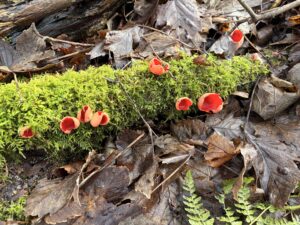
Our route back to the town takes us through the south-east section of woodland and we see various fungi and lichen clinging to the birch trees. We even see a slime mold, which Ellie photographs. We walk slowly and lean into slower timescales. This puts us in a reflective mood, and we wonder about the role that artists can have in places like this. Ellie says that we are conduits between experts, publics and places, and she believes that site-based art can help people think differently about their environments. But for Ellie, it is so important for us to spend time learning, listening and getting to know the places where we work. She wonders what language she can use to argue for this as an essential part of a creative process.

Ellie also says that it is important for artists to understand what people want from them. I suppose the very bare minimum would be to turn up on time and not forget an appointment. From there, we can build towards a shared sense of belonging, a sensitive relationship with the environment, and artworks that really mean something to the people we meet, and matter to the places we visit.

css.php

Report this page

To report inappropriate content on this page, please use the form below. Upon receiving your report, we will be in touch as per the Take Down Policy of the service.

Please note that personal data collected through this form is used and stored for the purposes of processing this report and communication with you.

If you are unable to report a concern about content via this form please contact the Service Owner.

Please enter an email address you wish to be contacted on. Please describe the unacceptable content in sufficient detail to allow us to locate it, and why you consider it to be unacceptable.
By submitting this report, you accept that it is accurate and that fraudulent or nuisance complaints may result in action by the University.

  Cancel