March has arrived with birdsong, sunshine and new shoots. Today I am walking with Carol, who got in touch after hearing about the project through Walk Run Cycle East Dunbartonshire. Carol had originally suggested meeting a couple of weeks ago in the hope that her granddaughter would accompany us during the half term school holidays. But perhaps unsurprisingly, the prospect of a wander round a bog with a random researcher did not appeal to an eight-year-old, so only Carol and I will be circling the Moss this morning.
We set off round the Moss, and we are soon witness to a drama in the skies as crows swoop down to the birch trees to fend off rivals. Their ‘caw-caws’ and screeches reach out across the bog. Smaller birds fly off to safer perches. After the stillness of winter, there is a notable change in the land this week. The tiniest of hawthorn leaf buds are visible. The Moss is charging itself up, ready for the explosion of life that comes with the new season.
Carol is recovering from a broken pelvis, acquired while holidaying on the Isle of Arran, after an encounter with a suitcase in the dark. It has been a long, slow process. Carol has been in a lot of pain and has had to return to hospital over the last few months. She is gradually testing how far she can go and while she is fine for now, she doesn’t know whether the pain will return during our walk.
Halfway up Bea’s Path, we encounter a group of women of a similar age to Carol, kitted up with waterproofs and hiking boots. Among them is a friend of Carol’s, who she knows from the Ramblers. They share a hug and while the rest of the pack continue on their way, the two friends stop for a quick chat. The group are Soroptimists – ‘a global volunteer movement whose mission is to transform the lives and status of women and girls through education, empowerment and enabling opportunities’; they are walking for the upcoming International Women’s Day. Carol introduces me and my project. I learn that there will be a talk on the history of Lenzie Moss on Thursday, delivered by Kay for the Kirkintilloch Antiquaries.
The connections that Carol has made through walking mean a lot to her, but it seems that her injury has made it difficult to maintain these friendships. Carol has only lived in Lenzie for about the same time that I have. She moved here from Lancashire to be close to her daughter and granddaughter. I tell Carol that I made the same move, in a way (I lived in the same county for a couple of years when I was a toddler and my younger brother Phil is a native ‘Lancashire Lad’). Carol is enjoying living here but she is spending more time indoors than she would like to and is watching more television than she is accustomed to.
We dodge the huge puddles on the path and Carol tells me about some of her adventures over the years. She spent most of her career as a maths teacher, which included taking part in an exchange programme that allowed her to live and work in Australia for a year. Later, Carol left her job and travelled to Papua New Guinea, where she also worked as a teacher, and she then spent time as a travel rep in the Swiss Alps. Carol notices a plane fly over the Moss, and she tells me that she is less inclined to travel by air these days.
We pass the great oak on the North Woods Path and stop to admire its twisted branches, which are leafless for now but full of potential. A couple of pigeons are roosting high above us. Carol says that she loves trees and has been known to hug them, too. We examine the shapes against the sky and Carol says that she would like to take up drawing again. I wonder if there are any art groups nearby and can well imagine Carol and the Soroptimist women visiting the Moss with sketchpads and pencils. Walking and drawing are closely related since both are actions that create lines and entanglements. Close by, a new plaque has appeared on a tree stump, commemorating ‘Gus “Wee G” King of the Moss 2010-2026’.
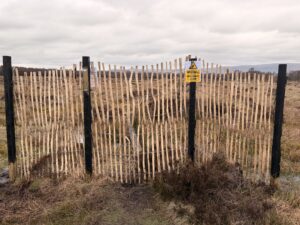
As we emerge from the trees to look out across the bog, Carol asks me about the fencing that has appeared here since her last visit. I explain that it is there to block access, and Carol understands the reasons for this. There has been another development, though. Now several of the fence posts have been painted in a thick black anti-vandal paint, which is visible across the bog. A new sign – already blurred by heavy rain – warns potential transgressors away. The sign that I noticed with Logan is now lying in the mud. So, this is the third sign in just a few weeks, and these have evolved from ‘help make space for nature’ to ‘Please don’t walk on the bog’ to ‘Warning anti-vandal paint’. I worry about how these new physical barriers and the dialling up of rhetoric in the signage will be received.
We follow the path back into the woods and as we reach the narrow wooden bridge that is really part of a dam, something splashes into the water. As we move closer to inspect, we are surprised by a pair of copulating frogs! I photograph them and apologise for invading their privacy, but they seem quite happy and entirely indifferent to our presence. Then we balance as we walk cautiously along the plank (Carol is comfortable to do so) and join the path on the other side.
As we reach the end of our walk, Carol notices that she has been pain free for the last hour. We have made steady progress round the Moss today, stepping over puddles, navigating uneven surfaces and shuffling along a narrow beam. I am delighted that Carol seems to have enjoyed this walk without discomfort. I am sure that she will be out rambling with her friends again soon. Some barriers can be overcome.