Any views expressed within media held on this service are those of the contributors, should not be taken as approved or endorsed by the University, and do not necessarily reflect the views of the University in respect of any particular issue.

44. David K

When I meet David on Kirkintilloch Road, he is wearing a camouflage jacket, which he attributes to his career as a deer stalker. David used to work for Scottish Natural Heritage (now NatureScot) in the Cairngorms National Park. He then went on to study countryside management and was involved in surveying the deer population across the East Dunbartonshire area, including at Lenzie Moss. David also remembers working for the council in this area in the 1990s, when he was employed to clear rhododendrons from the north part of the Moss. I hope we will see the roes on our walk today.

It is one of those days in Scotland when all the seasons come together: frost on the ground among the daffodils; snow on the hills beyond; clouds in the sky; and sunshine cutting through the trees. There is also a strong breeze. Given our direction of travel, this might help us locate the deer, who will not be able to smell us coming.

When I walked with my brother, Phil, just before Christmas, he recounted some recent deer stalking adventures and talked about the appeal of slowing down and paying careful attention to the environment. This is a sensibility that David knows well. David reads the landscape as we walk, noting the way that the wind moves through the branches – which are still without leaves – and the direction of the higher clouds, as well as the behaviour of the dogs we meet, and the flight of birds. It is fascinating to walk with someone who experiences the Moss in this way.

A silver-grey Weimaraner dog runs ahead of us and David notices that it has picked up a scent. We suddenly veer off the path and walk slowly through the trees towards the bog. As we reach the other side of the narrow strip of birchwood, we encounter two deer enjoying the sunshine. As they move away from us, David makes a squeaking call and instructs me to head slowly back towards the main path. We meet the dog once more, and his owner puts him on the lead, on our suggestion. But the deer have taken a different route now, and we don’t see them again.

As we reach the top of the boardwalk, David points out the location of the entrance to the drainage tunnel that runs between the Gadloch, south of the railway line, and Park Burn in Boghead Wood, to the west of the Moss. David tells me that the tunnel was dug by Napoleonic prisoners of war. We examine the area through his binoculars (David extols the benefits of a good pair) and notice an access point by the railway bridge on Crosshill Road, which seems aligned with the path of the tunnel.

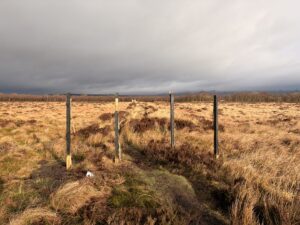
We reach the boardwalk and look out across the bog. When I walked with Tony and Julia six weeks ago, we noticed the sections of fencing that had appeared, preventing access to the centre of the site. I said at the time that I wasn’t sure that they would be there for long. After various signs were put up and quickly removed, Carol and I noticed the addition of anti-vandal paint. Today, David and I observe what is left after someone has visited in the night and torn down most of the fencing. The route has been opened again, leaving only the deep-set posts that would have been difficult to remove on the fly.

David says it is all a bit of an eye-sore, but he is sensitive to the efforts to discourage access. David sees the bog as a vast carbon sink. He notes that the Moss used to extend further – reaching Bishopbriggs and further south than the trainline. He sees the fragment that is left as an important place that needs to be protected. For David, the answer lies in education. If people knew what was at stake, they would take more care.

David worries that people are becoming disconnected from landscapes like this. Young people stay inside on their screens (a situation I am often attempting to counter at the very local level of my own household). But if we can get them outside, engaged with the issues of conservation and biodiversity, then sites like the Moss are more likely to be protected. David says that we need to appreciate nature and the natural world more.

David tells me about a walk with the Ramblers (where he met Carol, who put us in touch). Half-way along the ‘Magnificent 11’ route round Linn Park, King’s Park and Castlemilk Park in the south side of Glasgow, he asked the group to stop. They stood in a circle with hands linked and eyes closed. And they listened. This invitation to become immersed in the environment and to take part in a listening exercise together had a profound effect on some of the group. Some told David they had not expected to be so deeply moved.

David encourages me to close my eyes and listen now. For a couple of minutes, I tune into the wind. It sounds different notes from various directions: a shrill whistling through the trees and a low, rumbling countermelody from the west. An approaching train joins the harmony, and I open my eyes to sunshine falling across the heather.

Suddenly, there is a commotion, and David excitedly directs my attention to the far side of the bog. He tells me there is a buzzard being mobbed by crows. I see a flash of brown dropping to the ground and we watch as a single, brave corvid sustains the attack. This is similar behaviour to the incident that I noticed with Carol, in the nearby trees. I wonder whether there was more going on then than I realised at the time. Perhaps the buzzard was involved then, too.

For the final section of our walk, we return to the main path. We say good morning to a jogger, who I have chatted with during the Lenzie Running Club outings. He is always very encouraging to Ruairidh, who joins in too. A mother pushes her baby in a pram. A couple walk their labrador.

I feel like I have just returned from an adventure into a wilder Moss, which exists just beyond the everyday journeys that people take here. David has shown me that there are roe deer, buzzards, and shifting winds out there to be discovered by those who take the time to listen. I think we can all learn something from David’s way of being in a place like this.
43. Stewart

In every town and city today, cutting across parks and waste ground, you’ll see unofficial paths created by walkers who have abandoned the pavements and roads to take short cuts and make asides. (Robert Macfarlane, The Old Ways)

I meet Stewart on the high street and appreciate his energy right away. We set off at a quick pace, and our conversation matches our passage. Stewart grew up on the Isle of Arran, works in property development, and has lived in Lenzie with his family since 2018. His wife is from the town, and they now live in her old family home. They have three children at the local primary and secondary schools and relatives nearby – in Lenzie and Bishopbriggs. While Stewart occasionally walks their dog on the Moss, it isn’t a place that he spends much of his time, but he is enthusiastic about the chance to walk with me today and to think about the possible futures for this place.

Stewart’s thinking is shaped by a varied career, including ten years as a navy officer and several in a senior banking role, with RBS and Barclays. He is used to being part of and leading complex multi-partner projects. Now, in his current job, he is always thinking about chains and networks and management. What would it mean to manage the ‘project’ of Lenzie Moss differently?

Stewart tells me about the ‘dig once’ concept in urban planning, which encourages the integration of different workstreams. If a gas engineer is digging up a high street to replace pipes, then it makes sense for the telecommunications, electricity and draining projects to come together to use the opportunity to do their work at the same time. That makes a lot of sense, but it requires clear communication channels, effective databases and strong project management. Stewart suggests that these things might be missing here and that they may be key to navigating the multiple interests and requirements of the Moss – from broken benches to hydrological surveys to community access. Everyone needs to have ‘skin in the game’.

We also discuss the funding required to maintain a place like this. Local councils are under severe financial pressure at the moment, leading to increases in tax and difficult decisions about priorities. In the long term, there is no guarantee that the Moss will receive the same level of investment. But if I have learnt one thing about bogs over the last year, it is that they are always changing. As Jackie said to me at the start of the project, without continual conservation, homes could flood and fires could start; the site would quickly dry out and revert to scrub-land, and birch trees would take over.

Stewart mentions the plans for community ownership of Lenzie Public Hall, which I learnt about when I walked with Clare. For community-driven development projects like this, Stewart promotes pragmatism about sustaining the business. Leasing, corporate hires, philanthropy – all these could be key to sustaining the community groups and education activities that people want to see thrive. I think back to my time working at the Arches arts centre in Glasgow, which closed in 2015 after many years of large-scale club events supporting a vibrant artistic community and arts programme. I remember lots of tension between the different uses of the building; every new project involved a negotiation with the different programming teams about space and resources.

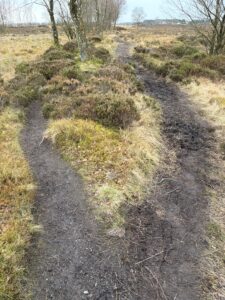
We leave the boardwalk and wander across the bog, following the well-established ‘desire path’ that skirts this side of the south woods path. Desire lines have been mentioned several times during this project. These are trails made by people or animals taking the most desirable route through a landscape and sometimes creating an ‘unofficial’ pathway through repeated footfall. In The Old Ways, Robert Macfarlane explains that these rough trails establish themselves and become part of the physical and cultural landscape.

There are examples of Scandinavian and North American landscape architecture responding to desire lines. Perhaps most famously, the Ohio State University paved the lines created by student’s repeated footfall over the years, modelling the network of new paths on the lines made by previous generations. It seems that this has happened on the Moss as well, as the relatively new boardwalk includes a short side route with steps down onto the main desire path – just at the point where Deirdre and I noticed the exposed root system, which I took as a metaphor for the entanglement of lines that comprise this project.

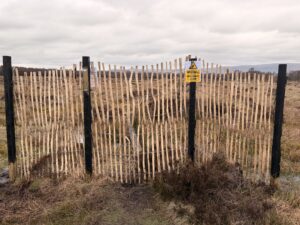
The Moss is criss-crossed with desire lines, which are most prominent in the woodland around edges of the bog. The newly erected fencing, placed at intervals along the central raised bank, is intended to prevent this practice from continuing into the centre of the site. Today, it would be difficult to circumvent these structures due to the wetness of the mire. But in very icy or very hot weather, it would be possible to simply walk around them. Elsewhere on the Moss, when barriers are put in place, desire paths form as routes meander round pools and fences. We follow the unofficial lines through the wood to return to the main path, which takes us back to the station carpark.

As we walk up Kirkintilloch Road together, Stewart offers more examples of planning and infrastructure projects, which have shaped his approach to site development and long-term planning. From navy boat docking to aeroplane engineering, medical bookings to large-scale tourist events: Stewart pays close attention to how systems work and applies this thinking to the Moss, too.

What else could Lenzie Moss be used for? What are the alternative funding streams that haven’t yet been considered? How can the different users be brought together to work towards the same goals? How should such coordination be managed? Stewart suggests that we need to ask such questions here. He implies that the Moss would benefit from more ambitious and radical plans. He talks about the importance of listening to the ‘voice of the customer’. By bringing together what the different groups – such as conservationists, dog walkers, and families – actually want, we can define the ‘so what’ and the ‘why’. This would allow the Moss to develop in a way that is intertwined with its users, rather than treating different needs as ‘parallel pillars’.

Just before we go our separate ways, Stewart mentions that his perspective and his way of talking about community spaces isn’t always welcome. To bring a property developer into the room is often to disrupt established approaches; to set a cat amongst the pigeons. I can see how some of Stewart’s terms, questions and suggestions could run counter to the slow, careful conservation that is often preferred for the Moss. But my own thinking about the site has been challenged today and I have valued the many examples and analogies that Stewart has shared with me. Thinking differently about the Moss might be just what is required for more ‘customers’ to invest in its future. Perhaps this is how new desire lines are formed?

42. Carol

March has arrived with birdsong, sunshine and new shoots. Today I am walking with Carol, who got in touch after hearing about the project through Walk Run Cycle East Dunbartonshire. Carol had originally suggested meeting a couple of weeks ago in the hope that her granddaughter would accompany us during the half term school holidays. But perhaps unsurprisingly, the prospect of a wander round a bog with a random researcher did not appeal to an eight-year-old, so only Carol and I will be circling the Moss this morning.

We set off and are soon witness to a drama in the skies, as crows swoop down to the birch trees to fend off rivals. Their ‘caw-caws’ and screeches reach out across the bog. Smaller birds fly off to safer perches. After the stillness of winter, there is a notable change in the land this week. The tiniest of hawthorn leaf buds are visible. The Moss is charging itself up, ready for the explosion of life that comes with the new season.

Carol is recovering from a broken pelvis, acquired while holidaying on the Isle of Arran, after an encounter with a suitcase in the dark. It has been a long, slow process. Carol has been in a lot of pain and has had to return to hospital over the last few months. She is gradually testing how far she can go and while she is fine for now, she doesn’t know whether the pain will return during our walk.

Halfway up Bea’s Path, we encounter a group of women of a similar age to Carol, kitted up with waterproofs and hiking boots. Among them is a friend of Carol’s, who she knows from the Ramblers. They share a hug and while the rest of the pack continue on their way, the two friends stop for a quick chat. The group are Soroptimists – ‘a global volunteer movement whose mission is to transform the lives and status of women and girls through education, empowerment and enabling opportunities’; they are walking for the upcoming International Women’s Day. Carol introduces me and my project. I learn that there will be a talk on the history of Lenzie Moss on Thursday, delivered by Kay for the Kirkintilloch Antiquaries.

The connections that Carol has made through walking mean a lot to her, but it seems that her injury has made it difficult to maintain these friendships. Carol has only lived in Lenzie for about the same time that I have. She moved here from Lancashire to be close to her daughter and granddaughter. I tell Carol that I made the same move, in a way (I lived in the same county for a couple of years when I was a toddler and my younger brother Phil is a native ‘Lancashire Lad’). Carol is enjoying living here but she is spending more time indoors than she would like to and is watching more television than she is accustomed to.

We dodge the huge puddles on the path and Carol tells me about some of her adventures over the years. She spent most of her career as a maths teacher, which included taking part in an exchange programme that allowed her to live and work in Australia for a year. Later, Carol left her job and travelled to Papua New Guinea, where she also worked as a teacher, and she then spent time as a travel rep in the Swiss Alps. Carol notices a plane fly over the Moss, and she tells me that she is less inclined to travel by air these days.

We pass the great oak on the North Woods Path and stop to admire its twisted branches, which are leafless for now but full of potential. A couple of pigeons are roosting high above us. Carol says that she loves trees and has been known to hug them, too. We examine the shapes against the sky and Carol says that she would like to take up drawing again. I wonder if there are any art groups nearby and can well imagine Carol and the Soroptimist women visiting the Moss with sketchpads and pencils. Walking and drawing are closely related since both are actions that create lines and entanglements. Close by, a new plaque has appeared on a tree stump, commemorating ‘Gus “Wee G” King of the Moss 2010-2026’.

As we emerge from the trees to look out across the bog, Carol asks me about the fencing that has appeared here since her last visit. I explain that it is there to block access, and Carol understands the reasons for this. There has been another development, though. Now several of the fence posts have been painted in a thick black anti-vandal paint, which is visible across the bog. A new sign – already blurred by heavy rain – warns potential transgressors away. The sign that I noticed with Logan is now lying in the mud. So, this is the third sign in just a few weeks, and these have evolved from ‘help make space for nature’ to ‘Please don’t walk on the bog’ to ‘Warning anti-vandal paint’. I worry about how these new physical barriers and the dialling up of rhetoric in the signage will be received.

We follow the path back into the woods and as we reach the narrow wooden bridge that is really part of a dam, something splashes into the water. As we move closer to inspect, we are surprised by a pair of copulating frogs! I photograph them and apologise for invading their privacy, but they seem quite happy and entirely indifferent to our presence. Then we balance as we walk cautiously along the plank (Carol is comfortable to do so) and join the path on the other side.

As we reach the end of our walk, Carol notices that she has been pain-free for the last hour. We have made steady progress round the Moss today, stepping over puddles, navigating uneven surfaces and shuffling along a narrow beam. I am delighted that Carol seems to have enjoyed this walk without discomfort. I am sure that she will be out rambling with her friends again soon. Some barriers can be overcome.

css.php

Report this page

To report inappropriate content on this page, please use the form below. Upon receiving your report, we will be in touch as per the Take Down Policy of the service.

Please note that personal data collected through this form is used and stored for the purposes of processing this report and communication with you.

If you are unable to report a concern about content via this form please contact the Service Owner.

Please enter an email address you wish to be contacted on. Please describe the unacceptable content in sufficient detail to allow us to locate it, and why you consider it to be unacceptable.
By submitting this report, you accept that it is accurate and that fraudulent or nuisance complaints may result in action by the University.

  Cancel