The currency in a gift economy is relationship, which is expressed as gratitude, as interdependence and the ongoing cycles of reciprocity.” (Robin Wall Kimmerer, The Serviceberry. Cited in Feminist Culture House, Windows of Tolerance).
Before we reach the Moss, Kate draws my attention to the pots of primroses outside the flower shop on the main street. They sit unassumingly in what is likely to be sphagnum moss peat. All of the items on display have ‘plant passports’, indicating that they have been imported from the Netherlands, where Kate lives when she is not in Scotland. Kate also suspects that they may be covered in pesticides. Despite passing this spot hundreds – maybe thousands – of times, I have not noticed the proximity of the international peat trade to a protected bog before. So, within seconds of meeting Kate for the first time, she has shown me something new and encouraged me to engage critically with my local environment.
The practice of using peat for commercial horticulture has only been popular for under a century, but today it is as commonplace as it is controversial. Recognising the environmental damage caused by peat extraction, the Scottish government recently ran a public consultation on ending its sale in this country. Promoting their campaign for the UK government to legislate to end peat sales, the Peat Free Partnership explains that ‘the horticulture industry has made encouraging progress in becoming peat-free, reducing usage of peat by over 50%’. However, they note that ‘the pace of change doesn’t match the urgency needed, and progress without legislation is slowing’. With ongoing extraction contracts in place for many years to come and international chains supplying shops like this, more action is needed.
Kate is an environmental artist, who has committed to support peatland restoration in this capacity and has worked on many related projects for over a decade. In a recent biography, she is described as being ‘part of a movement re-imagining connections people can make to peatlands’. Since 2016, Kate has convened Peat Cultures (Veencultuur), an ‘artist’s project highlighting diverse cultural values of peatlands’.
Kate’s artistic process stems from field-drawing and involves studio-based work. Her current projects include a series of ‘Peatland Figures’ that help her explore outmoded peatland paradigms and the process of shifting mindsets. These manifested initially as shadow puppets that inserted cultural considerations into scientific peatland research. More recently she started making glove puppets. For Kate, these figures ‘articulate unwelcome mindsets that I want to move away from, such as self-centredness, romanticism, denial, despair and complicity.’ But importantly, ‘they also make me laugh!’
Kate’s web of connections includes grassroots organisations, research centres and museums. She has worked with the Crichton Carbon Centre and several universities (she has a PhD in Social Policy and an MSc in interdisciplinary Creative Practice) and has campaigned for peat-free futures with Peatland Justice and as an older member of the youth-led collective, RE-PEAT, for whom she recently presented work at a collective show – Limbo – in the Netherlands. Kate knows a great deal about peatlands and how we should care for them, even though she says her knowledge is partial. There is a lot that I can learn from her.
At the top of Bea’s Path, we pause to discuss the ethics of my project. Gently and sensitively, Kate prompts me to consider the dynamic of this exchange. I will find out more about Kate’s work and benefit from her insights into places like the Moss, Kate will widen her experience of peatlands in Central Scotland, and we will both get to meet a new collaborator. But we are not here on an equal footing: I am a salaried academic, conducting these walks as part of my research time at the university where I work; Kate is a visiting freelance artist, who has generously given up her time and covered her own expenses. I have to confess that I have not given enough thought to this power imbalance and I am grateful to Kate for raising the issue. Kate recommends a book by Feminist Culture House, which offers Tools for Ideal Collaborations in an Unideal (Art) World. This introduces the idea that collaborators have different ‘windows of tolerance’ within which they can offer their time, their energies and their emotional investment.
My repeated circling of the Moss with friends, family and neighbours, as well as visiting scientists and artists, has always seemed to me to be a shared rather than an extractive experience – something that both parties will enjoy and benefit from in various ways. Kate agrees with this, saying that she greatly values the introduction to Lenzie Moss and the supportive exchange. But she adds that she and other independent artists, are often invited to contribute their experience or ideas only to find that they are the only unpaid person in the room. This project does not come with a research budget and Kate’s point is not a request for payment, but what are the other ways in which a reciprocal arrangement can be ensured? I carry this open question with me as we walk.
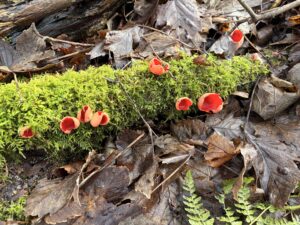
Kate catches sight of what she thinks may be a sparrowhawk. I am too slow to see it but hope that she is correct. Turning off the boardwalk, we encounter three of the roe deer on their morning walk. They stay close to us as we cross the bog and listen in as I tell Kate about the fencing and the pools and the tensions that occasionally arise here. We come across an abundance of scarlet elf cup fungus (Sarcoscypha austriaca), which grow on sticks and branches all along the south woods path. These striking red bowls are nestled on beds of spongy moss. They are the counterpoint to the primroses that are on sale round the corner.
As we circle back to our start point, I share my experiences of walking with people who have very different opinions on how this site should be managed. My approach has been to remain as neutral as I can so that I can listen and learn from others without imposing an agenda. Kate considers this for a while and formulates a response as we return to the main pathway by the station. She then offers a challenge to my neutrality, arguing that sometimes it is important to take a position on ecological injustice and environmental harm when it occurs.
What would I be prepared to say, now that I have come to know this place so well and spent so much time with people who live, work and visit here? Well, I certainly believe that the bog needs to be protected and that this is a shared responsibility. I also feel that there needs to be greater dialogue and more collaboration between those who manage and use the site. I subscribe strongly to the use of creativity and conversation in brokering these connections. And I support Robin Wall Kimmerer’s argument – brought to my attention by Ada – that land restoration also requires relationship building. Perhaps these are things that need to be said.
At the same time, I think that nurturing relationships with places like this happens by listening to each other and being open to alternative perspectives. I am consciously deferring the point when I attempt to speak for the site, or on behalf of those who have walked with me here. Some of the artists I have met, like Ellie and Deirdre, have shared a similar reticence. Kate understands this impulse but also sees it as a moral imperative to take a position on climate justice. We need to listen and move carefully, but also to acknowledge and articulate our starting points.
I feel that what I can offer to Lenzie Moss is my time and a careful attention to its ecology, as I stay so close to it through the seasons and over the years. Part of that is listening to and learning from the people who know this place well, along with those who are sharing my life here and those who visit from elsewhere, bringing new perspectives on peatlands and environmentalism more generally. For me, the gift of these walks is to step outside the institution where I work, to meet new people, encounter different worldviews, and to share experiences of this place. Part of the responsibility that comes with this is to be sensitive to the situations that my collaborators have joined me from – their ‘windows of tolerance’, their values and their contexts.