A cold breeze accompanies me to the station, where I meet my old friend Logan from the train. Logan and I were at university together in the early 2000s and she is now a Senior Lecturer in Contemporary Literature at the University of Sheffield. After 25 years in the UK, having moved here from Luxembourg, Logan has decided it is about time for her to seek British citizenship. Having spent much of her time in Berlin over the last few years – typically for more than the 90 days out of the country that is permitted for the application process to commence – she is staying in this country a lot more now and, I’m pleased to say, making more frequent visits to her beloved Glasgow. Logan is currently studying for her Life in the UK Test, and I wonder whether a walk round a centuries old peat bog might help. Probably not, but it should.
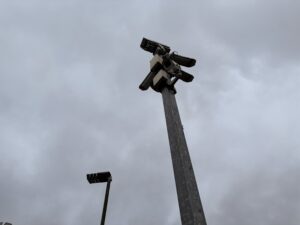
Logan writes about techno-cultures – the ways in which our cultural lives are shaped and determined by various technologies. As we walk through the station carpark, we note the cluster of CCTV cameras by the platform, which capture everyone who enters or leaves this corner of the Moss. While it might seem that we are free of surveillance as we take cover in the birchwood, our phones betray our positions, and we may also be visible to satellite technologies, capable of monitoring human activity from hundreds of miles away in low Earth orbit.
Technology is more present in our environments than we might assume. We cannot see the decades of heavy industry that extracted thousands of tonnes of peat from this place. But they have certainly shaped the landscape. Logan also points out that the way we see and understand the world is conditioned by our technological experiences. James L and I considered this as well, as we explored the postdigital bog. We bring a whole host of digital references, visual methods, images and narratives to all our encounters and excursions.
Logan tells me about one of the topics in the citizenship test. She has been learning about English country gardens and the famous landscape architects Lancelot ‘Capability’ Brown and Gertrude Jekyll, who respectively pioneered large-scale ‘naturalistic’ landscapes in the eighteenth century and Arts-and-Crafts-inspired horticultural aesthetics in the late nineteenth and early twentieth. Logan tells me that this is about the extent of the content on nature and environments. While the tests do also cover national parks and countryside care and responsibilities, the problem is that this rote learnt knowledge does nothing to create active, engaged citizens. Even if the environmental content was significantly increased, it is not clear how this would lead to ecological responsibility and sustainability action.
Some of the topics in the test have led Logan into further research. She has been reading T. M. Devine’s The Scottish Clearances and learning about the history of dispossessed people and radically altered countryside. Logan has discovered that sheep are not indigenous to this island. They were introduced by early Neolithic farmers, shipped in from the Near East as agriculture spread into Britain. Could there be anything more quintessentially British than sheep grazing on rolling green hills? Neither the livestock nor the fields were here 6000 years ago.
We look over to the Campsies and reflect on the lack of tree cover. Land has been cleared for farming and fuel, leaving only a few patches of woodland in the valleys and lower hillsides. This is another example of how our landscape has been shaped by technologies that have created a legacy of absence. The historical clearing of the Scottish lowlands might be considered as an extension of the great British gardening tradition. Our landscapes have been dominated and curated in various ways for longer than we have the capacity to remember.
We take the path across the bog and detour onto the central embankment to inspect the new sections of fencing. We can only go as far as the first, which effectively blocks the way with tall wooden slats. A few days ago I came here with Iona and Clyde and read a notice pinned to the fence:
help make space for nature
Please note – conservation works are ongoing in this area
A QR code directed us to NatureScot’s Pollinator Strategy for Scotland 2017-2027. It was not clear who the information was intended for, or what function it had here.
This sign has now been replaced with one that reads:
HELP PROTECT OUR PRECIOUS PEATLAND
We are working here to save the wildlife of Lenzie Moss
Please don’t walk on the bog
There are cartoon pictures of a skylark and a sundew. We are told that the bog is ‘crucial for ground nesting birds’ and ‘an important habitat for insect eating plants’. I hope that these facts and explanations will be enough to convince people of the necessity of these barriers, but I have seen evidence to the contrary in disgruntled posts on social media in recent days. We turn back to the main path, and I see the original sign – water damaged, ripped into pieces and discarded in the mud. I can’t be sure, but the action seems deliberate. I pick it up and we continue on our way.
We walk through the birchwood and come across another discarded item. A soggy notebook is leaning against a tree in such a way as to suggest it has been carefully placed there. On closer inspection, it is a child’s journal. There is a Komodo dragon on the front cover, rain-smudged pictures of mice and puppies inside, and a list of ‘things you can see’ in pencil on the back page: dogs, bird nests, tree stump, robin, fairy door, mushrooms, ruins. And the name Lily. Perhaps we have discovered a handbook for ecological citizenship.
I deliberate as to whether to leave the book in its place to be reunited with its owner, or to bring it with me to clear the site of more rubbish. Logan is ruthless in her recommendation to bin it, but I decide to keep it with the torn and blurred sign in my pocket. I will return with souvenirs from this walk (but if anyone reads this who lost a notebook in February 2026 and would like it back, I’d be most happy to return it!). Maybe we could check the CCTV for a little girl entering the Moss with a book in hand and returning an hour or so later without it.