Any views expressed within media held on this service are those of the contributors, should not be taken as approved or endorsed by the University, and do not necessarily reflect the views of the University in respect of any particular issue.

41. Kate

The currency in a gift economy is relationship, which is expressed as gratitude, as interdependence and the ongoing cycles of reciprocity.” (Robin Wall Kimmerer, The Serviceberry. Cited in Feminist Culture House, Windows of Tolerance).

Before we reach the Moss, Kate draws my attention to the pots of primroses outside the flower shop on the main street. They sit unassumingly in what is likely to be sphagnum moss peat. All of the items on display have ‘plant passports’, indicating that they have been imported from the Netherlands, where Kate lives when she is not in Scotland. Kate also suspects that they may be covered in pesticides. Despite passing this spot hundreds – maybe thousands – of times, I have not noticed the proximity of the international peat trade to a protected bog before. So, within seconds of meeting Kate for the first time, she has shown me something new and encouraged me to engage critically with my local environment.

The practice of using peat for commercial horticulture has only been popular for under a century, but today it is as commonplace as it is controversial. Recognising the environmental damage caused by peat extraction, the Scottish government recently ran a public consultation on ending its sale in this country. Promoting their campaign for the UK government to legislate to end peat sales, the Peat Free Partnership explains that ‘the horticulture industry has made encouraging progress in becoming peat-free, reducing usage of peat by over 50%’. However, they note that ‘the pace of change doesn’t match the urgency needed, and progress without legislation is slowing’. With ongoing extraction contracts in place for many years to come and international chains supplying shops like this, more action is needed.

Kate is an environmental artist, who has committed to support peatland restoration in this capacity and has worked on many related projects for over a decade. In a recent biography, she is described as being ‘part of a movement re-imagining connections people can make to peatlands’. Since 2016, Kate has convened Peat Cultures (Veencultuur), an ‘artist’s project highlighting diverse cultural values of peatlands’.

Kate’s artistic process stems from field-drawing and involves studio-based work. Her current projects include a series of ‘Peatland Figures’ that help her explore outmoded peatland paradigms and the process of shifting mindsets. These manifested initially as shadow puppets that inserted cultural considerations into scientific peatland research. More recently she started making glove puppets. For Kate, these figures ‘articulate unwelcome mindsets that I want to move away from, such as self-centredness, romanticism, denial, despair and complicity.’ But importantly, ‘they also make me laugh!’

Kate’s web of connections includes grassroots organisations, research centres and museums. She has worked with the Crichton Carbon Centre and several universities (she has a PhD in Social Policy and an MSc in interdisciplinary Creative Practice) and has campaigned for peat-free futures with Peatland Justice and as an older member of the youth-led collective, RE-PEAT, for whom she recently presented work at a collective show – Limbo – in the Netherlands. Kate knows a great deal about peatlands and how we should care for them, even though she says her knowledge is partial. There is a lot that I can learn from her.

At the top of Bea’s Path, we pause to discuss the ethics of my project. Gently and sensitively, Kate prompts me to consider the dynamic of this exchange. I will find out more about Kate’s work and benefit from her insights into places like the Moss, Kate will widen her experience of peatlands in Central Scotland, and we will both get to meet a new collaborator. But we are not here on an equal footing: I am a salaried academic, conducting these walks as part of my research time at the university where I work; Kate is a visiting freelance artist, who has generously given up her time and covered her own expenses. I have to confess that I have not given enough thought to this power imbalance and I am grateful to Kate for raising the issue. Kate recommends a book by Feminist Culture House, which offers Tools for Ideal Collaborations in an Unideal (Art) World. This introduces the idea that collaborators have different ‘windows of tolerance’ within which they can offer their time, their energies and their emotional investment.

My repeated circling of the Moss with friends, family and neighbours, as well as visiting scientists and artists, has always seemed to me to be a shared rather than an extractive experience – something that both parties will enjoy and benefit from in various ways. Kate agrees with this, saying that she greatly values the introduction to Lenzie Moss and the supportive exchange. But she adds that she and other independent artists, are often invited to contribute their experience or ideas only to find that they are the only unpaid person in the room. This project does not come with a research budget and Kate’s point is not a request for payment, but what are the other ways in which a reciprocal arrangement can be ensured? I carry this open question with me as we walk.

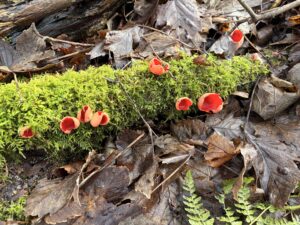
Kate catches sight of what she thinks may be a sparrowhawk. I am too slow to see it but hope that she is correct. Turning off the boardwalk, we encounter three of the roe deer on their morning walk. They stay close to us as we cross the bog and listen in as I tell Kate about the fencing and the pools and the tensions that occasionally arise here. We come across an abundance of scarlet elf cup fungus (Sarcoscypha austriaca), which grow on sticks and branches all along the south woods path. These striking red bowls are nestled on beds of spongy moss. They are the counterpoint to the primroses that are on sale round the corner.

As we circle back to our start point, I share my experiences of walking with people who have very different opinions on how this site should be managed. My approach has been to remain as neutral as I can so that I can listen and learn from others without imposing an agenda. Kate considers this for a while and formulates a response as we return to the main pathway by the station. She then offers a challenge to my neutrality, arguing that sometimes it is important to take a position on ecological injustice and environmental harm when it occurs.

What would I be prepared to say, now that I have come to know this place so well and spent so much time with people who live, work and visit here? Well, I certainly believe that the bog needs to be protected and that this is a shared responsibility. I also feel that there needs to be greater dialogue and more collaboration between those who manage and use the site. I subscribe strongly to the use of creativity and conversation in brokering these connections. And I support Robin Wall Kimmerer’s argument, brought to my attention by Ada, that land restoration also requires relationship building. Perhaps these are things that need to be said.

At the same time, I think that nurturing relationships with places like this happens by listening to each other and being open to alternative perspectives. I am consciously deferring the point when I attempt to speak for the site, or on behalf of those who have walked with me here. Some of the artists I have met, like Ellie and Deirdre, have shared a similar reticence. Kate understands this impulse but also sees it as a moral imperative to take a position on climate justice. We need to listen and move carefully, but also to acknowledge and articulate our starting points.

I feel that what I can offer to Lenzie Moss is my time and a careful attention to its ecology, as I stay so close to it through the seasons and over the years. Part of that is listening to and learning from the people who know this place well, along with those who are sharing my life here and those who visit from elsewhere, bringing new perspectives on peatlands and environmentalism more generally. For me, the gift of these walks is to step outside the institution where I work, to meet new people, encounter different worldviews, and to share experiences of this place. Part of the responsibility that comes with this is to be sensitive to the situations that my collaborators have joined me from – their ‘windows of tolerance’, their values and their contexts.
40. Gary

I have only a few reasons to keep on running, and a truckload of them to quit. All I can do is keep those few reasons nicely polished. (Haruki Murakami, What I Talk About When I Talk About Running)

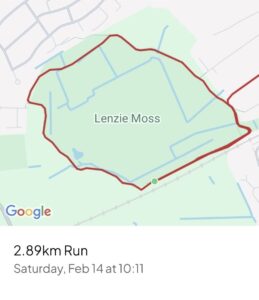
My good friend Gary is visiting today and we plan to go for a run, followed by brunch. Gary is organising a 10k for his work colleagues next week and he is behind in his training. A couple of weeks ago, we both set off from my house on my usual 7.5km route. We ran clockwise round the Moss and across the football pitches to Boghead Wood. From there, we followed Christine’s Way to the canal and jogged through the centre of Kirkintilloch to Luggie Park. Passing the leisure centre, we ran down to Whitegates Park and then back along the residential streets to complete the loop. The route has over 100 meters elevation gain, which is equivalent to an extra kilometre of effort. I have been forcing myself to do it every week this year, along with a shorter run such as the 5k parkrun at Drumpellier Park, which I attended for the first time last week. I have also been out with the recently formed Lenzie Running Club, which circles the Moss on occasional Sunday mornings. New year, new me.

Lenzie Moss is perfect for gentle running. It has nice wide paths free of obstacles and no hills. We therefore decide to stick to the Moss today. It has been very cold overnight (Gary sent me a screenshot showing that it was -4°C when he woke up). But it doesn’t feel too bad as we set off, and the pavement is free of ice, which was our main concern. Gary starts his Map my Run app as we leave my house and turn left onto Bea’s Path.

For two laps, we maintain a steady pace. There are several people out running this morning, and we see some of them more than once as they pass us in the opposite direction. There is a certain quality to the greetings exchanged between joggers: an encouraging nod and a half-smile of solidarity.

Neither Gary nor I are natural runners. I don’t think either of us even enjoy it, to be honest. Unlike the marathon-running novelist Haruki Murakami (of whom we are both fans), we don’t run as a habit or a daily ritual. Every outing requires an effort of will. But thankfully, we have enough reasons to keep on running. I suppose that chief most among them is the need to stay healthy as we reach our mid-forties. I may be maintaining a weekly run at the moment, but experience tells me that this pattern is easily broken. If a busy work week or a bad cold or a holiday gets in the way and causes me to miss a week, then the motivation evaporates and I give up on my streak. The trick is to keep doing it, then.

As we run, Gary’s app alerts us to each kilometre that we reach. We agree that we will run continuously until we reach the sixth. This happens just short of the bottom of the boardwalk on the south woods path. At this point, we about-turn and switch to a walk. It feels good to have pushed ourselves and while our pace has not been particularly impressive (even by our standards), we both feel a sense of achievement. Gary checks our distance and time on his phone and restarts the app.

As we switch direction and gait, I sense our attention shift to the landscape around us rather than the pathway ahead. We pass many dog walkers and several families with warmly wrapped children running off to explore the woodland. Magpies hop behind the grasses, which glimmer in the frost.

I tell Gary about the local running club that I have enjoyed being part of. For the last two runs, I have taken Ruairidh with me. The first time, he ran twice round the Moss at a surprising pace, beating most of the adults back to Billington’s for hot chocolate. Last Sunday, he set off even faster, staying in the lead for half of the first lap. At the top of the boardwalk, he looked back to me, red faced and exhausted and not willing to run any further. I think this hard-won lesson about pacing will serve him well for tomorrow’s run.

Gary’s eye is drawn to the silver birch, glinting in the bright winter sun. He notices that some have been felled or damaged in storms and it reminds him of a time in Sri Lanka, when he visited a forest that had apparently been flattened by elephants. My own point of reference is closer to home, and I tell Gary about my visits to a beaver reintroduction project at Bamff Estate in Perthshire, where the water has spread into the woodland, bringing down tens of trees. One summer night, I stayed in a lodge beside the main dam and walked along the river just before midnight, accompanied by beavers swimming alongside me.

We pick up the pace again and jog along the north woods path, only walking again as we leave the path through the trees and look out across the bog. A couple of days ago, the Campsies were covered in snow. Today, there are only remnants on the tops. Gary grew up in the nearby town of Kilsyth, at the foot of these hills, so he knows the geography here. He points out the snow-capped peak of Meikle Bin and tells me that his elderly aunt always used to say that she would climb it one day but never did and is now too frail. I suggest that we should do it on her behalf some time.

Gary and I have climbed far higher than Meikle Bin, although we realise with alarm that we haven’t been hiking together for years. Even longer ago, we started to bag Munros, and managed several, including Beinn na Lap, where Steve recently completed his 282nd mountain adventure. Our best made plans never went very far, diverted as we were – and frequently still are – by travel, pubs and restaurants. Being outside together and looking out to the hills on such a fine winter’s day puts us both back in the mood for adventures and we agree to make time for them this year.

We run for the final section back to my house. This walk-run alternation makes this particular circle the quickest of the 40 that I have done so far (at 24 minutes 17 seconds) and the only one that isn’t entirely walked. But despite the speed with which we have moved along, we have enjoyed being in each others company this morning. Running with a friend is about making time for each other, catching up and hatching plans. It is also about achieving something together and rewarding that achievement, which is another very good reason to keep on running. We head off for our reward now with a visit to Billington’s for a well-earned beer and a breakfast roll.

39. Logan

A cold breeze accompanies me to the station, where I meet my old friend Logan from the train. Logan and I were at university together in the early 2000s and she is now a Senior Lecturer in Contemporary Literature at the University of Sheffield. After 25 years in the UK, having moved here from Luxembourg, Logan has decided it is about time for her to seek British citizenship. Having spent much of her time in Berlin over the last few years – typically for more than the 90 days that is permitted – she is staying in this country a lot more now and, I’m pleased to say, making more frequent visits to her beloved Glasgow. Logan is currently studying for her Life in the UK Test, and I wonder whether a walk round a centuries old peat bog might help. Probably not, but it should.

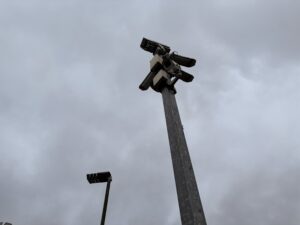
Logan writes about techno-cultures – the ways in which our cultural lives are shaped and determined by various technologies. As we walk through the station carpark, we note the cluster of CCTV cameras by the platform, which capture everyone who enters or leaves this corner of the Moss. While it might seem that we are free of surveillance as we take cover in the birchwood, our phones betray our positions, and we may also be visible to satellite technologies, capable of monitoring human activity from hundreds of miles away in low Earth orbit.

Technology is more present in our environments than we might assume. We cannot see the decades of heavy industry that extracted thousands of tonnes of peat from this place. But they have certainly shaped the landscape. Logan also points out that the way we see and understand the world is conditioned by our technological experiences. James L and I considered this as well, as we explored the postdigital bog. We bring a whole host of digital references, visual methods, images and narratives to all our encounters and excursions.

Logan tells me about one of the topics in the citizenship test. She has been learning about English country gardens and the famous landscape architects Lancelot ‘Capability’ Brown and Gertrude Jekyll, who respectively pioneered large-scale ‘naturalistic’ landscapes in the eighteenth century and Arts-and-Crafts-inspired horticultural aesthetics in the late nineteenth and early twentieth. Logan tells me that this is about the extent of the content on nature and environments. While the tests do also cover national parks and countryside care and responsibilities, the problem is that this rote learnt knowledge does nothing to create active, engaged citizens. Even if the environmental content was significantly increased, it is not clear how this would lead to ecological responsibility and sustainability action.

Some of the topics in the test have led Logan into further research. She has been reading T. M. Devine’s The Scottish Clearances and learning about the history of dispossessed people and radically altered countryside. Logan has discovered that sheep are not indigenous to this island. They were introduced by early Neolithic farmers, shipped in from the Near East as agriculture spread into Britain. Could there be anything more quintessentially British than sheep grazing on rolling green hills? Neither the livestock nor the fields were here 6000 years ago.

We look over to the Campsies and reflect on the lack of tree cover. Land has been cleared for farming and fuel, leaving only a few patches of woodland in the valleys and lower hillsides. This is another example of how our landscape has been shaped by technologies that have created a legacy of absence. The historical clearing of the Scottish lowlands might be considered as an extension of the great British gardening tradition. Our landscapes have been dominated and curated in various ways for longer than we have the capacity to remember.

We take the path across the bog and detour onto the central embankment to inspect the new sections of fencing. We can only go as far as the first, which effectively blocks the way with tall wooden slats. A few days ago I came here with Iona and Clyde and read a notice pinned to the fence:

help make space for nature
Please note – conservation works are ongoing in this area

A QR code directed us to NatureScot’s Pollinator Strategy for Scotland 2017-2027. It was not clear who the information was intended for, or what function it had here.

This sign has now been replaced with one that reads:

HELP PROTECT OUR PRECIOUS PEATLAND
We are working here to save the wildlife of Lenzie Moss
Please don’t walk on the bog

There are cartoon pictures of a skylark and a sundew. We are told that the bog is ‘crucial for ground nesting birds’ and ‘an important habitat for insect eating plants’. I hope that these facts and explanations will be enough to convince people of the necessity of these barriers, but I have seen evidence to the contrary in disgruntled posts on social media in recent days. We turn back to the main path, and I see the original sign – water damaged, ripped into pieces and discarded in the mud. I can’t be sure, but the action seems deliberate. I pick it up and we continue on our way.

We walk through the birchwood and come across another discarded item. A soggy notebook is leaning against a tree in such a way as to suggest it has been carefully placed there. On closer inspection, it is a child’s journal. There is a Komodo dragon on the front cover, rain-smudged pictures of mice and puppies inside, and a list of ‘things you can see’ in pencil on the back page: dogs, bird nests, tree stump, robin, fairy door, mushrooms, ruins. And the name Lily. Perhaps we have discovered a handbook for ecological citizenship.

I deliberate as to whether to leave the book in its place to be reunited with its owner, or to bring it with me to clear the site of more rubbish. Logan is ruthless in her recommendation to bin it, but I decide to keep it with the torn and blurred sign in my pocket. I will return with souvenirs from this walk (but if anyone reads this who lost a notebook in February 2026 and would like it back, I’d be most happy to return it!). Maybe we could check the CCTV for a little girl entering the Moss with a book in hand and returning an hour or so later without it.

css.php

Report this page

To report inappropriate content on this page, please use the form below. Upon receiving your report, we will be in touch as per the Take Down Policy of the service.

Please note that personal data collected through this form is used and stored for the purposes of processing this report and communication with you.

If you are unable to report a concern about content via this form please contact the Service Owner.

Please enter an email address you wish to be contacted on. Please describe the unacceptable content in sufficient detail to allow us to locate it, and why you consider it to be unacceptable.
By submitting this report, you accept that it is accurate and that fraudulent or nuisance complaints may result in action by the University.

  Cancel