A couple of months ago, as I was busy reprimanding Clyde for something or other, I was greeted by a couple at the end of my street on their way onto the Moss. They introduced themselves as Tony and Julia and they recognised Clyde from my blog, so surmised that I must be David. Apart from my delight at this moment of very local fame, I was pleased to meet more of my neighbours. Of course, I opportunistically asked if they would be interested in joining me on a walk, and they agreed.
*
We meet on a cloudy Friday morning outside Julia and Tony’s home. I will walk with Julia later in the year, but today is Tony’s turn. Tony is a widely published haiku poet, who often takes his inspiration from very regular ‘orbits’ of Lenzie Moss. He soon corrects my commonly held misconception that haiku always use the five-seven-five syllable format. Tony will read some of his poems as we walk, and I will learn that there is leniency in the length (most poets now average 10-12 syllables). But there are still rules. Haiku are brief impressions of the world, grounded in direct observation, they use cuts or shifts in perception, rather than continuous sentences, and they avoid similes and metaphors. But to use a metaphor, haiku are pebbles cast into the reader’s mind.
I think about the rules that have emerged for my walks, such as traveling in the same direction and only walking with one person at a time. I am breaking one of these today, for a particular reason, and learning that rules are not always appropriate. Julia will accompany us on this walk. This is because Tony has been sight-impaired since birth and is now certified legally blind. He tells me that like about 90% of blind people, he has some sight, but that ‘life is a veritable blur!’ Julia will look out for any obstacles. She says she will let Tony do most of the talking, but I am also hoping to benefit from her keen interest in the birdlife here, which has become very active in recent weeks. And I will look forward to talking more with Julia on another occasion.
As we turn onto the Moss, I check it’s okay to walk anticlockwise and, because of Tony’s reliance on regular patterns and features of the landscape, he says that we really have to. Tony tells me that his blindness is not only limiting: it heightens his perception and focusses his attention to other ways of knowing and being in the world. He feels the earth with his feet, attends closely to the sounds of the birds, and leans into the wind. Perhaps the haiku is the best way to capture and share this experience, creating intense encounters that reward careful attention. We turn off Bea’s Path and pause by the pools that I saw were dried out on my first walk, but which are now full of water. Tony reads the first haiku of the morning (they are typically read twice):
midsummer
neither a tadpole
nor a frog
Caught in an in-between state, like we are at the end of January as the first tentative shoots start to appear, and the birds test their voices. Tony writes many, many haiku – a few every day. These are often in response to a specific location, so they will structure our walk round the Moss today.
We walk along the north woods path and listen for the birds. Julia lists those that they have encountered here, and many of them I have yet to see: swallows, swifts, cuckoos, treecreepers, linnets, skylarks… The latter I had been told were no longer here, but Julia says she saw them last summer. Tony has written about almost all of the birds that Julia mentions.
On the boardwalk, Tony reads another poem:
barely light
breaking ice
on the boardwalk
This resonates with my walks here. I remember the ‘barely light’ 6am visit with Cathy and ‘breaking ice’ with Minnie. Tony likes this part of the Moss for its openness and exposure to the elements, and for the cottongrass:
the wind
in every fibre
cottongrass
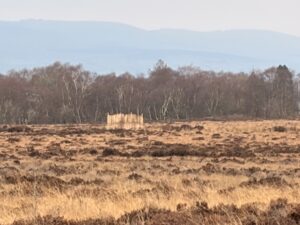
The white seedheads of the bog cotton, which I noticed in May with Ruairidh, won’t be back for a few months now. There has been a new addition to the bog today, though. A couple of conspicuous sections of fencing have appeared in the centre of the Moss, standing out against the subtle colours of the mire. I wonder whether these are to protect bog rosemary, which is rare and precious here, and could quite easily be snapped up by the resident roes. All three of us feel ambivalent about this intervention and I am sure that there will be others who are strongly opposed. I suspect that they won’t be intact for long.
Having lived in Lenzie for almost three decades and learnt about the history of peat cutting on the Moss, Tony is conscious of the damage that has been done here:
peatland
after fifty years
the scars still show
These scars are there in the striation of the landscape, the fragility of the ground, and the shallowness of the peat. When I walked with Kat, the satellite images that we looked at showed these marks very clearly. Julia and Tony are very supportive of the need to protect a place like this, but they also feel that the right balance has to be found and suggest that it is easy to over-manage the land.
We walk back along the pathway that runs alongside the railway line. Moss grows up the birch trees:
moss…
the quietest
of revolutions
I tell Tony and Julia that I am the chair of the board of trustees for James O’s Humanist charity, which happens to be called A Quiet Revolution. One of their key charitable activities is tree planting, so they are creating more habitats for the birds and the moss:
treecreeper
helter-skelter
up the mossy trunk
We pass the tree that I noticed with Linsey, which was decorated for Christmas. The tinsel has been dislodged, and nobody has returned to tidy up. But the other visible icon of the festive season still grows strong:
holly leaves
as if this winter
never happened
In haiku, I am told, flora, fauna and seasonal references ‘do the heavy lifting’. But haiku are only complete in the moment of listening or reading. They are the opening of a conversation, an act of co-creation. I have written about performance in similar terms and through this project, have come to think about walking in the same way, too.
We return to our street and spend some time chatting, then Tony and Julia return home and I head back to my desk for the rest of the day. I find it hard to switch back into office mode. Little sparks of verse fire around my head. The Moss has been rendered in a new light for me today. From the shapes and the brightness, something very clear has emerged.