Any views expressed within media held on this service are those of the contributors, should not be taken as approved or endorsed by the University, and do not necessarily reflect the views of the University in respect of any particular issue.

36. Ruby

The first place you ever knew was warm and wild and wet
And in that dark womb you grew
We are all bog born

(Karine Polwart, We are all bog born)

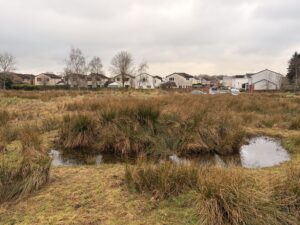
It has rained heavily overnight but this morning the sun is shining brightly through the clouds and the whole place sparkles. It feels like a good day for my second chance to walk with Ruby. She should have been the 19th walker to circle the Moss with me, but as I confessed to Ellie, who took that place instead, I missed my appointment earlier that morning. This cost Ruby a wasted trip all the way from her home near the Pentlands, just south of Edinburgh. Graciously, Ruby has returned today, and I couldn’t be more thankful. I meet her by her car at the far end of the station carpark. As we set off, I notice that a fairy door has appeared in a birch tree.

This isn’t quite Ruby’s first visit to Lenzie Moss, then. When she made the trip to meet me back in October, having realised that I wasn’t going to show up, she ventured some way onto the Moss. This will be her first full circle though. One major difference from three months ago is the birdsong that we encounter. Today, there are robins, great and blue tits, jackdaws, dunnocks and goldfinches soundtracking our walk. It feels like a spring morning, although we are still in the middle of winter.

Ruby recently returned to higher education after a decade working for NGOs, first in human rights and aid, and more recently in climate. She continues to work as a fundraiser for Friends of the Earth Scotland, but is now in the final stage of her MSc in Environment, Culture and Society at the University of Edinburgh. Ruby tells me of a recent fieldtrip with her class to Fala Moor in Midlothian, where they met the Scottish folk artist Karine Polwart. They explored soundscapes and field recordings and responded creatively to the bog.

I have seen Karine Polwart perform as part of the Spell Songs ensemble, a musical response to Robert Macfarlane and Jackie Morris’s book, The Lost Words, which conjures up ‘acrostic spell-poems’ by Macfarlane, illustrated by Morris. These poems are a way of rescuing words about the natural world, which are slowly disappearing from our children’s vocabularies. I have a print of Morris’ goldfinches on my bedroom wall and their gilded flight is the first thing I see each day. The spell songs are like stepping through a fairy door into the world that was already around us.

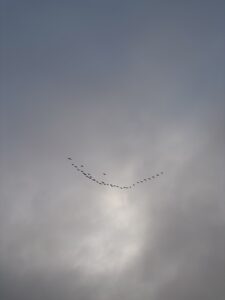
Ruby tells me that she has had a tough week in her studies. They are at the stage of pitching and refining their dissertation projects and Ruby has experienced something of an awakening to the scale and scope of research that is achievable. She is having to redesign her project and let go of some of the aspirations and ideas that had made it feel exciting. Ruby understands that this is part of the process and recognises that her master’s dissertation is the start of something that she can continue to develop in other places and contexts. But nevertheless, it is a difficult moment. Ruby values the opportunity to explore Lenzie Moss today and says ‘it will help me get out of my head’. A flock of pink-footed geese arches overhead.

Ruby has always had a strong connection to landscapes and environments. She grew up in Ecuador, moving to Speyside in Scotland at the age of ten. Her father was a geologist in the Ecuadorian mining industry. Ruby learned to snorkel when she was two and has always felt drawn to watery worlds. She says that all her formative memories are bound up in the places she has lived. At the same time, Ruby is concerned with extractive relationships with places. There is a clear connection between her childhood experiences and the work she is now doing.

All these concerns have informed Ruby’s research plans. She has been inspired by the More-Than-Human Life (MOTH) Program, the ‘interdisciplinary initiative advancing rights and well-being for humans, nonhumans, and the web of life that sustains us all’. The MOTH Program is informed by Ecuador’s pioneering rights of nature legal framework – especially the landmark 2021 Constitutional Court ruling that established legal rights for the Los Cedros cloud forest. They have also contributed to collaborative projects with Ecuadorian Indigenous communities, such as the Sarayaku people of the Amazon, whose activism has been central to these new laws. One of the key members of the collective is Robert Macfarlane, whose latest book, Is a River Alive? asks whether a rivers are living entities, which should be recognised as such, legally and imaginatively.

Ruby’s connections with this collective have led her to seek out other examples of rights of nature projects, such as the Embassy of the North Sea, an initiative based in the Netherlands that aims to listen to and act on behalf of the sea. Their mission statement is ‘to emancipate the North Sea in all its diversity as a fully fledged political player, via collectives of humans and non-humans’. Ruby has been inspired by the activism and creativity of organisations such as this. She now wants to explore the possibility of such a project in Scottish waters. Could the seabed have legal rights? Could human and more-than-human communities work together to protect the environment? How could we build sustainable futures for all? These are big questions and I now understand how Ruby’s plans for a masters dissertation may have been too ambitious.

As we walk, Ruby collects litter. I notice her almost unconsciously picking up a coffee cup lid and a crisp packet. When I ask her about this, she says that she does it all the time. She recently purchased a grabber stick, which she uses to tidy the woodland area behind her flat. Ruby says that removing litter is a way of caring for the land, which for her is vital. I tell her about Kyriaki’s artistic practice and recall retrieving a discarded drinks can from the Moss, which she planned to use in an artwork. I wonder what became of that found aluminium – whether it was melted down and recast.

As we complete our circle, we spend some time balancing on the foundations of the old peat plant. Ruby says this is what she would have done as a child. She notes the mature birch trees that are growing from the centre of the building. They have the right to do that, I think. And thanks to the work of Macfarlane and others, we now have the language to assert that right. I recall some words that Karine Polwart sang:

Enter the wild with care, my love, and speak the things you see
Let new names take and root and thrive and grow

(Spell Songs ensemble, Lost Words Blessing)

35. Eddie

For the first walk of 2026, I am joined by Eddie, an engagement officer at Archaeology Scotland. Eddie is preparing to lead some fieldtrips at Lenzie Moss with pupils at the local secondary school, Lenzie Academy. He has studied maps of the area, searched the archives, and planned locations for augering (a method of core sampling, similar to the coring method that Phil G told me about). But this is Eddie’s first visit to the site. It is a valuable opportunity for him to plan the visits for later in the year, when the weather will hopefully be more agreeable than this cold, wet day.

Eddie is working on a large-scale project known as the Clyde Valley Archaeological Research Framework (CVARF). Eddie’s job is to work with the local authorities in the Clyde River catchment to ensure public engagement with the project. Lenzie is part of East Dunbartonshire, but there will also be workshops and fieldtrips exploring the archaeology of the Clyde in East Renfrewshire, Glasgow City, Inverclyde, North Lanarkshire, Renfrewshire, South Lanarkshire and West Dunbartonshire. Together, over a third of Scotland’s population live in these areas.

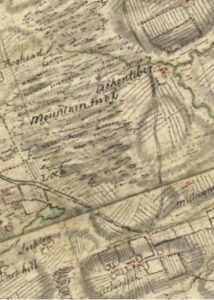
As we walk from the station up Bea’s Path, Eddie tells me what he has discovered so far. He mentions the Roy Military Survey of Scotland, an extensive survey of Scotland’s landscape between 1747-1755. A hundred years or so before the modern Lenzie was built, it is possible to see that the bog reached further and connected with other wetland areas. The trainline was constructed in the 1830s and 40s, cutting through the landscape and soon bringing further building (including my house on the new Fern Avenue some time around 1870, when Jane Vary Campbell and David Sinclair Campbell may have been the first occupants). Lenzie Moss became demarcated, boxed in, and separated.

Eddie will share this mapping exercise with S3 pupils – fourteen- and fifteen-year-old’s in their third year of Scottish secondary education. Prior to their fieldtrip to the Moss, they will also learn about some of the things that have been found in local bogs. These include the Cambusnethan bog body, found in North Lanarkshire in 1932, and initially believed to be a 17th-century Presbyterian Covenanter; and the Peelhill horde, the discovery of Late Bronze Age weapons at a site in South Lanarkshire in 1961, which were most likely buried ritualistically after a battle. While the bog body may in fact have been a murder victim, who died some years later than originally thought, both cases raise questions about the ways that bogs have been used throughout history as spaces of transition, between life and death, our world and the next.

I tell Eddie what I know about a gruesome discovery on Lenzie Moss, recounted in Bill Black’s excellent history of ‘Peat Extraction on Lenzie Moss’:

[Colin Graham] was on the moss about 400 yards west of Moncrieff Avenue on Wednesday [7th] July 1880. He had dug down about 4 feet when, suddenly, he exposed a human head, partially preserved, including the hair. When it was extracted it was identified as that of a female but further exploration around the area by the police failed to produce the remainder of the body. The victim was never identified, although it was suggested it might be that of a domestic servant, employed some years earlier by Mr Lang at Gallowhill House. She had disappeared without explanation, a fact confirmed by Lang, but in circumstances that were described as ‘suspicious.’

I imagine myself in the position of a teenager learning all this and then being invited to explore the local peatland. Perhaps they will hope to make a discovery of their own, whether grisly or golden.

When Eddie and the school groups extract samples from this site, they will look at the different layers and see how the differences in the peat indicate how long the bog has been forming, whether accumulation has slowed due to drainage and extraction, and how the site has been used for fuel, grazing, or industrial use. They will consider the different proxies that can be measured, such as Phil’s pollen analysis and Meike’s data on elemental composition. Eddie has a real passion for ‘weird watery places’ like this, and I can see how this enthusiasm makes him the ideal person to inspire young people about our local peatlands. Eddie reminds me that Lenzie Moss is a tiny fragment of what was once a wide-reaching area of lowland bogs.

We head onto the bog path and walk a short way into the centre of the Moss. Eddie tells me about the survey he is currently undertaking of Rannoch Moor in the Scottish Highlands. He spends days poring over satellite images of the site, identifying evidence of different activities and infrastructure, such as grazing, sheilings, and charcoal burning platforms. Eddie wants to counter the idea that places like this are ‘wicked wild wastes’, by developing archaeological narratives about moors and bogs. Rannoch Moor has been mentioned a few times on these walks. Like Michael, I think of Lenzie Moss as a miniature landscape that recalls the vast expanse of Rannoch. Despite the difference in scale, both places have complex histories of use and inhabitation.

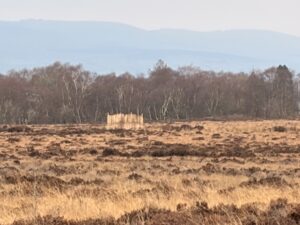
We reach the southeast woodland and make our way through the trees to the ruins. I’m sure that Eddie will have some thoughts about the old buildings. I have always assumed that the concrete platform that I have explored with Meike and others, was part of the light railway that was used for the peat extraction industry. Eddie agrees that this is likely and says it would be easy to confirm that by checking the plans for the site. While he is careful to frame his response as purely speculative, Eddie offers an alternative theory. He tells me that during the Second World War, a number of fake townships were created by positioning lights in rural areas away from major urban centres, in an effort to trick the Luftwaffe into wasting their bombs. Whenever large concrete platforms are located in places like this, that is always a possibility. Alternatively, as the Moss was an important location for fuel and close to the railway line, this could be the base of a barrage balloon, the gas-filled deterrents of low-flying aircraft, which could be brought down by the steel cabling tethering them to their concrete bases. While these theories might not be accurate in this case, I will now be on the search for such structures on future walks.

We exit the Moss into the station carpark and pass the Nature Reserve notice board, with the Friends of Lenzie Moss map of the site. After walking through history with Eddie, I am reminded that the current layout is only a snapshot in time. Bogs are often thought of archives of past events, whose traces are preserved for generations. Pollen, metals, artefacts and the dead are buried deep in the ground and are later discovered by farmers, peat extractors and archaeologists. But bogs have futures too. If we can teach young people about them now, then there will be people to care about them, visit them and stay close to them as they change along with the next generation.

css.php

Report this page

To report inappropriate content on this page, please use the form below. Upon receiving your report, we will be in touch as per the Take Down Policy of the service.

Please note that personal data collected through this form is used and stored for the purposes of processing this report and communication with you.

If you are unable to report a concern about content via this form please contact the Service Owner.

Please enter an email address you wish to be contacted on. Please describe the unacceptable content in sufficient detail to allow us to locate it, and why you consider it to be unacceptable.
By submitting this report, you accept that it is accurate and that fraudulent or nuisance complaints may result in action by the University.

  Cancel