From shared beginnings, my younger brother Phil and I have taken quite different paths through life. Phil went to university in Sheffield, as did my sister, so they were always closer to our family home in Derbyshire. Since I moved to Scotland 25 years ago, we have not spent huge amounts of time together, and when we have it has generally been during gatherings with the rest of the family. Phil now works as a finance director for a large outsourcing company in London, where he recently relocated. He has a very busy social life and travels a lot with friends and through work (recent trips include India, South America and Svalbard). There have been very few times when it has just been the two of us, but as Phil is the first to arrive to Lenzie for Christmas this year, we have a few hours together on the morning of Christmas Eve. He is keen to join me for a walk round the Moss before the rest of the family start to appear.
Phil arrived by train from London late last night and we shared some cheese and wine and caught up before bed. He is not yet officially on holiday and today he has ‘a big deal to tie up’ before he can switch off from work. He is receiving emails from the second he wakes up. Our walk will have to be early and relatively quick, and then we will set up an office space for him in his nephew’s bedroom. By tomorrow, there will be several people and dogs here.
We join the Moss at the end of Fern Avenue, and I notice the smell of gas once again. I phoned the National Gas Emergency Service when I walked by yesterday morning and there were engineers in and out of my neighbours’ houses for the rest of the day. I can’t help but feel guilty that one of them is now without a working boiler, meaning that they might be missing heating or an oven over Christmas. But as my brother rightly points out, I would feel a lot worse if I hadn’t called it in and there had been an accident.
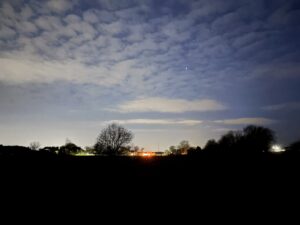
We step away from domestic infrastructure, and into the darkness of Bea’s Path. It is strikingly quiet and we talk with hushed voices. But it is also busier than expected and we encounter a parade of walkers, some presumably commuting to the station and others with dogs. We see the blinding torchlight first, moving unpredictably through the blackness and difficult to gauge for speed or distance. Then a mumbled or nodded greeting as they pass. When I took an early morning walk with Cathy, it was midsummer and the sun had risen long before we set off. Greetings were much warmer then, but now it seems that nobody is ready or able to connect.
Along the north woods path, the lights from the houses remind us that we are never far from human inhabitations. Phil has recently moved to Putney, and he is close to a number of large green spaces – Putney Common, Richmond Park and Wimbledon Common. These spaces are important to him and offer a valuable escape from a frenetic urban life. He walks and runs in these parks and says that in places, it feels like you are in the middle of the Peak District. He mentions Richmond’s red and fallow deer, and I tell him about Lenzie’s roes.
My brother knows a lot about deer. His friend is a professional deer stalker, and Phil has often joined him on shoots. Phil even completed a qualification last year, so has a lot of current knowledge of deer management and ecology. His friend has recently taken a new post at Kielder Forest in Northumberland and is busy culling twenty per cent of the herds there. Phil hopes to join him there in the next few weeks.
I have been entirely convinced of the need to manage deer in this way. Deer have huge impacts on the environment, preventing the regeneration of woodland and limiting biodiversity. In the absence of natural predators such as wolves or lynx, their numbers have to be controlled by shooting, which is the only viable way of managing populations at scale. I am very sure that Phil practices deer stalking with the utmost care and responsibility. I am equally sure that it is something I will never choose to do.
Phil talks about the quality of time he now spends in the outdoors through this hobby. He says that looking for something in the landscape means slowing down and attending to the environment in a different way. He talks about sitting and waiting at dawn or dusk, alert to the slightest change and witness to birds and animals’ movements in time and space. These are the things that matter to him. I think of what Jill told me about peat cutting on Lewis: that people who extract peat there know how to do it sustainably and maintain a deep respect for the land. These ostensibly violent practices of rural life – cutting, shooting, culling – can foster a much greater sense of care and responsibility than is usually found in urban and peri-urban green spaces.
Phil has not come prepared for a muddy walk round the Moss (he has travelled light as his next stop is Marrakesh). He opts for the south wood path rather than trekking across the bog. As the sky lightens, we watch the trains speeding past on their way to Edinburgh, notably emptier than usual but still transporting those busy professionals who need to tie up their various deals on Christmas Eve. Phil also needs to get back to the laptop. I will prepare for my parents and children arriving while he works, and we will all be sitting round the kitchen table before the day returns to darkness.
While we have circled the Moss more quickly than I am accustomed to on these walks, it hasn’t felt rushed. We have still been able to slow down, attune to the environment, and take notice of the changing light. It strikes me that what I am doing through this project is deepening my connection with this place, getting to know it better, learning to read the landscape and know its patterns and cycles. Phil and I might do things differently sometimes, and our journeys might take us in different directions, and play out at different speeds and scales, but as I complete my early morning walk with my brother on Christmas Eve, I am reminded, and reassured, that we share the same values.