The station carpark is full when I meet Meike, so I jump in her car, and we find a spot by the entrance to the Moss on Heath Avenue. This is Meike’s first visit to Lenzie, but she has a long-standing connection to peatlands. She is a researcher at the University of Glasgow, where she conducts interdisciplinary research in archaeology and soil health. Like Phil, I was introduced to Meike’s work when she presented at the Peat Café. Today, I will learn about soil science, peat formation, and X-ray fluorescence.
Meike asks me about this project: what I’m doing it for, how long it will take, what I will do with all the data. I assume that I have some convincing to do about slower, exploratory ways of working. But Meike understands completely. She talks about the ways in which universities prioritise productivity at the expense of creativity. Like the artists I have walked with recently, Meike values the time it takes to become part of an environment. I suggest that working at a bog meets this impulse to slow down with its muddy, meandering pathways. Meike says that she ‘absolutely loves bogs’ and tells me of others that she has come to know, including those in her home country of the Netherlands.
From the city of Delft, Meike spent time in York and on the Orkney Islands, before securing a PhD position at Glasgow. She remembers watching the television series Monarch of the Glen when she was growing up, and says she imagined living here ever since. Her love of the Scottish countryside is now informing her work. As an archaeologist, Meike looks for differences in the landscape. She investigates past usages and uncovers evidence of settlement or agriculture. While her methods are technical and precise, she also recognises the importance of story. This bringing together of data and narrative, analysis and interpretation, is not always easy.
I ask Meike about her methods. She uses something called PXRF (Portable X-ray fluorescence), which involves using a hand-held device to take readings from core samples. This returns data, which indicate the elemental composition of the soil. There are different readings for bohrium or zinc, for example. High levels of titanium can indicate an influx of ‘detrital input’, which might occur due to erosion of loose soil caused by ploughing. In this way, Meike asks to what extent past human activities have remained measurable. Soil health tells a story of rapid industrialisation, agricultural expansion, and shifting farming practices.
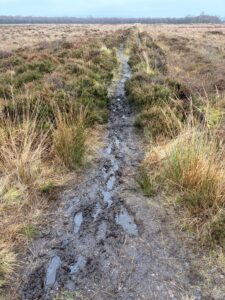
We walk along the path across the bog (Meike is unfazed by, if not drawn to, the mud). The recent rainfall has highlighted the deep footprints that are sunk into the raised pathway. I tell Meike all about the tensions I am discovering around access and land management. Meike understands the need to prevent access, and she talks about the dichotomy of individualism vs. communalism. In an environmental context such as this, Meike strongly believes that we have to make personal sacrifices for the benefit of the planet. If that means sticking to the main paths, then so be it.
I notice that Meike has been talking about peat as a soil, and I ask her about this. When I walked with Jill back in July, she mentioned that there had been some disagreement within her interdisciplinary research team about the status of peat. Meike offers me a lesson in soil typology. I learn that sediment is material that has been displaced and has settled in a new location. After a period of stability, a living system emerges through the formation of soil. Peat is different: it forms through the build-up of decaying plant-matter, and it does so in situ. Peat is therefore organic and sedentary. But Meike is content to call it a soil. She works with the James Hutton Institute, which holds the National Soils Archive. Apparently, they classify peat as a soil, because in Scotland, if you discounted peat, there would be little else left.
I presume that Meike will be interested in the ruins of the peatworks, so we pass by the concrete platform and the foundations of the processing plant. Meike’s investigative drive kicks in and she explores the site, pointing out features that I hadn’t previously noticed, and speculating on their potential uses. She points out that the structures at either end of the platform are hollow and have filled with organic matter. One has trees growing from inside it. At the processing shed, she notes what looks like a fireplace with soot marks on the wall. I wonder how I have not noticed these details before.
Meike asks me whether I have found any old maps or documents about the peatworks and I struggle to justify why I haven’t really looked. I think it is because I am trying to contain the project to the time and space of these walks, without relying on external research. The point, I suppose, is not to know as much as I can about Lenzie Moss. Rather, it is to see the site through other people’s eyes. Meike’s response to this place is at once scientific and environmentalist. Both Meike and Phil have shown me how we can know these places better through X-rays and pollen analysis. But as Meike stands looking out over the bog and the woodlands, her primary concern is with protecting these important environments, which are vital on the fringes of a large, industrial city like Glasgow. A deep knowledge of a place leads to understanding and responsibility.
I have walked with a few people recently – Phil, Chris, Brian – who also have not been to Lenzie Moss before. It is always fascinating to see the different ways in which people locate themselves here and make sense of this environment through the prism of their own work and disciplinary perspectives. Today, Meike has directed my attention to the composition of the peat beneath our feet. While we haven’t removed any samples, taken any readings or analysed any data, I have heard about new ways in which this is possible. And I have learned that the soil is an archive of human and more-than-human events and actions. If we can learn to read it, who knows what stories it will tell us.