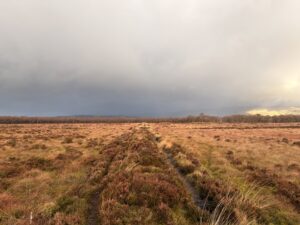
I arrive at the station in a rainstorm, but I am well prepared with waterproofs from head to toe. Brian meets me off the train from Edinburgh, and before we join the Moss through the carpark, he stops to get kitted up too. This is his first visit to Lenzie, but as an outdoor educator and researcher, he is no stranger to walking in inclement weather. I wonder what lessons the Moss will have for us today.
I met Brian when he attended a workshop I organised for the University of Edinburgh’s Sustainability in Education Research Group, of which we are both members. We went searching for hedgehogs around a student hall of residence, and we used creative methods to imagine non-human experiences of the site. I wrote an account of the event for the online journal, The Revelator. Coincidentally, in the same week, I joined a volunteer conservation group at Lenzie Moss and was tasked with cutting holes in a fence to enable hedgehogs to pass through.
In field trips like this, the roles of learners and teachers are blurred. Brian will teach me about outdoor education, and I will tell him about peatlands. He mentions that the Scottish Government have just approved a Residential Outdoor Education Bill, which entitles primary school children to a week at an outdoor learning centre. When I walked with Iona recently, she talked about her recent residential at Blairvadach. It was a hugely formative experience, and I tell Brian about the positive impact it had on her. Iona’s school is in the city, so opportunities like this are particularly valuable. Children who attend the schools in Lenzie are lucky to have the Moss for more regular outdoor education experiences, albeit at a smaller scale. I have often seen nursery and school outings here, and recall Clare telling me about accompanying her children on these trips.
Brian has had some amazing experiences as a teacher in different countries and cultures. At the start of his career, he spent time in New Mexico as a teacher in an Indigenous community. While he felt uneasy about the ‘white saviour’ dynamic of the project, the experience introduced him to a different model of education that was deeply rooted in place and culture. Brian married a fellow teacher, and they spent years living in different countries: Costa Rica, Armenia, the Netherlands, and now Scotland, where Brian is a year into a PhD on sustainable futures of the United World Colleges, the scholarship-based group of international schools, where he did many of his placements. Brian advocates a slower and more thoughtful approach to education and reflects on the value of a place-based approach that brings learners out of the classroom to engage with their wider environment.
The rain is much lighter now and as we take the pathway across the bog, the deer make their way into the southern woodland. We watch their progress and they are strikingly silhouetted amongst the trees. Now it is my turn to become the educator. I share all my knowledge about the peatworks and point out some of the key features of the site: the raised lines of the light railway; the exclosure and pools that have been added more recently; the fences and woodland management practices. I realise that I probably know enough now to host a student fieldtrip here and wonder if I might have the opportunity to do that one day.
We segue to talking about work. Brian is aware of a course that I run at the University called Creating Edinburgh: The interdisciplinary city. Students are invited to select from a sort of menu of pre-prepared field topics, including Sustainable Edinburgh and Wild Edinburgh, along with more discipline-based topics like Business and Mathematical Edinburgh. From these options, students choose which topics they would like to study and decide the order that they will do them in. Each week, in small groups, they then head out into the city to visit key sites and complete a series of tasks. Then they return to the tutorial room, where they work with a tutor to report on their experiences and reflections, and build a picture of the city from multiple perspectives. It has been a popular course – particularly with visiting international students – and Brian would make an excellent tutor. I encourage him to apply when we start recruitment in the summer.
What would a student field trip at Lenzie Moss look like? Perhaps we would provide some information beforehand about the various flora and fauna that make this place their home: the sphagnum moss; the meadow pipits; and the roe deer (we have seen all of these today). We could offer some statistics about the fragility of peatlands and tell students about the balance between access to the Local Nature Reserve and the need to protect and preserve the fragile bog. I would stress this: access has to be responsible and there are areas here where it might be best not to tread. Then, we could provide a map and direct students to follow the path around the site to see what they could find. We would ask them to record, document, take notes and pictures.
And then, because the act of return is vital, we could gather everyone together to reflect on the experience. Perhaps this could take place on the concrete platform in the woods – a temporary learning space amongst the trees. Students could share their findings and observations and tell each other about any unexpected encounters they had (there are always some). And then I would ask them whether they walked onto the bog, and how far they went. I would ask them whether they felt conflicted about doing this. How did they justify the act of passage to themselves and their classmates? What is the educational value of visiting these places, and might it be argued that it is sometimes better to leave them unvisited?
These questions are at the heart of my own learning journey on the Moss. They have not been, and probably will not be, resolved. But in the final section of our walk, Brian and I turn off the main path and walk a short way into the centre of the bog. We pick clumps of moss to examine, and we get close to the deer, who have made another appearance. We are mindful of the damaged peat layer, and we observe deep footprints and eroded banks along the way. I have been doing this for many months now and I always pause and consider the value in diverting from the main path. Today, walking with Brian, I think there is great value in it. It reminds us of the importance of learning from the natural environment, being outside, and meeting the world on its own terms. I am pleased that in Scotland at least, all children will now have a chance to do that.