I am walking with my eleven-year-old daughter, Iona. We have been waiting for a good time to do this for a while and today it is just the two of us at home, so it is the perfect opportunity. It is a foggy Saturday at the start of December and some of the houses on our street – ours included – have their Christmas lights on already. It feels like one of those mornings in the holidays when everyone puts on their wellies and treks out into the countryside. It is good to be outside together.
Iona instinctively gets the idea behind this project and she walks slowly, taking everything in. She says that I go too fast and makes me match her pace. We examine trees heavy with lichen, deep red hawthorn berries, mosses and heather. Iona says that she wants to roll around in the grass, but it has been raining so she settles for jumping up and down at the top of a bank. She says that she likes being surrounded by so much nature and that she appreciates being able to spend time outside the city, where she stays for the half of the week that she is not with me. Iona feels that she has the best of both worlds, living between Lenzie and Glasgow.
Iona recently went on a residential trip with her class to Blairvadach Outdoor Education Centre on the shores of the Gare Loch to the west of Glasgow. They saw seals, had a day canoeing on Loch Ard, went gorge walking, and climbed Lime Craig, where they looked out to the Carse of Stirling and the Highland Boundary Fault. Iona returned full of stories and a renewed love of the outdoors. On their way up the hill, the instructors told them about ‘old man’s beard’, a shrubby lichen so called because it was packed into the neckline of farm workers and shepherds’ jackets, to keep them warm in the winter months. Iona thinks that the lichen we have found today might be what they were talking about.
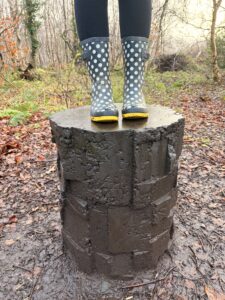
At the far end of the north path, we reach one of the stacks (Toby Paterson, Dug Macleod and Simon Whatley’s peat stack sculptures that punctuate the route). Iona can’t resist climbing up and standing on top of it. Then we move on to the climbing tree, which neither of my children seem able to pass without ascending. Today, without her little brother Ruairidh following her into perilous situations, Iona climbs higher and higher. She shouts down from the top branches, saying that I look very small. When I eventually persuade her to come down, she descends too quickly and slips on a wet branch. I catch my breath and she is unharmed, but a passing couple express their concern. Iona jumps onto my shoulders from one of the lower branches and she clings on tightly, but I eventually manage to struggle free of her strong grip and lower her to the ground.
As we follow the boardwalk, we pass countless dog walkers and joggers – one wearing a fetching Santa hat. We step onto one of the resting areas to the side of the walkway and look out over the fields towards Bishopbriggs. I tell Iona that there is a continuous urban area from there to her other home in the southside. Only a thin strip of greenbelt separates us from the city. In the other direction, we can only just make out the vague shapes of the Campsies – a dark line visible through the fog. It would be possible to walk through the clouds, over the hills, and northwards to the Highlands, without passing through a built-up area. We are at the edge of something – standing on a threshold. I say that this is a liminal place, and Iona says she doesn’t know what that means and that I should stop being so philosophical.
We can hear geese flying overhead, but the cloud is too thick for us to see them. A woman and her tiny poodle stop to chat. I have met them before on my walks with Clyde. She says that the geese go to the Gadloch to the south of the railway line and she talks about seeing the pink-footed geese at the Montrose basin – another Local Nature Reserve. I will remember this and will plan to visit one day.
We wander along the pathway that borders the bog and I show Iona the new pond, where the fencing I saw on my walk with Chris has now been removed. Given the ongoing tensions around this area, I am not comfortable to cross it to reach the tree swing, which Iona is keen to visit. We go back on ourselves, following the boardwalk to the bottom. We reach the second stack, which Iona pauses to stand on, then we take the muddy path into the woods.
After a quick swing, we follow the meandering pathway through the birchwood. I show Iona the bracket fungi, and we see more lichen growing in big clumps on the branches. Looking up at the canopy, Iona spots clusters of sticks resembling untidy birds’ nests. These are ‘witches brooms’, abnormal growths that are sometimes caused by fungal infections. My parents used to tell me and my siblings that these were naughty boys and girls, who had been transformed into these twiggy bundles by witches. Iona is alarmed by this, and I agree with her that this was a rather cruel thing to tell us!
We emerge by the ruined peat stacking shed on the main path by the railway line. At the other side is the third and final stack, and Iona leaps onto it before stepping over onto the foundations of the building. She has jumped, climbed, balanced and bounced around the Moss this morning and I am reminded that she is still a little girl, despite her maturity and self-confidence. I hope that she will stay in this place for a while yet – a liminal zone between childhood and adolescence, where I get the best of both worlds.