I am walking with Kyriaki, an artist and researcher who also goes by the name of Sandy. We haven’t met before, but she got in touch after I shared this project on the mailing list for the Edinburgh Environmental Humanities Network – a busy and supportive community of researchers that we are both part of. Sandy is using walking methods in her own work, and she is interested to explore artistic processes and ways of doing creative research. It is a nice coincidence that I walked with Deirdre – another artist – yesterday, and we talked about the same topics (which in turn connected to the walk I did with Ellie a few weeks before). I am seeing my walk with Sandy as a continuation of those conversations, even though Sandy, Ellie and Deirdre don’t know each other.
In stark contrast to yesterday’s walk in the crisp, clear air, a thick fog has now materialised. We won’t be looking out to the Campsies on this walk, but we enjoy the otherworldly atmosphere, and we peer into the trees, which are shrouded in greyness. Sandy asks me if I always walk with other people or whether I use solo walking as a way of exploring the sites where I work. I reflect that while I sometimes enjoy walking on my own (I am currently half way through a very drawn out journey along the different stages of the John Muir Way, for example), in my research, I tend to favour shared experiences. In different ways, all my work is about bringing people together in places to collaborate and create together.
This is a timely conversation as I have just been reading an essay by another Deirdre – my old PhD supervisor Dee Heddon, whose 40 Walks blog was a key inspiration for my Lenzie Moss project. Dee reminds us that some of the early proponents of solo walking – William Hazlitt and Henry David Thoreau – in fact walked often with companions. Dee also writes of ‘the art of companioning’ and notes the etymology of that word: Companion is formed from com and pain, meaning with bread. So, companions are ‘breadfellows’, who share sustenance. Walking projects like this often feel like they are sustaining me and building relationships with people and places.
Sandy and I walk through the birchwood, and I ask her about her work. Like me, she is a multi-disciplinary artist who works at specific field sites. Her current project, which, like Ellie, is part of a PhD at Edinburgh College of Art, is an exploration of post-industrial places in Europe. At the moment, Sandy is working at two sites: Malls Mire Park in in the Toryglen district to the south of Glasgow, which includes a community woodland and gardens, along with the remnants of a wetland environment; and urban areas of the Greek city of Eleusis in the Athens metropolitan area, where Sandy once lived. She is also interested in finding a third site in Eastern Europe.
Sandy talks about the materiality of these places and tells me about an artistic process in which she collected discarded drinks cans from the Glasgow site. These were cleaned, sand-blasted, melted and cast, using moulds made from the shapes of discarded wrappers and paper, which had been coated in wax. Sandy says that she tries to avoid making work that is ‘on the nose’, so she tends towards abstract shapes and exploratory formations. Her work sounds fascinating and I look forward to seeing these objects that have been crafted from the waste products of the places where she has worked.
While Sandy is drawn to the objects and textures of her field sites, she is also concerned with the ‘dematerialisation’ of art. We talk about walking, recording, and conversing, and think with Ellie and Deirdre’s invitation to recognise the inherent value of the exploratory, meandering routes that we might take, without always driving towards a finished product or output. It seems appropriate to talk about materiality as we walk through this strange foggy landscape. Sandy says that she feels like she is in the middle of nowhere, and without the usual reference points on the horizon, I share this feeling of dislocation.
Walking down the boardwalk, I spot a glint of metal in the heather a few yards into the bog. The ground is hard enough to hold my weight, and I venture out to retrieve an energy drink can, which I empty of its contents and pass to Sandy, who is pleased to have gathered something that can be used in her artworks. Apparently, there are many more such materials at Toryglen. Sandy tells me she has turned to Google’s aggregated location data to discover that the park there is particularly busy during weekend nighttime hours. This is a reminder that Lenzie Moss, too, is used by all sorts of people at different times of the day, and that the smashed glass, discarded cans and fire pits evidence human activity that takes place long after the hours that I am typically out here.
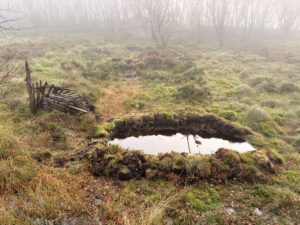
We turn from the boardwalk and head out across the bog. Sandy asks me about the Moss, and I offer a guided tour. Once again I find myself telling the history of peat extraction and the present-day tensions around access and site management. As I deliver my increasingly honed tour script, we pass by the spot that I had previously visited with Jill, and where James and I had recently encountered some workers digging ponds. The work has now been completed and it is clear that these new pools have been deliberately placed in an area that was being used as a regular pathway. This is to protect the fragile peat layer and to create diverse habitats, but I suspect it won’t be well received by all the people who walk here.
Sandy talks about the entanglements of people, places and practices in her work. That word – entanglements – has been mentioned a few times on these walks, and it is a concept that I have also explored elsewhere. I have walked enough times now for connections and resonances to emerge between walks and walkers. My time with Sandy has brought this into focus for me. The project is creating its own networks, layering meanings and experiences together, just like the peat that builds the bog.
We are at the end of our journey now and Sandy gets the train back west, joining a different type of network and making more connections as she travels.