This blog post was written by Helen Boyd, the Community & Education Partnerships Manager at George Watson’s College and part of the Micro:bits on the Move delivery team.
We’ve teamed up with the University of Edinburgh (UoE) Data Education in Schools team to pilot a Micro:bits on the Move project with a group of our S6 pupils this year. The plan is that we’ll give it a go, make mistakes, learn a lot and shape something other schools can build on. The pilot is funded through our Kerr Fry partnership.
It’s early days – we’ve only been doing this since the beginning of term in August – so this blog gives a quick look at what we’re doing, why and how it’s going so far. Our pupils will also be sharing their own blogs along the way.
What is the project?
In 2022, every school in Scotland received Micro:bits, which are tiny, programmable computers designed to make learning coding and computing science accessible and fun. Since then, the BBC has also sent out next generation Micro:bits for schools signing up.
The challenge is that many teachers, particularly in primary schools, haven’t had the time or confidence to use them so the boxes are at risk of gathering dust. To tackle this, a few years ago the UofE started working with Informatics students to run Micro:bits sessions in schools, helping them to make the most of the resource.
This project takes this a step further by giving senior pupils the chance to design and deliver sessions in primary schools, while working towards a Young STEM Leader Level 6 qualification.
What have we done so far?
We launched the project as part of our S5/6 Curriculum Enrichment programme, with eight pupils signing up. We decided to target our pupils in S6, partly because they tend to have more flexibility in their timetables than younger year groups. After an introductory session with the UofE in June, our S6s got hands-on with the Micro:bits, explored classroom management and observed P6 lessons to get a feel for teaching younger pupils.
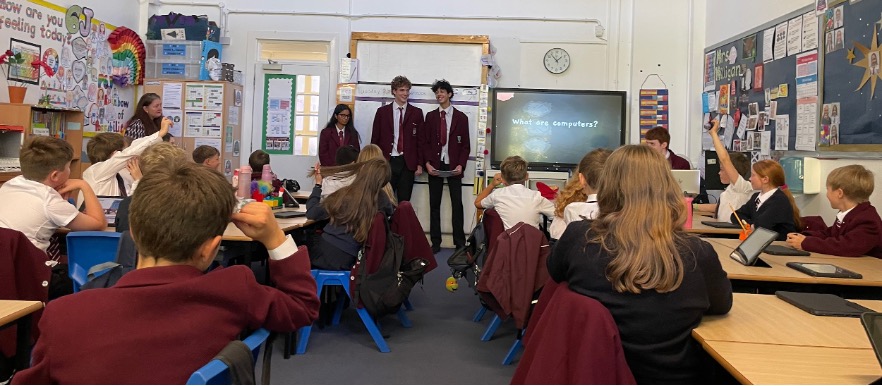
It’s very handy for us because we have a Junior school as well as a Senior School, so our S6s group so far have been able to try things out with our own pupils. Working in two teams, they planned their sessions (some more prepared than others!) and then were thrown in the deep end to deliver their first Micro:bit lessons to some of our P6s classes. The younger pupils loved it and our S6s experienced first-hand what worked – and what didn’t. They were buzzing afterwards and after reflecting and refining, their second round two weeks later went even better.
Next, we’re delivering to our remaining P6 classes and then heading out to local partner schools to try it in new settings. Watch this space for how it goes…
Who is it for and who should deliver?
Our S6s joined for different reasons – some love computing, others want to experience working with children – but no one needed prior computing knowledge.
The project is supported by a Junior School teacher with a digital remit and a D&T teacher, though they don’t both attend every session. As with pupils, no prior computing experience is needed for the teachers. They/we just need to be willing to give it a go ourselves and get our own heads around it before going out there.
Why do it?
We feel that it’s a ‘win-win’ for everyone:
- S6 pupils build confidence, communication and leadership skills, plus gain a qualification and meaningful UCAS material. For our pupils, when they go to other schools they will also be making connections outside of their usual bubble
- P6 pupils get hands-on coding experience
- Primary teachers in classes gain ideas and confidence to use Micro:bits themselves
- Everyone has fun, even if there is a bit of chaos – great for wellbeing.
Top tips so far
- Check the tech first – make sure the app, bluetooth and Micro:bits are all working!
- Get senior pupils teaching early – nothing beats the reality of standing in front of a class…
If you’d like to chat about running something similar, feel free to get in touch.