The ability to collect, organise, and interpret data is not only useful to those interested in computer science or statistics; it is a skill fundamental to many aspects of human thinking. It is about being able to retrieve and work with various types of information.
Data skills are at the core of historical research, too. Historians analyse, interpret, and cross-reference data that they have collected from primary and secondary sources. They evaluate it and collate it to reconstruct the past. If you think about it, historical research is not unlike the work of a detective!
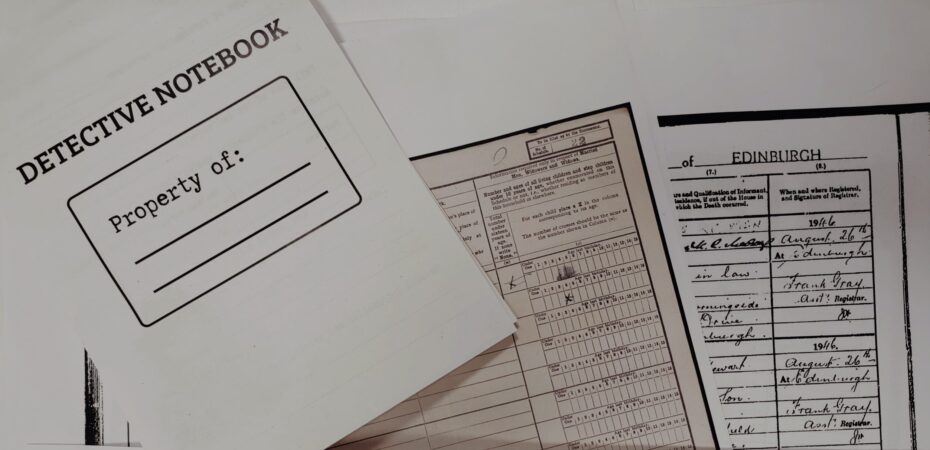
In January 2026, as part of the “Kerr Fry Endowment – Children’s Digital Futures” project, our team delivered the activity “Data Detectives in the Archives” to senior students at George Watson’s College History Society.
The session introduced the learners to archival research and what archival data can tell us about ordinary people in the past. We provided the pupils with copies of digitised documents from Scotland’s archives and asked them to collect as much information as possible about one individual of Edinburgh’s past: who they were, who their family were, where they lived, what they did. Throughout the activity, we prompted them to identify additional questions that may be answered by further archival search and make broader considerations not just on how ordinary people lived in the early 1900s but also on how information was recorded then, compared with today’s practices. By the end of the session, the learners had collated an identikit of the individual and were able to identify steps to take their research further.
Who’s the mysterious individual in the archives? You could find out yourself! We are now seeking to bring this one-hour, in-person activity to other schools.
The activity is aimed at senior students with a keen interest in subjects such as history, social studies, modern studies, and related subjects. The session will focus on key research and literacy skills preparing young people for University, including:
- selecting, sorting, and using information from primary sources
- selecting, evaluating, and cross-referencing sources of evidence
- using the evidence to recreate the story of an individual of local historical interest
- comparing ways of recording information in the past with modern practices, and contributing to a discussion of the similarities and differences
- using digital technologies to search, access and retrieve information
- being aware that not all sources of information will be reliable
Email Jo Spiller (jo.spiller@ed.ac.uk) and Giovanna Pasquariello (gpasquar@ed.ac.uk) to learn more.