
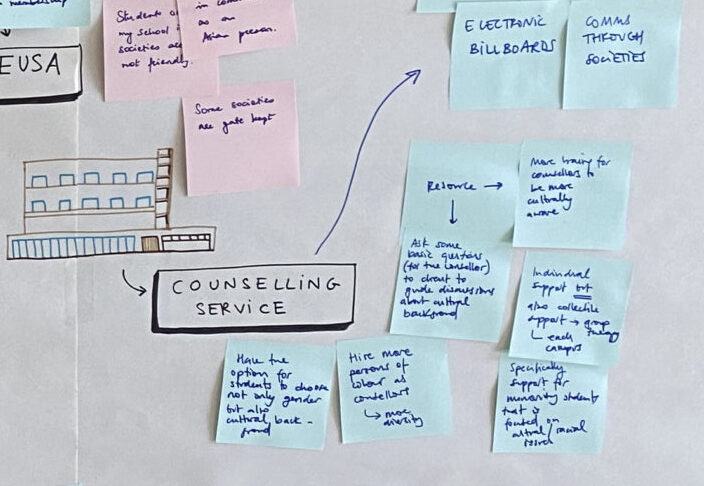
Drawing from their own experience with the university student counselling service, students offered the following suggestions for what could be helpful:
Allocate more resources…
… for training counsellors to be more culturally aware. Students felt that they needed to over explain their cultural background for the counsellor to get some context about themselves. They noted that it would be helpful if the counsellor asked some basic questions to the client to guide discussions about cultural background – so that they know what to share instead of being left completely open.
“I think I mentioned last time that I wasn’t sure how much background knowledge I should provide for myself…because, they would be, you know, just share me anything, I just didn’t know where to start. Where to begin, how I got here. And so if they ask me some basic questions that help me to answer and navigate, also help them to support me, so some resources to counsellors to support I guess minority cultures, and minority ethnic students. So that they can be more involved in these counselling sessions when cultural backgrounds start to intertwine and to start to matter in the content we’re talking about.”
Specialised practice:
Students noted that there is a necessity for specific emotional support for minority ethnic students focused on cultural and racial experiences and issues.
“I don’t think the counselling service is very open to those sorts of things. I feel like it’s more for if you were struggling at uni, but, like, academically…something they can help with… like, to give you advice, oh you should go here to get this money, you should go there to get food. But it’s not really for helping you with your culture.”
“maybe each campus we could have someone who’s in charge of supporting minority students. Or someone that’s clearly explaining introduced every year, or throughout the year even…that, oh this is a person you can talk to if you have encountered any problems or confusion or anything. It doesn’t have to be problem, I think. Anything you want to share you can come. It’s like a school counselling system, but particularly for ethnic minorities or something related to ethnicity, racism.”
Diversity in counselling team:
Students further recommended the hiring of more people of colour as counsellors. They acknowledged the lack of diversity in the team thereby resulting in being matched with counsellors who sometimes do not understand their cultural contexts (which especially is a barrier in time-limited short-term counselling).
“I’m not sure how many people of colour who are working as counsellors in the university. But if there aren’t many, I hope they hire more.”
Further, they wondered if it may be helpful to have the option to choose not only the gender of the counsellor they will be allocated to but also the cultural background. <did all students seem to agree with this?>
“and maybe ask that as a question. If you want a person of colour. Or maybe specifically, do you want someone from Asia who might share some background. So diversity in counselling workplace. […] because I was asked if I wanted a female counsellor or a male counsellor.”
Group support:
While individual one-to-one support is helpful, they recognised the need for group support as well – where they could come together as a group to listen to each other and find a sense of belonging and validation.
“but maybe it can also individualise, like, someone struggling in their career because of racial or cultural issues or because of discrimination or racism. And then they need to go to this counselling service to have one-to-one, rather than do something more collective”
“I think we need space where you can share individually and get support individually, but also collectively. Like when I mentioned about making a mandatory content for each society to go over about racial problems. Or it doesn’t have to be a problem about raising awareness. Something similar can happen in each campus, each course even.”
