What do I do when I am made to feel different? 

Limit Situations:

Summary:  

In response to feeling this rejection (limiting situation), the students were internalising a sense of being inadequate or not enough, needing to try harder. In the initial sessions, students began by describing their feelings of inferiority and insecurity with regards to their English language proficiency, speaking about their own culture (which was not taken into account or spoken about otherwise) to offer a few examples. From this experience, they unpacked that it felt as if they needed to know everything about their culture and represent it perfectly so that others did not stereotype them or ignore them. They further questioned this experience in the light of social and interpersonal racist dynamics: that is, they recognised that the weight did not need to be placed on the individual alone and instead they began to understand this pressure and feeling of inferiority in terms of the self as entangled in an unjust society. Finally, we noticed that this exercise of unpacking and listening to themselves and examining the impact of power structures perhaps allowed them to trust their embodied sense of the situations and to bring it up as a form of knowing.  So, in a way, when I am made to feel different, instead of internalising a sense of inadequacy and feel that I need to try harder, I realise that my feeling different has to do with wider unjust social dynamics. I realise that my feelings and sense of the situation are important and I listen to them.  
It is important to note that this might be a movement that we witnessed in the culture circles, but it is not a complete shift, rather a movement to a different way of relating to their sense of being othered that students might be able to enact sometimes. 

1. Internalisation of inferiority, insecurity, and ignorance:  

In Session 1, we asked the co-investigators the following question: 

  • Have you felt different while studying at the University? 

The co-investigators offered a variety of responses that showed how they had internalised a sense of inferiority with regards to their racial/cultural experiences. In this generative theme, we will be following the processes of Isabel, Cati, and Eris as exemplars of larger themes that the group grappled and resonated with. 

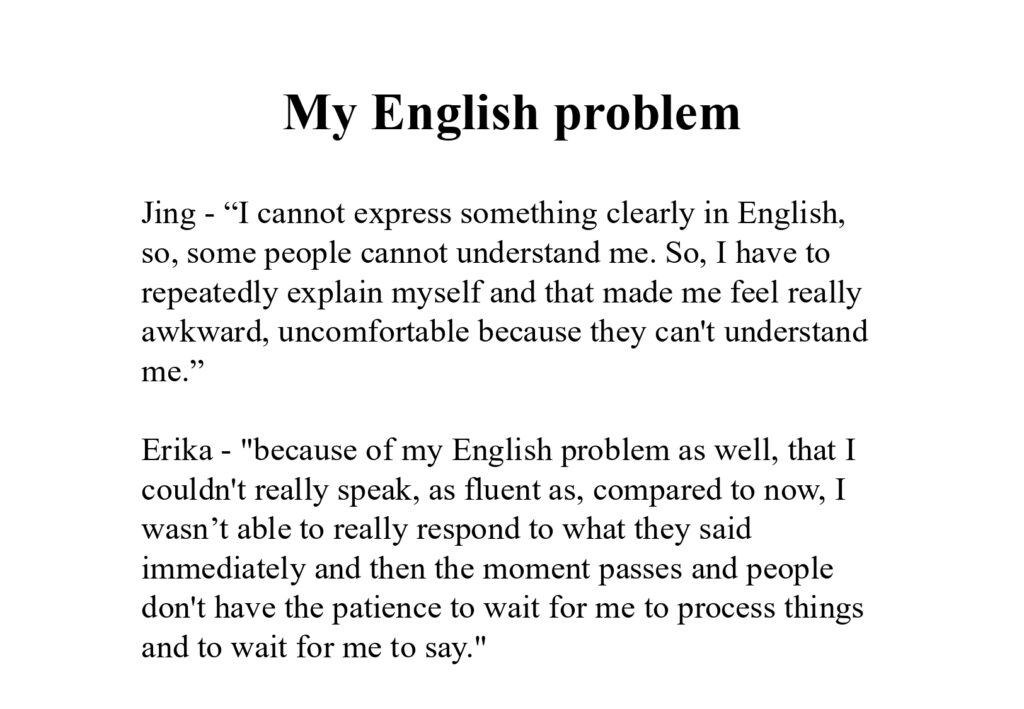
Some co-investigators mentioned their insecurities with the English language: 

Cati – “I started to feel like I wish English was at least my first language” [Session 1] 

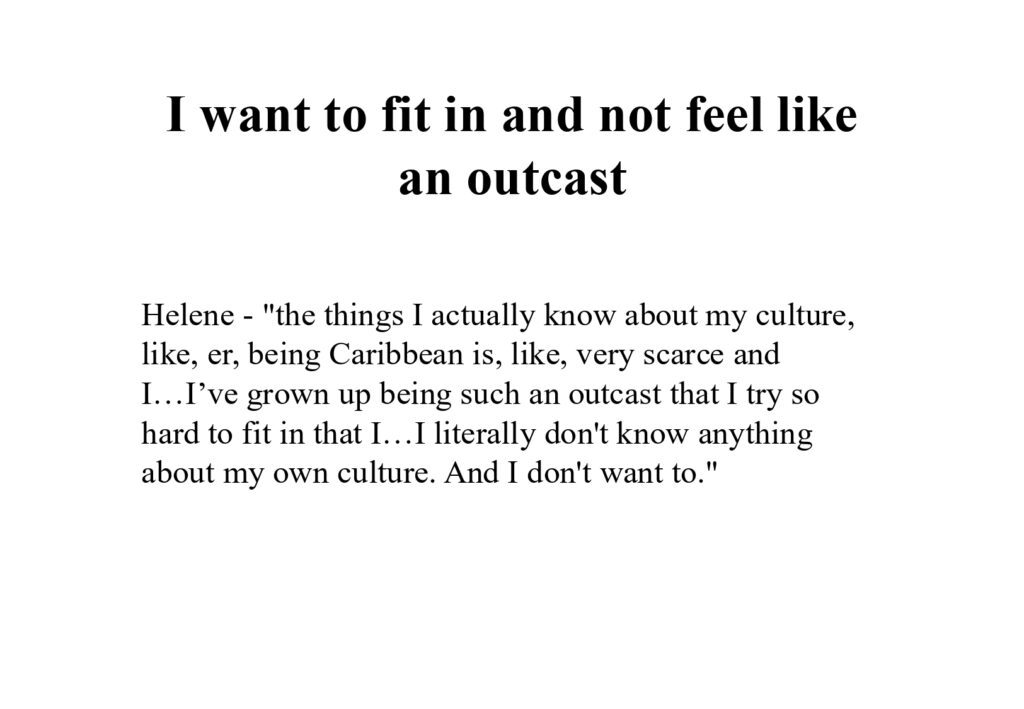
Isabel – “because of my English problem as well, that I couldn’t really speak, you know, as fluent as, like, compared to now, I wasn’t…I wasn’t able to really respond to what they said immediately and then…then the moment passes and people don’t have the patience to wait for me to process things and to wait…for me to say. Um, so, like, conversation just continued and…without…me saying any word […] coming from Asia it’s…English isn’t the language that we’re used to speaking […]” [Session 1] 

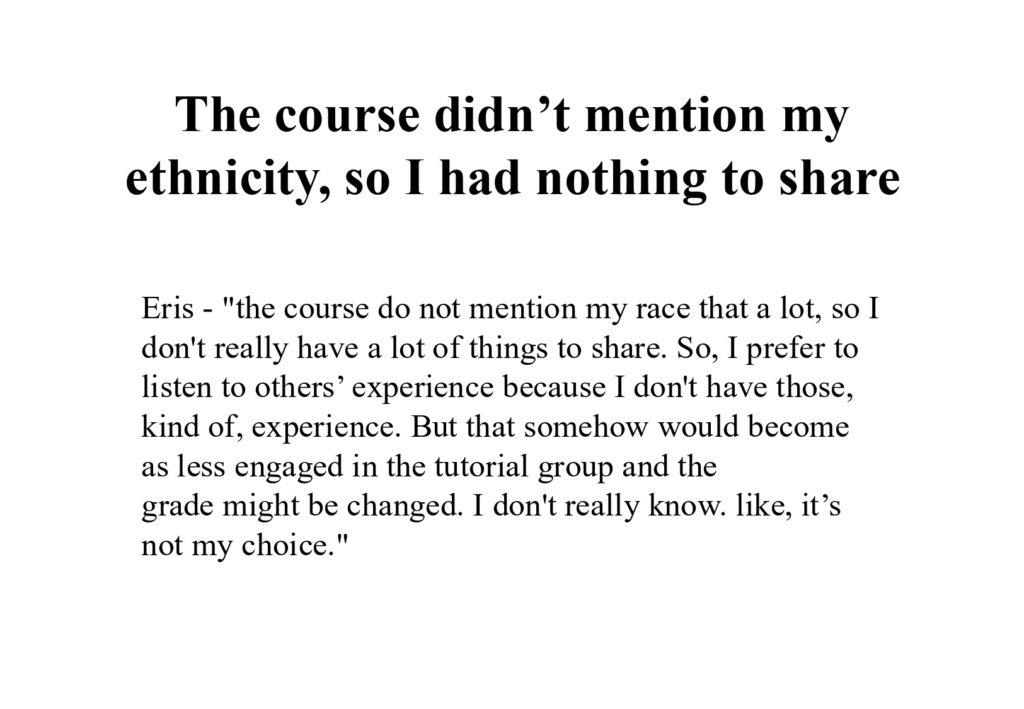
Some Co-Is spoke about feeling left out in course curriculum, and thereby not speaking up in class or wondering if it was okay to speak from their cultural positionalities: 

Eris – “I attend the [name of the] course and the tutorial group was, like, um…because I’m…the course do not mention my…like, my race that…a lot, so I don’t really have a lot of things to share. So I prefer…to listen…to others’ experience because I don’t have those, kind of, experience. But, um, that somehow would [become 07:31] as less engaged in the tutorial group…and the grade, like, somehow might be changed. I don’t really know…like, it’s not my choice.” [Session 1] 

Furthermore, some students expressed that they felt their own cultural background was not interesting for other people, and if they spoke about it, they would ‘make things boring’: 

Isabel – “especially in the beginning of my uni life, you know, all I could share was things that I knew, and usually from maybe [my country], or maybe East Asian background. I was brave enough to kind of, share that, but when it was in, like, you know, an in-person discussion, I could, I was the only, you know, international student.  Erm, and I wasn’t sure if I could, like, share in details, I wasn’t sure how much I could share about this East Asian background, like cultural information on artists. Because people just didn’t seem to get interested, or they didn’t really respond, maybe they didn’t know how to comment on what I was sharing at that time. […] But at that time, like I, kind of, in a way, censored myself for not, you know, sharing too much, because I thought, I’m, I’m making things boring.”  [Session 2] 

One Co-I wondered if it was her fault that she did not feel secure enough to talk to non-Asian people: 

Cati – “right after I came, I just arrived here, and once I joined a, like, flat party…there were a lot of people with, like, all race, I mean, like, different background. And they talked to me a lot, and they treat me really nice.  But, like, even though they treat me really nicely, I just found myself, a part of myself, like, feeling more secure when I’m talking to Asian people. So, I think, like, it’s not all their fault […] Like, I am the one, like, who kind of, feeling like, more secure when I talk to Asian people.” [Session 2] 

Another Co-I carried a strong sense of feeling ignorant – about the political and historical events that have shaped prevalent social/cultural/racial hierarchies and oppressions. It seemed that they felt they needed to be more knowledgeable before voicing out their perspectives on oppression.  

Isabel – “it just makes me feel like I’m quite ig…ignorant that I need to learn more about the history that […] oh am I not supposed to feel so comfortable […] I don’t have, like a strong history learning background.  So that kind of, puts me off to delve into historical […] incidents, and anything that happened in history, just because I feel like I’m ignorant” [Session 2] 

2. Pressure and responsibility of representing one’s culture and ‘knowing everything’

On feeling ignorant: 

As they stayed with this feeling of ignorance and insecurity, it sparked a moment of dialogue in Session 2 where one of the Co-Is, Kiara, complicated Isabel’s experience of her own ignorance… 

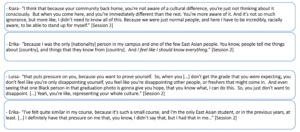
Kiara – “I think that because your community back home, you’re not aware of a cultural difference, you’re just not thinking about it consciously.  But when you come here, and you’re immediately, kind of, different…than the rest.  You’re more aware of it… and it’s not so much ignorance, but more like, I didn’t need to know all of this.  Because we were just normal people, and here I have to be incredibly, racially aware, to be able to stand up for myself. Back home, it doesn’t matter if I’m [country] or not, because everyone is kind of, just the same.  But here, I have to be really aware of how I present myself, as well. Just so I’m either not discriminated against, or if I am discriminated against, that I can defend myself.” [Session 2] 

Kiara’s response to Isabel’s feelings of ignorance opened up a connecting layer  – how one presents oneself to others, how one is expected to know everything about one’s culture and explain it to others, and how one feels less aware of things in general instils a feeling of not being ‘good enough’ that is culturally, racially, and historically reinforced! 

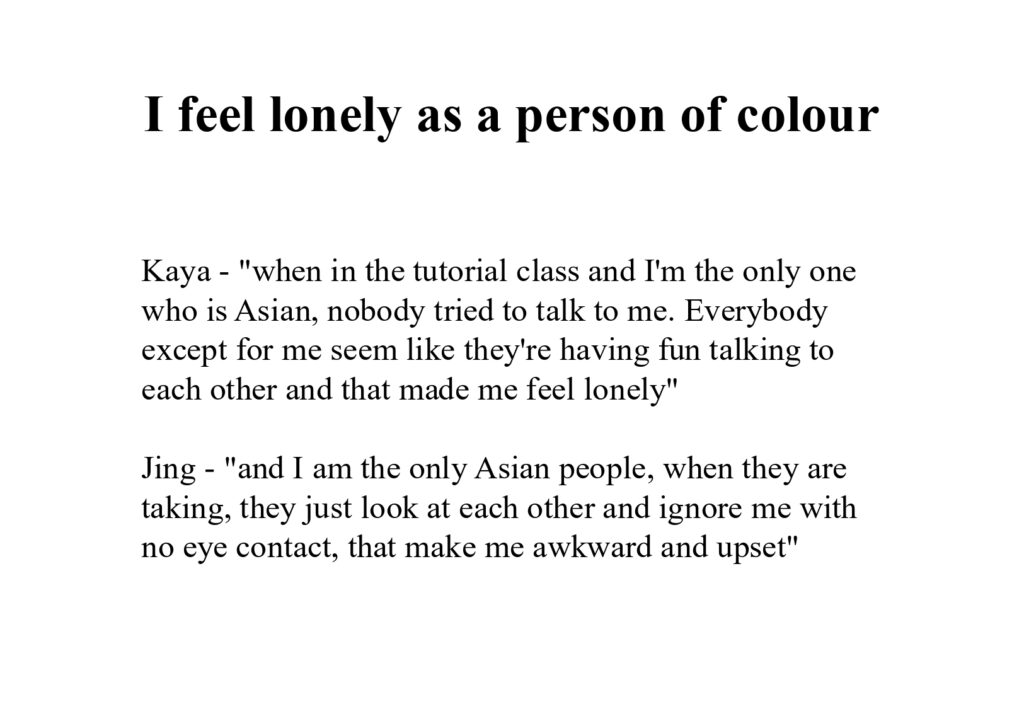
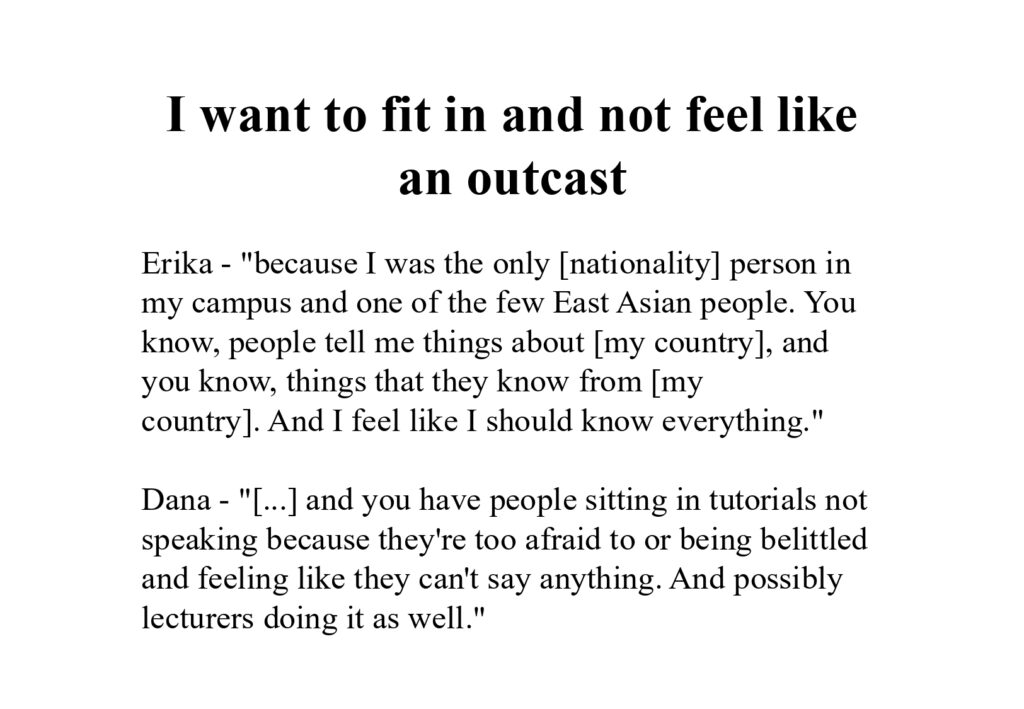
Isabel’s response to Kiara’s above-mentioned comment shows her unpacking these layers – “because I was the only [nationality] person in my campus and one of the few East Asian people. You know, people tell me things about [country], and things that they know from [country].  And I feel like I should know everything.” [Session 2] 

Isabel seems to have gone a layer deeper, recognising that because she’s the only East Asian she is (unfairly) expected to know everything about her culture, and this makes her feel like she should know everything. 

On representing one’s culture: 

By staying with this sense of pressure, Co-Is further explored the feeling of ‘pressure’ in not only how one presents oneself to others but also in ‘representing’ one’s culture – that is, to continually prove one’s cultural worth. 

Luisa – “that puts pressure on you, because you’re like, well you want to prove yourself.  So, when you […] don’t get the grade that you were expecting, you don’t feel like you’re only disappointing yourself, you feel like you’re disappointing other people, or freshers that might come in.  And even seeing that one Black person in that graduation photo is gonna give you hope, that you know what, I can do this.  So, you just don’t want to disappoint.  Or you want to make a change, and you know it starts with you, so there’s a lot of pressure added to that. Yeah, you’re like, representing your whole culture.” [Session 2] 

Hearing Luisa’s response seems to have allowed Isabel to recognise a similar pressure that she had been carrying as well… 

Isabel – “I think, I feel, I’ve, I’ve felt quite similar in my course, because it’s such a small course, but, and I’m the only, like, an East Asian student, or… in the previous years, at least.  This year, I have, like, a few more people, erm, from East Asian countries.  But, yeah, I definitely have that pressure on me that, you know, I didn’t say that, but I had that in me…” [Session 2] 

This further generated more conversation around the immense historical and cultural pressure that students seem to carry, reflected in the responses that other Co-Is had in response to Luisa’s comment in subsequent sessions. We noticed that such generative moments had a tendency to come back into the conversation in future sessions, as if Co-Is were (deliberatively or not) ruminating on these and letting it sink in before they felt a shift or resonance, and before they felt ready to articulate this in the group.  

Farah – “I remember you mentioned that getting a bad grade feels like you’re letting down a group of people.  And that really resonated with me, because I think I felt this all the time.  I remember before coming to uni in the summer before looking online, and seeing if people with my background had done a degree similar to me, who had managed to do well and stuff like that.  Actually, it verbalised something that I had been feeling of another layer of pressure in a way.  Because obviously, everyone’s aiming to do well, but also as if if I didn’t do well, I wouldn’t only be letting myself down, I’d be letting down people who are even younger trying to see if people from similar backgrounds as them could still succeed.” [Session 5] 

Luisa – “especially with the first years, or the freshers coming in the next year, or even just generations of people. I just want them to see someone on that graduation, like, I don’t know if you guys have seen, but they have graduation photos in the old college in one of the corridors.  And every time I walk past, I’m like, I hope I get on one of those things [laugh]…on one of these photos.  Because you just, subconsciously, look for a person of colour when you’re looking at these graduation photos. You’re looking for someone of colour, girls, you’re looking for a female, for me, a hijab, you’re looking for, a Black person. And there are some years where there’s literally not a single person who’s wearing a hijab in the photos, there’s not a single person who’s Black.” [Session 5] 

This layer illuminated the pressure of representing your culture for posterity, for creating a world different to the one you have experienced, where those who come after you do not feel as lonely or inferior as you.  

3. Recognising that it is an unfair responsibility and weight to carry:

Being the ‘perfect person of colour’: 

Staying with this theme of representing one’s culture opened up a discussion on being ‘good enough.’ Kiara noted that you need to either be “the good enough white person or the good enough exotic person.” 

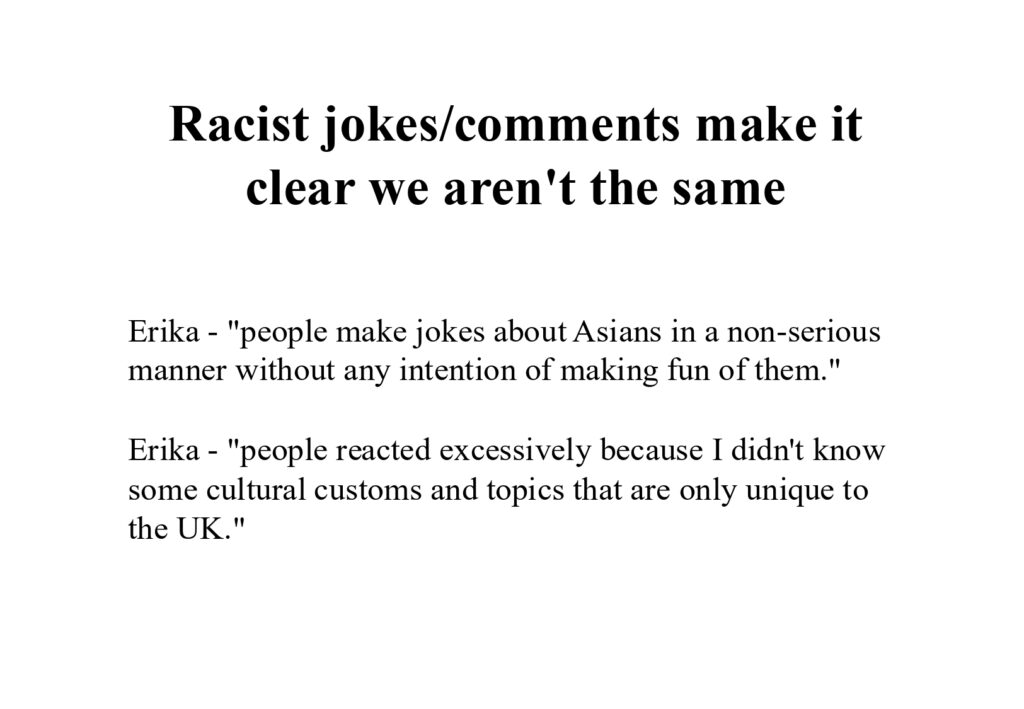
Kiara further complicated the need to carry this responsibility – questioning why we need to do the labour of representing our culture and educating others about our culture. When Jamal noted that he takes it on himself to educate people and dispel cliches they carry about his ethnic background, Kiara responded by pointing out that the responsibility always falls onto marginalised people and that was not fair. If one was proud about one’s culture and hence spoke about it to others, that felt different from having to ‘educate’ others. More often than not, people’s questions came from stereotypes (eg. being associated with eating tacos as a Latin American) and they were not interested in actually hearing about one’s culture when it did not conform to stereotypes. [Session 4] 

This seemed to have tapped into a sense of defiance that was beginning to build up in the group… 

Bella – “for White people, you have to have all the knowledge and educate them perfectly on your culture.  But then you’re also tip-toeing a line of being the perfect person of colour for them. So, you show them some parts of your culture, but you can’t be too political, and you can’t bring up too much, you have to just be exotic enough for them.” [Session 5] 

Wanting people to ask about oneself: 

This air of defiance seemed to give permission to other co-Is to speak up for what they feel and what they would want too. Cati who previously (in the initial sessions) felt that it was her fault that White people did not speak to her, expressed a different view in Session 6: 

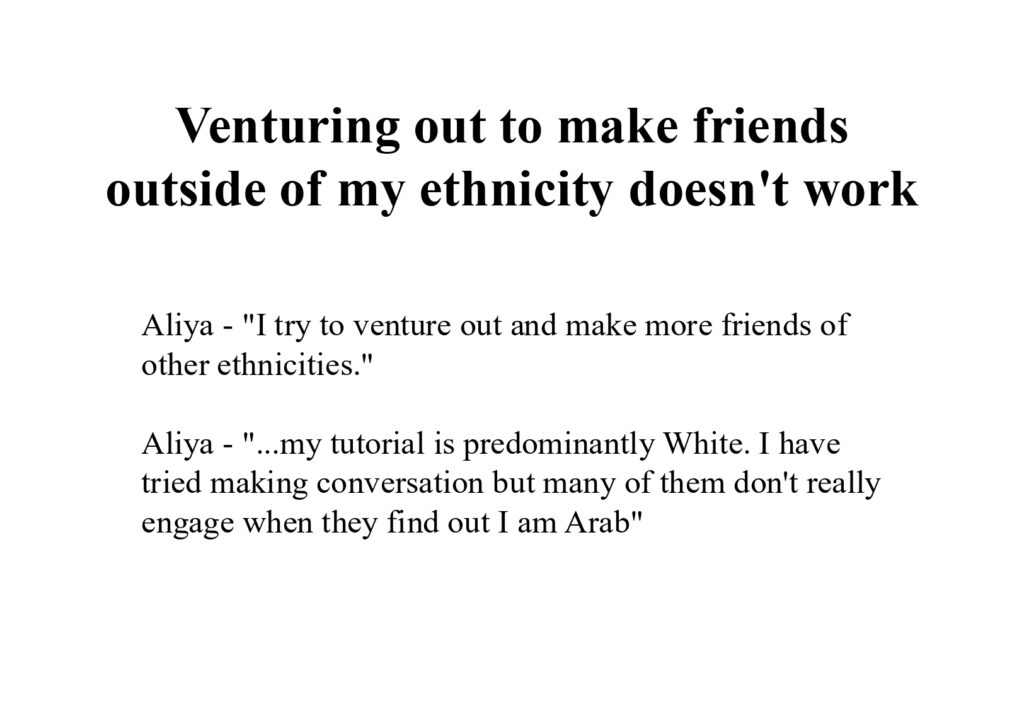
Cati – “[…] it makes me kind of feel lonely ‘cause sometimes I feel like, oh, they don’t have any interest in [country] or something like that. So, for me, I’d rather be happy, when they ask about my culture.” [Session 6] 

Further, in Session 7… 

Cati – “[…] I just realised that white tutors don’t ask me about different culture that much. So, maybe it would be better if all tutors ask us about, ask students about their different cultures in the tutorial maybe.” [Session 7] 

Not wanting people to ask or not wanting to explain: 

While Cati expressed a desire to be genuinely asked about herself beyond just dispelling stereotypes, others seemed less interested in having to explain. Luisa, in Session 8, echoed Kiara’s above comment: 

Luisa – “I remember during Ramadan, my mum sent me this cultural drink, and it’s made of this plant. And when I went to collect it from my flat, it’s quite British. When I went to collect it, they were like, is this bark, what exactly is this?  And I was like, oh it’s a cultural drink, and they were like, oh okay then. Like, my flatmates are always like, oh what is this, and they’re obviously interested, but you know, sometimes it can be a bit tiring having to explain.” [Session 8] 

Shift in focus from ‘I don’t know enough’ to ‘they don’t care to know about me’: 

As Co-Is stayed with this feeling of responsibility and weight, they identified that others who ask are not necessarily genuinely interested in knowing about their culture as they can be put off by the politics and the oppression or may appear performative in their attempts at being ‘inclusive.’ Such attempts at ‘inclusivity’ also needs to be questioned. How much of one’s culture is one expected to dilute to be ‘included’ into dominant culture spaces? 

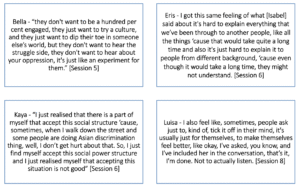
Bella – “they don’t want to be a hundred per cent engaged, they just want to try a culture, and they just want to dip their toe in someone else’s world, but they don’t want to hear the struggle side, they don’t want to hear about your oppression, it’s just like an experiment for them.” [Session 5] 

Eris – I got this same feeling of what [Isabel] said about it’s hard to, um, to explain everything that we’ve been through to another people, like all the things ‘cause that would take quite a long time and also it’s just hard to explain it to, er, people from, um, different background, ‘cause even though it would take…take a long time, they might not understand. [Session 6] 

Eris – “Sometimes as a person who wants to express something, sometimes, I try to express, but I don’t have any response back, but sometimes I do. […] during the last semester, there was some tutorials where I said something about my country, but they were asking me, but they were not listening.  […] I think they were trying to let me to engage with the environment, so they asked me.  But they don’t really care what I answer.” [Session 8]  

Luisa – I also feel like, sometimes, people ask just to, kind of, tick it off in their mind, it’s usually just for themselves, to make themselves feel better, like okay, I’ve asked, you know, and I’ve included her in the conversation, that’s it, I’m done. Not to actually listen. [Session 8] 

Integrating impact of social structures with personal experiences – the personal is political 

While Co-Is had spoken about systemic and historical influences on their experiences in previous sessions, they gradually seemed to reach a point of integrating that with their personal experiences rather than speaking about it in an abstract, theoretical, and removed manner. They noticed how the above experiences of inferiority and responsibility are tied to the systems they live within and that it is not okay to accept such structural injustices or brush them aside. 

Eris – “I do feel like the environment is not accepting us to do something. ‘Cause it’s quite somehow dangerous…[to challenge racist behaviour]” [Session 6] 

Cati – “I just realised that, um, there is a part of myself that, like, accept, like, this social structure ‘cause, like, sometimes, like, I…when I, like, pass down the street, like, walk down the street and, like, some people are doing like this to me, or like doing, like, Asian discrimination thing, well, like, to be honest, I don’t, like, get hurt about that. So, like, I just find myself, like, accept this social, like, power structure and this…[laughs]…yeah, I just realised myself that, like, accepting this situation is not good, I think” [Session 6] 

Isabel – “it’s quite small but I would love it if people don’t expect to hear everything about my culture from me. And you not be surprised. So, I want everyone to be aware that things that they think is normal is just not, could just not be normal. […] understanding what’s normal to you, which may just not be normal to someone else. So, expect differences, I guess.” [Session 7] 

Cati – “I just realised, like, it’s quite obvious in the UK that social structure really shaped our individual studying experience” [Session 8] 

4. Tapping into felt experience – a different way of knowing:   

As the sessions went on, students exemplified the above integration by speaking from their felt experiences – connecting with their deep intuitive and embodied ways of knowing and experiencing that are not always neatly expressed in words yet convey a world of meaning. They seemed to not only be able to tap into for themselves but also hold and understand for each other.  

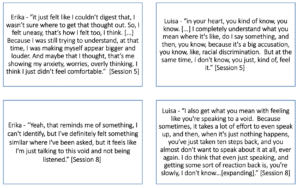
Isabel – “it just felt like I couldn’t digest that, I wasn’t sure where to get that thought out.  So, I felt uneasy, that’s how I felt too, I think, yeah. […] I think I wasn’t comfortable enough back in my second year to express my feelings, and I wasn’t sure if that was me overthinking, or if that was my parents overthinking. Because I was still trying to understand, at that time, I was making myself appear bigger and louder.  And maybe that I thought, that’s me showing my anxiety, worries, overly thinking. I think I just didn’t feel comfortable.”  

Luisa – “in your heart, you kind of know, you know. […] I completely understand what you mean where it’s like, do I say something, and then, you know, because it’s a big accusation, you know, like, racial discrimination.  But at the same time, I don’t know, you just, kind of, feel it.” [Session 5]  

Isabel – “Yeah, that reminds me of something, I can’t identify, but I’ve definitely felt something similar where I’ve been asked, but it feels like I’m just talking to this void and not being listened.” [Session 8]  

Luisa – “I also get what you mean with feeling like you’re speaking to a void.  Because sometimes, it takes a lot of effort to even speak up, and then, when it’s just nothing happens, you’ve just taken ten steps back, and you almost don’t want to speak about it at all, ever again. I do think that even just speaking, and getting some sort of reaction back is, you’re slowly, I don’t know…[expanding].” 


Reflections:

Reflections on Isabel, Cati and Eris’ process elucidating the generative theme:

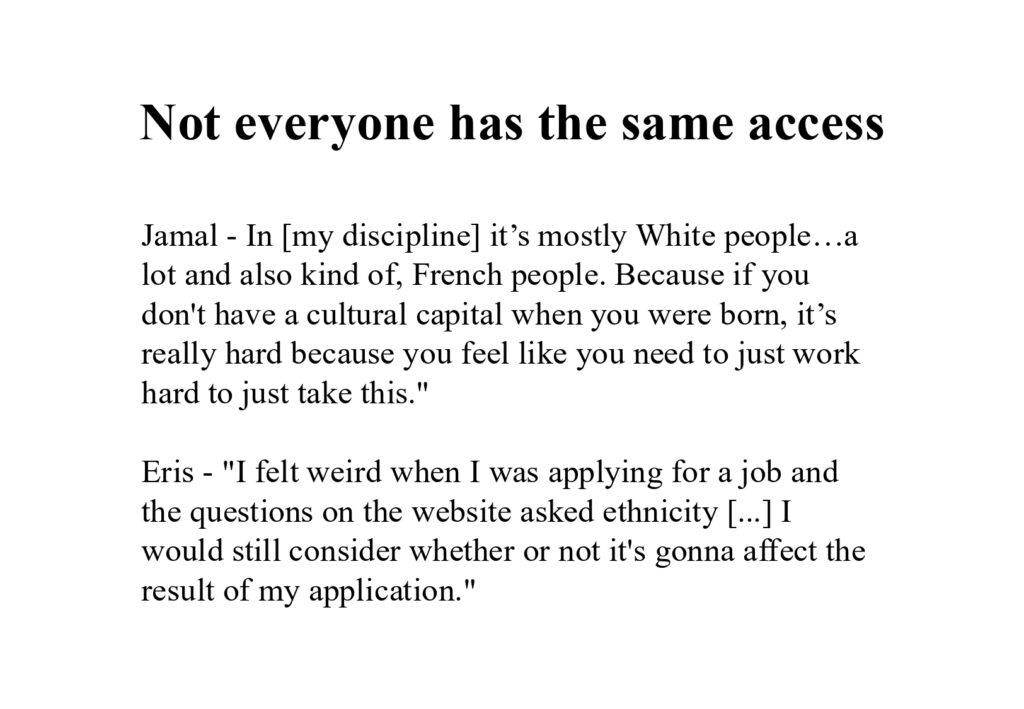
All three Co-Is moved through the generative theme of beginning from a place of internalisation of ignorance, inferiority, and insecurity to becoming more defiant in their expressions of what they experience, recognising the impact of others on them and naming social systems and structural injustices. They also spoke up more in expressing what they needed, thereby having to surmount feelings of ignorance, of not being ‘good enough’, to even speak up and claim space.

Cati moved from a position of internalising blame, that is, she seemed to note that she was at fault for not getting along with White people as she seemed to stick to her ‘secure’ place of being with East Asians. However, as the sessions moved, she noted ways in which East Asians face discrimination and also expressed her disappointment at White students and tutors not wanting to know about her country’s culture – she noted how she would prefer to be asked about her culture. This shows a shift from internalising blame to recognising that she was not being received wholly and therefore, it is not simply a matter of it being her fault. She also noted how social structures are so present in her experience as a student here, thus showing how she was reflecting beyond an internalisation of the blame.

Isabel seemed to have internalised a sense of ignorance in two ways: a) not knowing enough about her culture and b) not knowing enough about political and social structures to recognise and challenge racial discrimination. Through the sessions, she seemed to move back and forth between the above internalisation and reflecting on her experiences of a) being expected to know everything about her culture, and b) people not really wanting to know even if they asked about her culture. Most importantly, she began to tap into her felt sense by naming moments of discomfort and unease and to let that guide her experience. It is unclear if she consciously registered that even though she doubted her ‘knowledge’ of historical/structural influence, her body knew of the impact. Yet, since she began to express her felt experiences, it denotes some trust and safety in listening to and voicing out her intuitive and embodied responses to racial encounters.

Eris moved from noting that her culture is not present in course content to noting that people actually do not want to know anything about her culture. Even if they ask, they are not often listening, and she does not get any response in return. She further reflected on how dangerous the environment feels to stand up to racist encounters, thereby showing that she was engaging with socio-political structures (she did not seem to start from an internalisation of blame though her engagement with the socio-politics of racism seemed to gain several layers through the dialogue – reflecting on stereotypes, reflecting on how the environment contributes to whether/how one responds, to reflecting on not feeling listened to and received when she speaks).

Surmounting internalised racism, while a challenging task, seems to have begun to happen through dialogue and relationality, that is, from being heard, validated and understood. There were several affective moments where co-Is described a ‘sense’ of something, often unable to put their uneasiness (for example) into words. But being received by others allowed them to move past doubting their seemingly ‘vague’ descriptions and to instead start trusting their embodied responses to the world around them. Thus, the limit situations of feeling ignorant, internalising blame, feeling underrepresented (or unrepresented) in course curriculum and feeling inadequate with their English were unpacked throughout this generative theme as participants not only noticed and named the impact of social realities on their individual experiences (thereby gaining more of a sense of the whole picture). This further pushed them towards limit-acts – which perhaps in this generative theme feels more subtle with their slowly growing readiness to listen to, validate and speak from their embodied responses to injustice.