
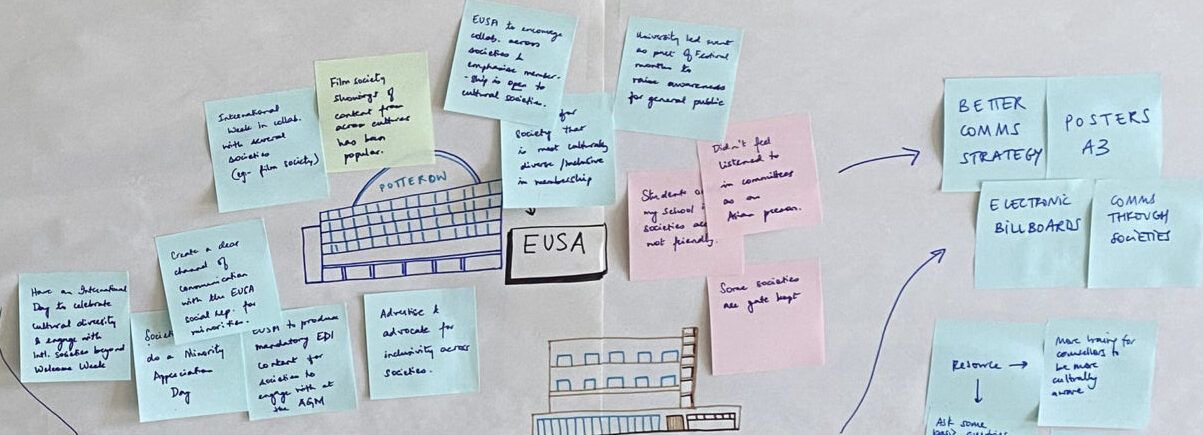
Students offered a variety of feedback based on their experiences in societies. We have grouped them into different categories below:
Policy: Advocating for inclusivity
Some students felt that they were not being heard at committee meetings:
“I used to be in the committees and I was the only Asian person, and I really didn’t feel like I was being listened to. But I was just, kind of, drowning in that community. I wasn’t sure who I could share that with.”
“And yeah, some, you know, um, like president, vice-president they could, because they’re going to be the ones who essentially, like, I would put…um, they were the ones who told me if, you know, if I had any problems I could tell them. But I wasn’t comfortable with them because to me they didn’t really listen to me.”
They recommended that EUSA create mandatory EDI content for societies to engage with at the AGM:
“I don’t know if they send out any, you know, emails to each society to maybe go through some of the, the racial problems in an AGM, for example, kind of, having that short period of time… as, like, a group to acknowledge what… might be happening, and that would make them aware…of minorities.”
“So, it’s from EUSA…asking each society to go through this particular…slide or watch something together. [EUSA produce some] Content [that is mandatory to be covered in the AGM] So, they don’t…it’s not the, the decision to be made by president, vice-president…who can be just not… yeah, aware of that.”
Communication
They noted that while information on the support available to students is being communicated via emails, a lot of it gets lost due to the volume of emails they receive. Students acknowledged the difficulty in getting the word across and brainstormed on possible solutions that may be helpful for EUSA:
- Creating a clear channel of communication with the EUSA social rep for minority students so that students know a) that they can reach out to them when needed, and b) how to reach them.
- Develop a more attractive communication strategy through catchy A3 posters, electronic billboards or communicating through societies as a channel of reaching students.
Events:
Students further brainstormed on the possibility of having events that would allow international students to come together and feel a sense of belonging. They suggested
Having an International Day to celebrate cultural diversity and engage with international societies beyond Welcome Week:
“Do they have any, like, int…international day where…you know different cultures are introduced? That might be a good idea. […] No, but some kind of, doing welcome week you get to talk to different international societies, um, but as, like, a separate event where, you know… there would be stalls and you get to learn different cultures and it might be done in each campus, um. […] but more like, kind of, emphasising the fact that Edinburgh has an international…presence, rather than maybe, like, minority. As, like, which can be, like, a label.”
Hosting an International Week in collaboration with several societies (e.g. Film Society).
“I think, like, the idea of the international, um, international day is really good. I’m just wondering, like, in the film society they can make, like, int… an international week. And, like, be more diverse in their programme, so yeah. […] Yeah, in societies where we can just show something and just, like, kind of, sensibilisation to a specific culture.”
“But probably, like, you can attract more people during, like, the international day. Like, if it’s something, like, just about all societies, like, an international week, especially, like, in the film society or other societies, to just be more yeah, I think, um, diverse in this week. And then if it’s good, I mean, you can do, do that, like, all the year, but if you have, like, a specific week probably you can sensibilise more people to that.”
Hosting a university-led event as part of the festival months to raise awareness for the general public.
“I’m just wondering if, like, in Edinburgh there is, like, a festival for diversity or, like…? I just know, like, in France you can find, like, a festival where there’s a lot of diversity, like, people and just exchange food, other things. And I think it would be great, like, if the university can do that. In just, uh, a week, like a festival. And I’m sure they will have, like, a lot of resources after to just, like, be able to have fundings to make that. […] just, like, for students. Like, just a… festival about societies. […] it’s just a festival for societies. And all-inclusive because every people can come, so they can be part of an association. They…if, like it’s a chance for people to just be in contact with others.”
“I don’t know if it’s, before I forget, we’re talking about EUSA, but speaking of the festival if the, if the university could arrange some, kind of, event where the, the local, you know, the public can join, the general public can join. Because Edinburgh, centre of Edinburgh is it’s, like, a city of university. And I think in such a big university, if this big university promotes this diversity, um, and, you know, even extend it outside of the university I think it would be really effective…to raise awareness… in local community. Because I feel a bit separated from non-students and students.”
Miscellaneous
Students further suggested that it would be helpful if EUSA encouraged collaboration across societies and specifically, if there was an emphasis that membership is open to all cultural societies.
“I wonder if EUSA could encourage societies to collaborate, like, a multicultural…collaboration. Because when I was in Japan society I…we organised this East Asian, kind of, ball. But that was, you know…quite close, closed in that and, I’m not sure why, but people around me who are not Asian, kind of, assume that they can’t join Japan society if they’re not Japanese. It’s just not true. So, I think, you know, those cultural societies if they’re, you know, if that’s…membership’s open to anyone I think they have to emphasise that more because there are actually people who, who are interested in those cultures, they want to join, um. But they just assume they can’t.”
Some students also appreciated the efforts being made by certain societies, for example, the film society:
“I remember in one of the last weeks of term we showcased, like, Persian movies. And, and like, we tried to make it as diverse as possible. And, and I’d say, like, um, the turnout has been, like, a lot higher than we expected, so it is something that is not just of interest to people of colour but, like, everyone is interested.”
