Hello! I’m Charlotte, this year’s Open Educational Resources (OER) summer intern within the University’s Information Services Group. My first week of this internship has thus far been largely characterised by extensive reading – which, as a French and English Literature student, I assure you that I am quite accustomed to! In perusing both the OER service’s digital catalogue of published resources (on Open.Ed, TES Resources and Edinburgh Diamond, to name a few) and the vast array of online open access textbooks similarly published by other institutions, in such a brief span of time I feel I have already become thoroughly familiar with the department’s operations and its fundamental values, namely of providing widespread, barrier-free access to teaching and research materials of high quality.
Despite appearances, reading up on the ins and outs of copyright legislation has also proved more exciting than it sounds! I have gradually come to understand a great deal about the importance of providing adequate attribution to third-party sourced materials, particularly works published under a Creative Commons (CC) licence, so that students and staff using our OERs can freely distribute, re-use and adapt these materials according to their needs without infringing on any copyright restrictions. In practice, sourcing CC-licensed or public domain materials may appear a complex process as it requires careful attention to detail, but by using the open repositories of resources available on Open.Ed alongside documents like asset registers (the swanky name for spreadsheets which compile images used for an OER and their corresponding licensing details – see an example below), it becomes a fairly straightforward task.
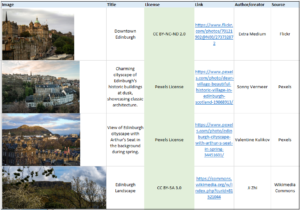
My first attempt at creating an asset register in Excel.
As a student who has encountered the frustration of a paywall or subscription-based barrier all too many times throughout my secondary school research projects, acquiring free access to countless academic journals and publications through the University of Edinburgh has immeasurably benefitted the quality of my coursework submissions. Such free open access has unfortunately yet to become the norm, and for the time being remains a privilege for individuals like myself in higher education. This fact informs much of my reasoning for wanting to contribute to the OER service, as producing educational resources that are made publicly available and able to be adapted by teachers and students alike is, in my view, a fantastic initiative and direct progress towards the ultimate goal of making education openly accessible for all.
More broadly speaking, with regards to my experience working at ISG so far, I have had nothing but friendly and warm interactions with other members of staff in the department as well as other student interns in different positions. The working atmosphere in Forrest Hill is light and pleasant – even if the building initially seems a bit of a labyrinth – and my line manager Charlie has been very gracious with spreading out my onboarding tasks so as to not overload me with information from the very beginning. In essence, the principle tasks I will be undertaking this summer are that of adapting and publishing educational learning materials supplied by outreach students in the form of OERs, and, excitingly, working on the curation of two new open textbooks which will be published in line with the same premises of open licensing and free access. Now that I am beginning to feel well-acquainted with the intricacies of copyright and digital publishing, I look forward to getting properly started on these projects!
Header image: Edinburgh Old Town, 2026, by Charlotte Ness, is licensed under CC BY 4.0