Hi! I’m Suhana Grewal, a first-year undergraduate student pursuing Economics with Finance at the University of Edinburgh. In December, I joined the ranks of the Website and Communications (WAC) team as a Community Engagement and Events Intern (yes, that’s quite a mouthful).
My role focuses on promoting engagement initiatives and events across the Portal Services, Web Development, University Website, and UX teams, particularly:
- supporting community engagement activities
- helping teams ideate, plan, and organise events that align with their goals and audiences
- developing structured frameworks to make event planning more accessible and sustainable
Having been here for seven weeks now, it feels like the right moment to pause, reflect, and share what I’ve been up to.
Weeks 1, 2 & 3: Context, Culture, and Cake
My first week was largely dedicated to training, induction into the Information Services Group, and getting to know the people behind WAC. While my role is undeniably a lucky one, with the rare opportunity to work with all teams across WAC, it did mean my first few days involved memorising an impressive number of names, faces, and acronyms in record time.
Although I’ve had prior experience managing events in high school, this was my first time doing so in a professional setting. And so, I turned to external resources, including ICC Belfast’s “Complete Guide to Planning Events” which became a nifty guidebook.
That said, the most valuable learning came from observing real events in action. The first of these was the ISG All Staff Event– which also happened to be my first day on the job. In hindsight, it was a generous (but mildly misleading) introduction to work life at ISG: I was blissfully fed cake and cream, attended talks on ISG’s work so far, and participated in fun trivia. While this isn’t a typical day at ISG, it was a lovely introduction to the culture.
I paid close attention to the details:
- how the agenda was structured
- how catering and room flow were managed
- how icebreakers were used to encourage participation.
It was my first glimpse into the thought and coordination behind successful community events.
During my second week, I familiarised myself with MyEd’s staff portal, including Booker and the Catering and Event Booking Admin tools– resources that would become integral for event management.
Weeks 4 & 5: From Familiarisations to Frameworks
The following weeks focused on meetings with Team Managers to understand event needs and aspirations through 30-45-minute conversations. I gained a clear picture of the types of events teams want to run and identified where interests overlapped.
Across these discussions, a recurring observation emerged: while teams were keen to host events, ideation and planning felt overwhelming.
To hopefully address this, I designed a standardised event-planning framework on Miro.
The first component is an Ideation Map that encourages teams to brainstorm events based on either:
- an audience they want to reach, or
- an issue they want to address
This approach was inspired by the backward “Event-Mapping Strategy” discussed during the UX team’s Content Improvement Club session in December. Rather than starting with an event format, the process works backwards: identifying a problem, defining a clear goal, and shaping a meaningful event.
I translated the Ideation Stage into a Miro flowchart following the sequence:
Signal to be Targeted → Problem to be Solved → Desired Outcome → Ideal Event Format → Event Concept
Each stage includes prompts and guiding questions to support decision-making. If a team is able to clearly answer these questions, they move on to the Planning Stage
For planning, I similarly divided the process into structured stages:
- success metrics
- event experience design
- defining logistics
- event agenda
- timeline creation
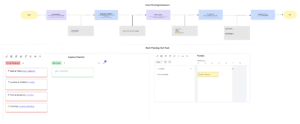
In what I can only describe as a fondness for micromanagement, I created Kanban boards and checklists for each stage, embedding all relevant event management links and tools in one central space for easy access.
Looking ahead, I’m excited to develop a similar framework for Feedback Collection, a stage I’ve come to see as essential for ensuring that today’s insights shape tomorrow’s events.
Weeks 6 & 7: Putting it into Practice
Since creating the frameworks, I’ve been implementing them alongside Team Managers. I’ve had the chance to begin streamlining event ideas and outreach processes for the Web Development team, as well as complete rigorous event ideation with the Portal Services Team.
Goals Going Forward
Looking ahead, I have a few clear goals (aside from the obvious improvement of my Miro skills).
One is to support the organisation of 5-6 concrete events from ideation all the way through to planning.
I’m also focused on developing my own soft skills. Networking is a big one. Working amongst such experienced staff, the opportunity to understand their work, take guidance, and build connections is incredible, and I hope to lean into that rather than shy away from it.
I’m eager to strengthen my organisational skills. Seeing colleagues’ reliance on calendars and time-blocking, I’ve been inspired to manage my time intentionally. This skill will benefit me far beyond this role, especially as a student.
Final Thoughts
These first two months have been a mix of learning curves, small wins, and growing confidence. I’ve learned that things often take longer than expected, especially when multiple teams are involved, but that collaboration is where meaningful work happens. I’ve felt genuinely supported, trusted to experiment, and encouraged to learn along the way.
Although I may be losing the glamorous view of the Edinburgh Castle I’ve gotten so used to, I’m sure the next few months have a lot in store, both in terms of the events we bring to life and skills I build along the way.