Any views expressed within media held on this service are those of the contributors, should not be taken as approved or endorsed by the University, and do not necessarily reflect the views of the University in respect of any particular issue.
Information about People and Culture activities and resources in the School of Informatics
As EDI Manager, I’ll be working to support an environment where everyone can thrive through policy, culture, and the everyday interactions that shape our workplace. One of the most effective ways we can do this is through learning. That’s why I wanted to use my first post to highlight the range of EDI learning available to staff, and how it connects to the values that define the School of Informatics.
EDI isn’t a standalone initiative. It’s part of how we work, lead, collaborate and grow. Learning gives us space to reflect, challenge assumptions, and build practical skills that help create a more inclusive and effective workplace. Just as importantly, engaging with EDI is a way of putting our values into practice. Many of these sessions invite us to explore perspectives that may differ from our own, an essential part of both personal and professional growth.
The learning opportunities span multiple values, because inclusion itself isn’t one-dimensional. Each opportunity highlights a different way we can bring our values to life in practice.
Value
What it means in practice
Relevant Learning Opportunities
Civility
We treat everyone considerately, care for each other, and seek to influence society responsibly.
While these opportunities are designed for staff, the values they support shape the experience of our whole community. Our students are central to this. The learning we undertake influences how we teach, supervise, collaborate, and communicate and, in turn, the kind of environment students learn and grow in.
At the same time, students are not passive recipients of this culture. Through their contributions in classrooms, group work, societies, and everyday interactions, they actively help build a community grounded in respect, curiosity, and inclusion. Many of these values are already reflected in how students support one another, challenge ideas, and bring diverse perspectives into shared spaces.
I encourage you to take some time to explore the learning opportunities not as a tick-box exercise, but as a genuine investment in how we work together. Small shifts in awareness and behaviour can make a real difference to our day-to-day culture. More details of the EDI learning can be found on the EDI Learning page.
I’m really looking forward to meeting many of you, hearing your perspectives, and working together to embed EDI into everything we do.
As a fresh graduate student, I had the good fortune to be welcomed into the privacy enhancing technologies (PETs) community that remains a core part of my academic work. Reflecting on what made a difference to me in feeling a sense of belonging I pick out two memories that have stuck with me over all these years and which, I think, hold a few lessons that I have taken away.
My first memory is of a Tor-dev meeting, which brings the developers, network operators, and many other contributors to the Tor project, and how it was run.
The format was a new one for me: each day was broken up into 1-hour blocks and the first part of the morning was deciding what those blocks would be used for. To arrive at topics everyone was given sticky notes and asked to take 10 minutes to think of things that they’d like to have discussions about, learn more about, or work on and then to stick these on to a large wall with all the other sticky notes from everyone else.
After all the sticky notes were up, we were asked to start moving the stickies around into topic clusters (no guidance on what made a cluster, that was for us to decide). This resulted in around 8-10 clusters being formed. Then we were each given 5 little coloured stickers that we could affix to the sticky-clusters if we also wanted to hear/work/think about the topic that had emerged. The clusters with the most stickers were then allocated the 1-hour blocks with participants being free to choose which ones they went to. Every block had someone in attendance report back on take-aways so that everyone got a chance to hear about all the topics.
What struck me as a newcomer was how inclusive the 2-day meeting was: anyone, a newcomer or old-timer, could have their thoughts right up there for anyone to see and to discuss. It also meant that people were generally more invested in the sessions they went to and provided a great way to mix old and new people together.
My take-away here was that ideas can come from anywhere, and getting people invested in what happens requires giving them a choice of what to do and how to do it.
The second memory is also about that first Tor-dev meeting, but from the perspective of the people I met. As an academic, albeit a novice one, I came in with the perspective of finding and solving important problems. However, I soon encountered in the participants a different world of thoughts, hopes, and dreams that gave me pause on what was important and who would care about my solutions. Here were people who would not give out their real names, who were wielding soldering irons and burning out capacitors to disable the microphones and cameras on their laptops, and who were not interesting in publications, but their actual safety in the real world.
At first this seemed surreal and paranoid, but over the course of the two days I started to see that these different mindsets, and lived experiences, and backgrounds, were the diverse truth (i.e. the many aspects of real problems). I had come in thinking of a particular set of experiments, schemes, and protocols, but left thinking more about whether Alice and Bob* were actually safe in the real-world and how I my work would help (or harm them).
The takeaway for me was real world solutions must be many-sided catering to many diverse users, their needs, and their local contexts. This continues to be a guiding principle in my research work, which is both inspiring yet overwhelming at times.
While I have related these examples above to my academic work, I think the take-aways also relate more generally to leadership and community building, two aspects that we all exercise at different scales and times in our lives, especially as members of the Informatics community.
Science and spirituality are often not compatible, because spirituality usually entails believing in God or a supernatural being that often does not reside in the materially oriented scientific way of thinking.
Image (From Canva @prerna-madans-team)
Religions were primarily developed to guide people in their everyday matters, and to pass down values of harmony and not division, such as compassion, acceptance, humility, kindness, forgiveness, and refraining from injury or revenge against others. Over time, the application of these virtues in the smallest matters of life has diminished. However, if we return to practising psychological virtues now, I believe great progress can be made, including in science. I will illustrate this using an example from my work.
Since 2018, together with my colleagues at UCL, Oxford University and the University of Edinburgh, I have been working on a meta-analysis (which in the words of Richard Dawkins – is “an analysis of analysis”) determining the association between oral hormonal contraceptives (OCs) and depression in healthy women. Following the strict criteria, we included 14 studies with a total of 2.5 million pill users. The results of the analysis showed that in users of contraceptive pills, the incidence of being diagnosed with clinical depression increased by 27%, and the incidence of being prescribed antidepressants increased by 25% compared to non-users. Depression is one of the most commonly reported side effects of any hormonal contraceptives (see the Lowdown), including pills, patches, intra-uterine devices, such as coils, injections, implants, and rings.
Now let’s look at what we found over so many years of delving deeper into the topic:
Very early in our research, we collated a list of prescribed contraceptive pills, and their patient information leaflets. We noted that depression or anxiety are reported in ‘1 in 10’ or ‘Very Common’ categories for almost all types of contraceptive pills. However, we also noted that the 2011 Cochrane Review on this topic has not mentioned depression a single time. The omission of this important data remains unclear and questionable, especially from a body such as Cochrane. We also noticed how language around the reported side effects in more recent pills has been changed. When reviewing the patient information leaflet for the latest contraceptive pills (e.g., Opill), the terms depression or anxiety are not listed, but are replaced with the term “nervousness”. There are several plausible explanations for this. One is that the trials were conducted on women who already had these as pre-existing conditions (depression, anxiety), in which case, these don’t need to be categorised as a new side-effect. A second possible explanation is that all mental health effects were combined into a single descriptor “nervousness”, which is reductive of the border and more serious mental health side effects of contraception.
A lot could be said for the widespread push-back and lack of acknowledgment of women’s experiences regarding their health, even by the choice of scientific methods. Perhaps one of the most important discoveries while performing our meta-analysis was how little a layperson would know about the methods used in the studies. Almost all studies that showed no effect between OCs and depression used unclear methodological choices. For example, three (21%) of studies treated women as “non-users” if they have been on birth control for less than one month, three months, or six months. This is ambiguous because women become users of contraception the very day they first take the pill or a hormonal contraceptive. This is almost unimaginable in any other type of drug testing. Furthermore, these women were grouped into “non-users”, which could vastly underestimate the incidence of depression in OC users.
In yet another large study, the methodological decisions became unclear when the authors excluded the category of women who had symptoms of depression combined with symptoms of anxiety. The reasoning seemed to be that women should show only one or the other form of the disorder, again something that is not entirely clear and runs counter to modern diagnostics, which treats the respective diagnoses as two sides of the same psychological coin. In adolescents who have the strongest association between depression and hormonal contraceptives (and as data suggests, persisting and irreversible), it is a common occurrence to experience depression coupled with anxiety. But again, why are such choices made in research that should be sensitive and not omissive of the very experience they are striving to study?
Our meta-analysis was not the first, but the second in the world on this topic. A group of researchers had already performed a meta-analysis in 2021 using a type of statistical method that, for reasons too complex to list here, is completely inappropriate for the data studied. For example, the authors in this meta-analysis made statistical conclusions, unsupported by the data – the authors claimed: “We provide quantitative evidence on experimental data that hormonal contraceptive use is relatively safe regarding the effect on depressive symptoms”, but the authors provided no evidence on the safety of hormonal contraceptives because they did not analyse any safety data! This sort of ambiguity should have been picked up by the reviewers at the least.
If we consistently apply the principles that are not favourable to human experience and wellbeing, and even negate them, we only drive ourselves deeper into confusion and to put it bluntly – “hell”. It has been over 60 years since the pill was first created, and the evidence for hormonal contraception causing a great deal of mental and physical suffering to many of its users is incontrovertible and overwhelming. In the words of Viktor Frankl, “The ultimate freedom given to human beings, at any moment in life, is one’s attitude in any given circumstances. Life is not primarily a quest for pleasure, as Freud believed, or a quest for power, as Alfred Adler taught, but a quest for meaning.” What, then, is the meaning of pretending we cannot see the extent of true suffering for contraceptive users? If we didn’t pretend up until now, we could have been at a different reality of contraceptive science. And this is how I see that “spirituality and science as one”.
Our meta-analysis is due for submission in The Lancet Obstetrics, Gynaecology, & Women’s Health in May 2025.
Diving headfirst into the world of self-development has been a game-changer, not just for my personal life, but for how I approach my research and connect with others. This year, I challenged myself to read 52 books—a daunting task, I admit! But the first ten, including Mindset, Atomic Habits, and The Four Agreements, have already delivered profound shifts in my perspective.
As someone with undiagnosed ADHD and dyslexia, I’ve often felt I had to work twice as hard to keep up. But these books have shown me that my perceived ‘disadvantages’ can be turned to my advantage. For example, Atomic Habits taught me how to break down complex tasks into tiny, manageable steps, a strategy that’s been invaluable for tackling research proposals and projects. It’s about leveraging my strengths – like my ability to think outside the box – and creating systems that work for my unique brain.
One of the most powerful lessons has been about mindset. Mindset and The Magic of Thinking Big have helped me shift from a fixed mindset, where I saw challenges as roadblocks, to a growth mindset, where I now see them as opportunities to learn and grow. In research, where proposals and projects regularly don’t go as planned, this shift has been transformative. I’ve learned to embrace ‘failures’ as data points, not setbacks.
The Four Agreements and The Fifth Agreement have been particularly impactful in my interactions with others. As someone who loves to build community, these books have reminded me of the importance of clear communication, integrity, and avoiding assumptions. In academia, where collaboration is key, these principles have strengthened my relationships and fostered a more positive environment.
You are a F*cking Success, and The Let Them Theory have resonated with my passion for empowering others. They’ve reinforced the importance of taking ownership of my career and advocating for my research. As someone who loves to give value to others, I’ve realised that I also need to value my own contributions and not be afraid to pursue my goals.
And as someone who’s passionate about healthy living and active ageing, Feel Good Productivity and Attitude is Everything have reminded me that well-being is non-negotiable. Research can be demanding, but prioritising my mental and physical health has actually boosted my creativity and productivity.
These books aren’t just theoretical; they’re practical tools for navigating the complexities of academia and life. Whatever your role in our school, I encourage you to invest in your self-development. It’s a journey that will not only enhance your professional performance but also enrich your personal life. And who knows, you might just find your own advantages along the way!
As a woman studying in the University of Edinburgh’s School of Informatics, I’ve often felt like the odd one out. Informatics, and especially computer science, is still a field largely dominated by men, and this can sometimes feel isolating. There have been times when I’ve felt that my voice wasn’t heard as much, or that my opinions weren’t as valued by my male peers. It’s not always easy to speak up in a space with so few women, and there are moments when I’ve questioned whether I belong.
However, some things that have helped me navigate these challenges are getting involved in the Makerspace and becoming an ambassador for Scottish Women in Informatics. Over the summer, I had the opportunity to complete an Edinburgh Award in the Makerspace, where I was able to get hands-on experience with various technologies and projects. The Makerspace is an incredible environment for creativity and learning. It’s a place where students can get involved with exciting projects, such as 3D printing, laser cutting, and robotics. These can be projects that students are working on as part of their degree, or simply a personal project they are passionate about.
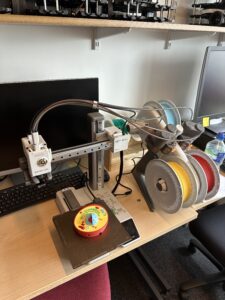
Students can drop by the Makerspace on level 3 of Appleton Tower, at any time to see what’s going on, get involved, or even just chat with the friendly team. The Makerspace team is always enthusiastic about new projects and loves helping students develop their skills. It’s also a great space to explore opportunities like the Edinburgh Award, which makes a great addition to the CV. During my time in the Makerspace, I worked on various projects, including learning to use the new 3D Bambu printers that print in multiple colours. I was given the creative freedom to choose what I wanted to print while learning how to operate the printers, and among other things, I chose to print a log cabin and a highland cow. (Photos of these are included below!) Getting involved with the Makerspace has allowed me to meet and collaborate with people from different backgrounds, including other women in the field. This experience has helped me build confidence in my technical skills and has given me a greater sense of belonging within the Informatics community.
Being an ambassador for Scottish Women in Informatics has also been an empowering experience. As an ambassador, I get to engage with prospective students and help create a more welcoming and inclusive environment for women who are interested in studying in the School of Informatics at the University. It’s inspiring to see how many women are passionate about technology and eager to get involved in this field. I’ve also learned the importance of supporting and encouraging each other, especially in a space where women are still underrepresented.
Through these experiences, I’ve learned the value of respecting and being confident in my own opinions. It’s easy to second-guess yourself in a male-dominated space, but I’ve come to realise that my perspective is just as valuable as anyone else’s. I’ve also learned that there is strength in numbers, and getting involved in societies and embracing opportunities like those from engaging with the Makerspace can help you find your voice and connect with others who share your passions and challenges.
I want to encourage other women in Informatics, or those considering the field, to get involved in spaces like the Makerspace or consider becoming an ambassador to meet like-minded people and grow confidence. For those interested, you can find the Makerspace on level 3 of Appleton Tower or visit the Makerspace SharePoint to access a range of resources and contact information. Additionally, becoming an ambassador offers a great opportunity to build connections and develop your leadership skills. It’s important to build support networks and remember that you belong here just as much as anyone else. While the journey may sometimes feel isolating, there are communities and opportunities that can help you grow and thrive. The key is to respect your voice, trust in your abilities, and connect with others who share similar experiences.
One of the Bambu mini printers in action, printing with 4 colours.
The Royal Society has led the way on research culture in recent years, establishing the following definition, which is now widely adopted:
Research culture encompasses behaviours, values, expectations, attitudes and norms of our research communities. It influences researchers’ career paths and determines the way that research is conducted and communicated.
You can find out more about the Society’s activities in this area. Recently they produced a video illustrating what research culture is and why it is important:
The University of Edinburgh published its own Research Culture Action Plan, and supporting Delivery Plan in 2023.
Both within the University and more widely much of the focus of research culture development is on early career researchers. In contrast, there has been less attention paid to those towards the end of their career and the role that they can play in creating a vibrant and inclusive research environment. In 2022 Professor Veronica van Heyningen, who has held leadership positions at UCL and the University of Edinburgh, led a Royal Society project on Changing Working Lives, which particularly looked at the roles and opportunities for researchers at different career stages. The project took into consideration general changes in the research environment and the impact of the pandemic on working practices.
We are all aware of demographic changes that are taking place in society, with rising numbers of older people and a falling birth rate. This project sought to understand the implications of these changes within academia, and in particular, on research culture. A key outcome of the project was the need for explicit consideration of the responsibilities of older researchers and intergenerational fairness.
In the last decades there have been several changes that have led to longer active careers for older researchers such as the fact that there is now no fixed retirement age in most universities, flexible and part-time working has become more accepted and readily available for all, and the benefits of people staying healthy and active for longer are widely recognised. In the academic setting the continued participation of experienced researchers has considerable benefits for the scientific community and our shared endeavours.
Nevertheless, sensitivity and awareness are needed to ensure that this “older” generation is supporting and generating opportunities for the “younger” generation, rather than becoming a block on their careers. This is particularly true when, as now, universities are working under situations of limited resource. Funding, PhD students, working space and positions of responsibility are all vital for early and mid-career researchers to establish themselves, but they may not have the credentials to compete directly with late career researchers.
The Royal Society Changing Working Lives project highlighted these issues and suggested that intergenerational fairness called for action from different stakeholders in research. Researchers themselves should consider how best to advance science. Particularly for those later in their career, this wider consideration should start to take precedence over advancing their own career. Funders should consider selection processes and the role of track record in funding decisions. Universities should consider special support systems and resources for mid-career researchers to enable them to step up to the demands of senior leadership roles, then creating opportunities for early career researchers too.
Diverse teams have been shown to be more effective and creative in many circumstances, and diversity should include consideration of age and experience. But it should not become the default that the most senior member of the team should be the leader. These team members are likely to bring invaluable skills and experience, but in the long term these skills may be best used to focus on technical aspects of the problem whilst mentoring and supporting a less experienced colleague in the position of leader. It is essential that we maintain a flow of talent and provide sufficient resource for those in their early and mid-career for that talent to grow and flourish.
I would like to take this opportunity to advertise the fantastic ED&I reading group that regularly meets in the Informatics Forum.
This reading group usually discusses a research paper on a topic related to equality, diversity and inclusion. Everyone in Informatics – and beyond – is invited to attend. To give you an idea of the sort of research the reading group discusses, the first paper was “Everyone has an accent” by Nina Markl and Catherine Lai. The first author joined us to present key points of her work and we discussed it directly with her. The paper was published at Interspeech 2023, and it points at a gap between how accents and accented speech are thought of in the linguistics literature and how speech technology research talks about them.
In everyday language, we might say that someone ‘has an accent’, which makes it sound like some people don’t have an accent. The speech technology literature seems to have embraced this idea. For example, there are studies that try to detect from a voice recording how “accented” someone’s speech is, and try to measure it on a scale. There have been suggestions that this technology could be used to decide whether a customer service employee is right for the job or whether they might require additional training. The linguistics literature, however, is clear: Everyone – from someone who has just started to learn English to the King – has an accent. The difference is that they have different accents, so they pronounce things differently.
Why does this distinction matter? One reason it matters is that perceptions of accents depend on the listener: an American may find that a Hollywood actor “doesn’t have much of an accent” but of course a Scottish person would disagree if the actor sounds American. Therefore it does not make much sense to say that one person has more of an accent than someone else, objectively. Where things do start to have an impact is when you are having difficulty understanding someone’s speech. Therefore, a more useful concept than accentedness is intelligibility. That is still not something we can measure in a single number (intelligible to whom?) but we can measure whether someone’s speech is intelligible to a specific group of people or to a specific voice recognition system.
To me, this research shows what happens when we take everyday notions and shorthands, like “having an accent” and incorporate them into our research without reflecting on the hidden biases that they are based on. In this case, could stereotypes about English learners and about class be playing a role when researchers equate the poorly defined idea of “accentedness” and intelligibility? It’s perfectly possible for someone to be easy to understand while they also have an accent that clearly shows where they grew up. Decisions about who gets a job or not, or who receives additional training, should not be based on research that uses flawed, outdated concepts.
For me, the goal of discussing such issues in a group isn’t to point fingers, it’s to critically reflect on our own stereotypes, and how they may be influencing our research, so that we can become better researchers.
The ED&I reading group usually meets once a month on a Tuesday at 1pm, in G.03. There is a mailing list (inf-edi-reading-group@mlist.is.ed.ac.uk), please find sign-up instructions here. For those who come, there’s pizza!
Research in AI is an increasingly exciting and fast-paced environment, with many new interesting features and applications available at a wider scale. However, it is also the topic of heavy criticism for often failing to represent and serve minority groups, which have historically been underrepresented in conversations about technology. Being PhD students in the CDT in NLP, we think it is extremely important to keep up with issues regarding equality, diversity and inclusion (ED&I), both to improve our own work but also to be critical about new advancements in the field.
Because of that, we are currently hosting a reading group in ED&I once a month, open to all postgraduate students and staff from the School of Informatics.
Anyone involved can choose a paper which they think is of interest, no matter whether it is their own work or not. Although attendees are encouraged to read the paper beforehand, this is not a requirement as we start with a ~15 min presentation. Afterwards, an informal group discussion follows, which allows everyone to comfortably express their ideas and ask questions. For the past few months, the sessions have had a very friendly atmosphere and we have learned a lot from each other about how to be more mindful researchers.
Through the ED&I reading group, we’re hoping to raise some awareness on how issues relating to equality, diversity and inclusion can impact current AI research, but also how AI research can have consequences in areas which have a direct or indirect impact on society. We also aim to foster a welcoming and inclusive environment where researchers can share and discuss their ideas on how AI research is impacting our society. We hope that attendees leave with thoughts on how their choices as a researcher can make a difference for people who have often been left out of the conversation about AI and how their choices can change that.
From the past few sessions, we have learned a lot from all the people who have presented and whom we have shared a discussion with! Our past sessions have covered:
With AI being an exciting and constantly evolving area of research, we believe that issues of equality, diversity and inclusion are more important than ever for researchers to be aware of, even if their own topic of research is not directly linked to them.
If you are a researcher at the School of Informatics, we hope you’ll join us the last Tuesday of every month from 1-2pm for engaging presentations and fruitful discussions. Let’s all learn from each other! We usually meet in G.03, with the exception of 30th April, where we will meet in IF 1.15.
Our School works best when everybody is heard, and nobody is left behind. We are always eager to find out how to improve our community, with regular official feedback opportunities. In the last two years the School Culture survey, Athena Swan focus groups, and the University’s Staff Engagement survey have been implemented. These have revealed some common issues that we should improve; and although some we can only raise to College or University, there is a great deal that we as a School can act upon.
Findings to date may indicate that we need to listen and respond further to the needs of our staff. We’re keen to hear voices from across the whole School, especially including those who may not have contributed their views yet.
Therefore, the School is contracting an external body, Advance HE, to do three things:
Analyse all available data to understand what workplace issues are happening;
Facilitate an independent consultation of our School community to understand why these issues are challenging;
Develop independent recommendations about improving staff and student experiences.
Practically, over the next couple of months, Advance HE will be conducting 8 focus groups – 2 for professional services staff, 2 for academic staff, 2 for research staff, and 2 for research students – as well as in-depth interviews with key senior staff members. All work is completely independent from the School leadership, with robust and proper privacy and ethics considerations in place.
Our School has kindly invested in this work to improve our culture. When you are invited to join a focus group, please grab the chance, even if – especially if – you typically don’t respond to surveys. It is a great opportunity to improve our effectiveness to work together as a productive and happy community. Let’s seize it!
I went to the WomEncourage conference in Trondheim, Norway in September 2023, and here are some lessons that I learnt.
It’s amazing to be in a female-dominated computing environment. We are all used to spaces where people are talking about computing being very male dominated. Mostly that is ok, and mostly we can feel welcome and part of that environment. But it’s a wonderful change to be discussing technical details about computing in a room that is 80% female – being in the majority feels good.
Women working together is inspiring and uplifting. WomEncourage was formed by a group of women who had been working to support other women in their home countries and came together to form ACM-W Europe, and soon after came up with the idea of an annual conference – here is the inspiring story. Anyone in tech can join ACM-W and get involved in working with this community, and this is something I would very much encourage our female staff and students to do.
Hackathons don’t have to focus on coding. The WomEncourage hackathon required teams to come up with innovative ideas about how tech could create meaningful solutions to some of the UN Sustainable Development Goals. Understanding tech and having plausible ideas about what could work was key, but the focus was on hacking the ideas and not the code.
There is a huge skills gap in ethics and DEI in tech. Employers cannot find enough people with technical skills who also have an understanding of:
How to support and encourage diversity within the workplace (tech firms are often terrible at this and want to get better)
How to develop technology that is ethically aware and accessible to all – e.g., not just aimed at the most common (white, male) demographic
Encouraging our students to develop these skills is not just about doing the right thing – it’s about equipping our students for the modern job market and helping tech firms fill these crucial roles.
Most people (companies, universities, etc.) are doing the right thing in terms of talking about unconscious bias and other diversity issues. But very often this has very little payoff because it’s not deeply engrained into every day life but instead is an add on. This is rarely effective.
In university settings, ethics is often taught as a separate or additional subject rather than as a core part of every single branch of CS and tech – and it’s often taught by people with no background in ethics. Every time we teach or learn anything, we should regard thinking about the ethical and societal impacts to be as important as the technical knowledge.
The paths into tech careers are many and various. Women and other minorities can flourish by following a ‘standard’ path in tech or by creating a new path that focusses on their passions and skills. Birgit Penzenstadler, whose research focusses on sustainable software development, talked about how she brings yoga and mindfulness into her teaching and research practice.