

【Edinburgh Bayes Coffee House Tech Talk】Towards an End-to-End Tensor Compiler
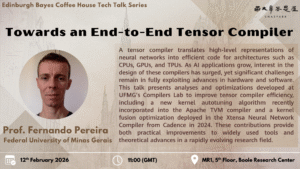
Event Title: Towards an End-to-End Tensor Compiler
Speaker: Nachiappan (Nachi) Valliappan
Dates: Thursday, 12th February 2025
Time: 11am (GMT)
Location: MR1, 5th Floor, Boole Research Center
Join Online:https://app.huawei.com/wmeeting/join/98629112/x8nxVMaRb1ZsYk9kzYcCo6ethoLXhbBpM
Meeting ID:98629112
Passcode:502526
Talk Abstract
A tensor compiler translates high-level representations of neural networks into efficient code that runs on diverse architectures such as CPUs, GPUs, or TPUs. With the growing popularity of artificial intelligence applications, interest in the design and implementation of such compilers has surged. Yet, much remains to be done before we have tools fully capable of exploiting advances in hardware technology and emerging software trends.
This talk will present analyses and optimizations developed at UFMG’s Compilers Lab to make tensor compilers more efficient. In particular, we will discuss a new kernel autotuning algorithm recently incorporated into the Apache TVM compiler and a kernel fusion optimization deployed in the Xtensa Neural Network Compiler from Cadence in 2024. These contributions represent not only practical improvements to widely used tools but also theoretical innovations in a rapidly evolving research field.
Speaker
Fernando Pereira received his Ph.D. from the University of California, Los Angeles in 2008. Since November 2009, he has been an Associate Professor in the Department of Computer Science at the Federal University of Minas Gerais, where he leads the Compilers Lab. His research develops principles and techniques that enable programmers to use modern hardware resources more efficiently through static analyses and compiler optimizations. His contributions include the puzzle-based register allocator (Patent US 2009/0083721 A1), the Divergence Analysis currently adopted in Mesa3D, the Droplet Search algorithm used in the Apache TVM compiler, and the MST Kernel Fusion algorithm employed in the Xtensa Neural Network Compiler.




Comments are closed
Comments to this thread have been closed by the post author or by an administrator.