Any views expressed within media held on this service are those of the contributors, should not be taken as approved or endorsed by the University, and do not necessarily reflect the views of the University in respect of any particular issue.
Skip to content

3

On Tuesday 30th January we'll be holding a Discovery Day event in the Main Library where representatives from 3 publishers of digitised primary source collections and our very own Centre for Research Collections will be on hand to help you navigate through and find useful material in the huge range of primary sources you have access to at the Library. Adam Matthew are one of the publishers who will be attending and this blog post highlights the fantastic collections the Library has access to through them.

The Library has access to a large and broad range of digital primary source collections that can be accessed via the Primary Source database list (see also the separate lists for Newspapers & Magazines and Images & Moving Images).

Adam Matthew are a publisher who specialise in producing high-quality, digitised primary source collections online. They put together thematic collections sourced from libraries, archives, museums, etc., around the world and they have databases that cover the Medieval period onwards.
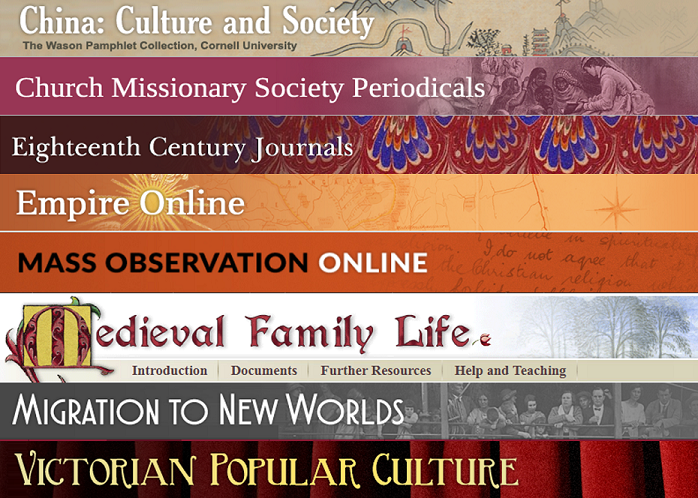
The Library is very lucky to have access to 11 of these collections (or databases) from Adam Matthew and all can be accessed via the Primary Source database list.

China: Culture and Society

...continue reading "Spotlight on Adam Matthew digital primary sources"

I'm happy to let you know that Adam Matthew Digital are very kindly giving us trial access to 7 of their fabulous primary source databases. This gives you a unique opportunity to access some extensive digitised primary source collections that between them cover the 16th to the 21st century.

So if you're interested in the history of the book or history of publishing, theatre history, socialism in the 20th century, Japan in the 20th century, social and cultural history, 17th to 19th century poetry, Shakespeare, Wordsworth, etc., there may be something here for you.

Left: Advertisement for the New Music of Country Dance executed by several celebrated horses at the Olympic Pavilion (1807) from Eighteenth Century Drama. Right: Architectural plan for Oxford University Press, Amen Corner (1913) from Literary Print Culture.

All the databases can be accessed via the E-resources trials page.
Access is available on and off-campus.

Trial access to all the Adam Matthew Digital databases ends 20th November 2017.

I've already highlighted Socialism on Film and Foreign Office Files for Japan in previous blog posts so this post will round up the further 5 databases available to us for the trial period. ...continue reading "On trial: primary source databases"

1

Are you interested in Japanese history in the twentieth century? Do you want to know more about Anglo-Japanese ties in the first half of the twentieth century?

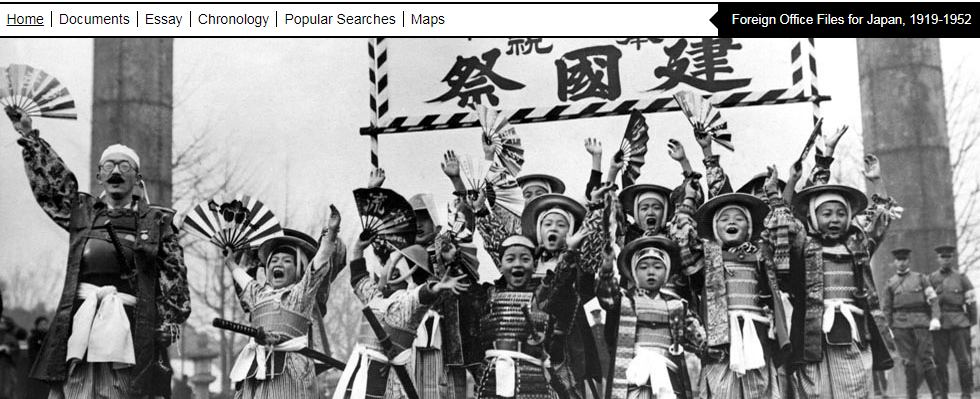
The Library currently has trial access to Foreign Office Files for Japan, 1919-1952 from Adam Matthew Digital. This database makes available extensive coverage of British Foreign Office files dealing with Japan between 1919 and 1952.

You can access the database via the E-resources trials page.
Access is available both on and off-campus.

Trial access ends 20th November 2017. ...continue reading "On trial: Foreign Office Files for Japan"

1

I'm pleased to let you know that the Library has been given the opportunity to trial for a second time the fascinating Socialism on Film: The Cold War and International Propaganda from Adam Matthew Digital and the BFI National Archive.

This impressive collection of documentaries, newsreels and features reveals the world as seen by Soviet, Chinese, Vietnamese, East European, British and Latin American film makers. Documenting the communist world from the Russian Revolution until the 1980s and covering all aspects of socialist life. And what makes this resource unique is the collection of films were produced almost exclusively in the communist world and then versioned into English for distribution in the West.

You can access the database via the E-resources trials page. Access is available both on and off-campus.

Trial access ends 20th November 2017. ...continue reading "On trial: Socialism on Film"

*The Library has now purchased access to the 'Women's Magazine Archive, collection I and II'. See New to the Library: Women's Magazine Archive.*

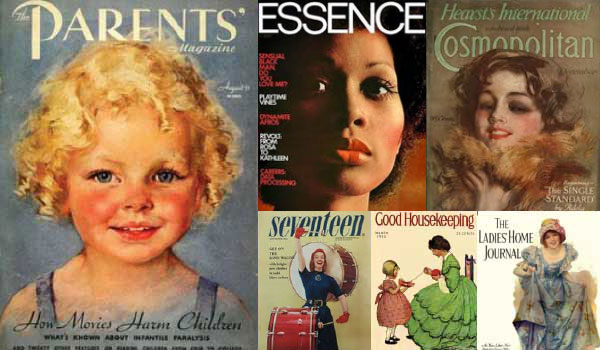
Following a request from a student in HCA the Library now has trial access to ProQuest's Women's Magazine Archive, collection I and II. This unique database comprises archival runs of leading women’s consumer magazines of the twentieth century.

You can access the database via the E-resources trials page.
Access is available both on and off-campus.

Trial access ends 16th November 2017. ...continue reading "On trial: Women’s Magazine Archive I and II"

*The Library has now purchased access to this resource. See New to the Library: Illustrated London News Historical Archive*

Thanks to a request from a member of staff in HCA the Library currently has trial access to the Illustrated London News Historical Archive, 1842-2003. Illustrated London News was the world's first pictorial weekly newspaper and this archive gives access to the full run of this iconic illustrated newspaper.


You can access this online archive via the E-resources trials page. Access is available both on and off-campus.

Trial access ends 31st October 2017.

The first issue of Illustrated London News was published on Saturday 14 May 1842 and as the world’s first fully illustrated weekly newspaper, it marked a revolution in journalism and news reporting. ...continue reading "On trial: Illustrated London News 1842-2003"

In August 1947 British India won its independence from the British and split into two new states, India and Pakistan (East Pakistan subsequently became Bangladesh), that would govern themselves. The Partition of India, as it was known, created a huge refugee crisis with millions of displaced people and the level of violence and loss of life prior to and after the Partition has caused reverberations over the years, with hostile relations between India and Pakistan continuing to this day.

With the 70th anniversary of the Partition of India being marked this month I've pulled together just a small selection of Library resources that will help you explore the Partition of India further.

What did the papers say?

The Library subscribes to a large number of online newspaper archives that will allow you to see what events were being reported on at the time and how they were being reported. Read full text articles, compare how different newspapers were covering the same issues and stories, track coverage from the start of the Indian independence movement in the 19th century until post-partition.

Screenshot from The Times of India.

The Times of India (1838-2007)
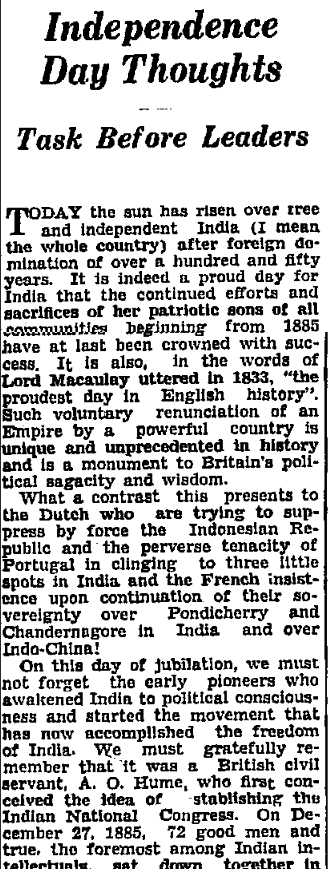
The Library has access to the online archive of The Times of India, which covers the period 1838-2007. The Times of India is the world's largest circulation English daily newspaper and, as would be expected, is particular valuable for its coverage of key historical events in India, such as the Partition.

But how does this compare with how newspapers in the UK were reporting on it e.g. The Times, The Guardian and The Observer, The Scotsman, The Telegraph, etc., or how international newspapers were reporting on events e.g. The New York Times, Washington Post, Le Monde, Japan Times, etc?

Want to look at more recent coverage of the Partition of India? The Library also subscribes to databases, such as Factiva and Nexis UK, that allow you to search and access the full text of a large number of UK and international newspapers from around the 1980s up to date. You can access these, the databases mentioned above and many other newspaper archives and magazine archives from Newspaper Databases. ...continue reading "Explore the Partition of India through our library resources"

2

I'm pleased to let you know that after a successful trial in semester two, 2016/17, the Library has now purchased access to four more collections from ProQuest's Digital National Security Archive (DNSA).

The four new collections are:

  • Chile and the United States: U.S. Policy toward Democracy, Dictatorship, and Human Rights, 1970–1990
  • Electronic Surveillance and the National Security Agency: From Shamrock to Snowden
  • The Iran-Contra Affair: The Making of a Scandal, 1983–1988
  • Iraqgate: Saddam Hussein, U.S. Policy and the Prelude to the Persian Gulf War, 1980–1994

You can access these collections and the other 7 collections we already own from DNSA from the Databases A-Z list or subject databases lists. See Spotlight on Digital National Security Archive (DNSA) for information about the 7 previously purchased collections. ...continue reading "New to the Library: 4 new collections of declassified U.S. government documents"

1

In this week’s blog I’m using some of the Library’s online resources to find primary source material relating to the popularity of women's football during and just after the First World War and the decision by the FA to ban it.

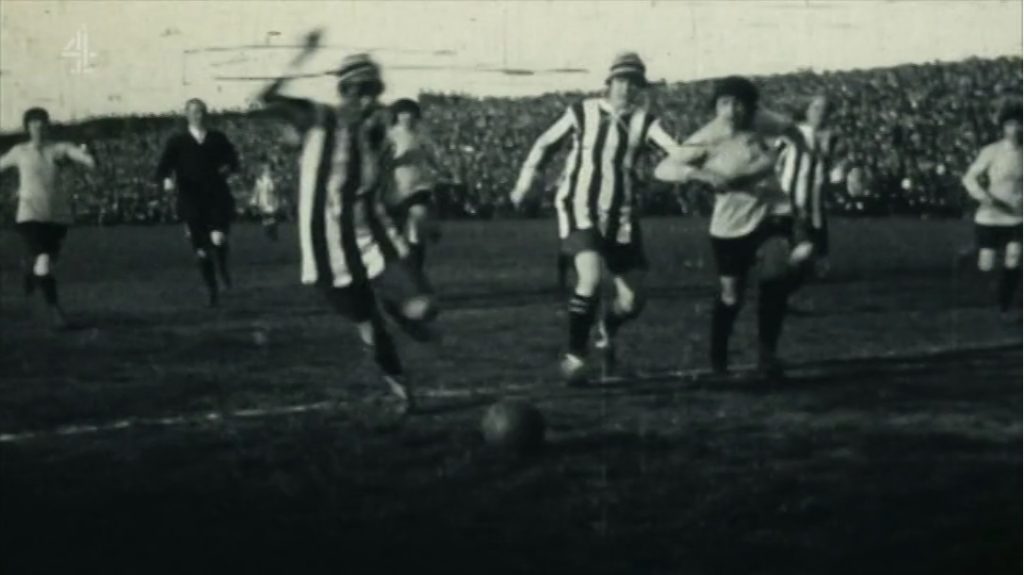
The other night on catch-up I watched the Channel 4 documentary When Football Banned Women, programmed to coincide with the Women’s EURO 2017 (which Channel 4 just happens to be showing, it’s like they thought about their programming or something!) This interesting documentary looked at the rise in popularity of women's football during the First World War and the subsequent decline after the decision by The Football Association (FA) to ban the women's game in 1921.

If you’ve not seen it you can watch it on Box of Broadcasts (BoB).

Screenshot from 'When Football Banned Women' (Channel 4).

As I am always looking for an excuse to use some of the University Library’s fantastic online primary source collections, I decided this was a perfect story to try and find out more about from our online archives.

While I primarily used some of the online newspaper archives the Library has access to for that period, I did do some searching in some other primary source collections that covered the period in question. You can find a list of the specific databases I used at the end of the post.

Women's football in the First World War

With 1000s of men being called up to fight in the First World War, women were expected to take on roles as never before in the workplace and with this came other opportunities. Women’s football teams began to form, often put together or sponsored by the industries and companies now employing the vast female workforce. These teams began to play matches with the primary aim of raising money for charity and while spectators may have originally attended to help raise money and to watch what they thought of as a novelty, they continued to attend as the matches were good and the teams had skill. ...continue reading "Why football banned women"

The Library now has access to the fascinating Presidential Recordings Digital Edition. This rich resource includes transcripts and corresponding audio of secretly recorded conversations in the Oval Office from Presidents John F. Kennedy, Lyndon B. Johnson and Richard M. Nixon.

You can access Presidential Recordings Digital Edition via the Databases A-Z list and relevant Databases by Subject lists e.g. Primary Sources, Politics, etc. and you can access it via DiscoverEd.

Presidents Franklin D. Roosevelt through to Richard M. Nixon all secretly recorded many of their conversations in the Oval Office. The resulting 5,000 hours of telephone and meeting tape recorded during their time in the White House   capture some of the most significant moments in modern American political history. From Birmingham to Berlin, from Medicare to My Lai, from Selma to SALT, and from Watts to Watergate, the presidential recordings offer a unique window into the shaping of U.S. domestic and foreign policy. ...continue reading "New to the Library: Presidential Recordings Digital Edition"

css.php

Report this page

To report inappropriate content on this page, please use the form below. Upon receiving your report, we will be in touch as per the Take Down Policy of the service.

Please note that personal data collected through this form is used and stored for the purposes of processing this report and communication with you.

If you are unable to report a concern about content via this form please contact the Service Owner.

Please enter an email address you wish to be contacted on. Please describe the unacceptable content in sufficient detail to allow us to locate it, and why you consider it to be unacceptable.
By submitting this report, you accept that it is accurate and that fraudulent or nuisance complaints may result in action by the University.

  Cancel