Any views expressed within media held on this service are those of the contributors, should not be taken as approved or endorsed by the University, and do not necessarily reflect the views of the University in respect of any particular issue.
Are you interested in British intelligence, foreign policy, international relations, and military history in the 20th century? Then Secret Files from World Wars to Cold Wars: Intelligence, Strategy and Diplomacy may be just what you're looking for.
Secret Files from World Wars to Cold Wars provides access to British government secret intelligence and foreign policy files from 1873 to 1953, with the majority of files dating from the 1930s and 1940s.
Today's post, highlighting the wide range of newspaper archive databases the Library has and how these can be used to research a particular topic or event, is written by Louise Peterkin, Helpdesk Assistant, University of Edinburgh Libraries. During lockdown Louise also worked part-time with the Library Academic Support team.
I was delighted to be asked to write a blog showcasing the University’s wide range of databases and primary sources. These have been bolstered considerably in the last few months with the exciting addition of 365 new databases through our new ProQuest 350 Access subscription.
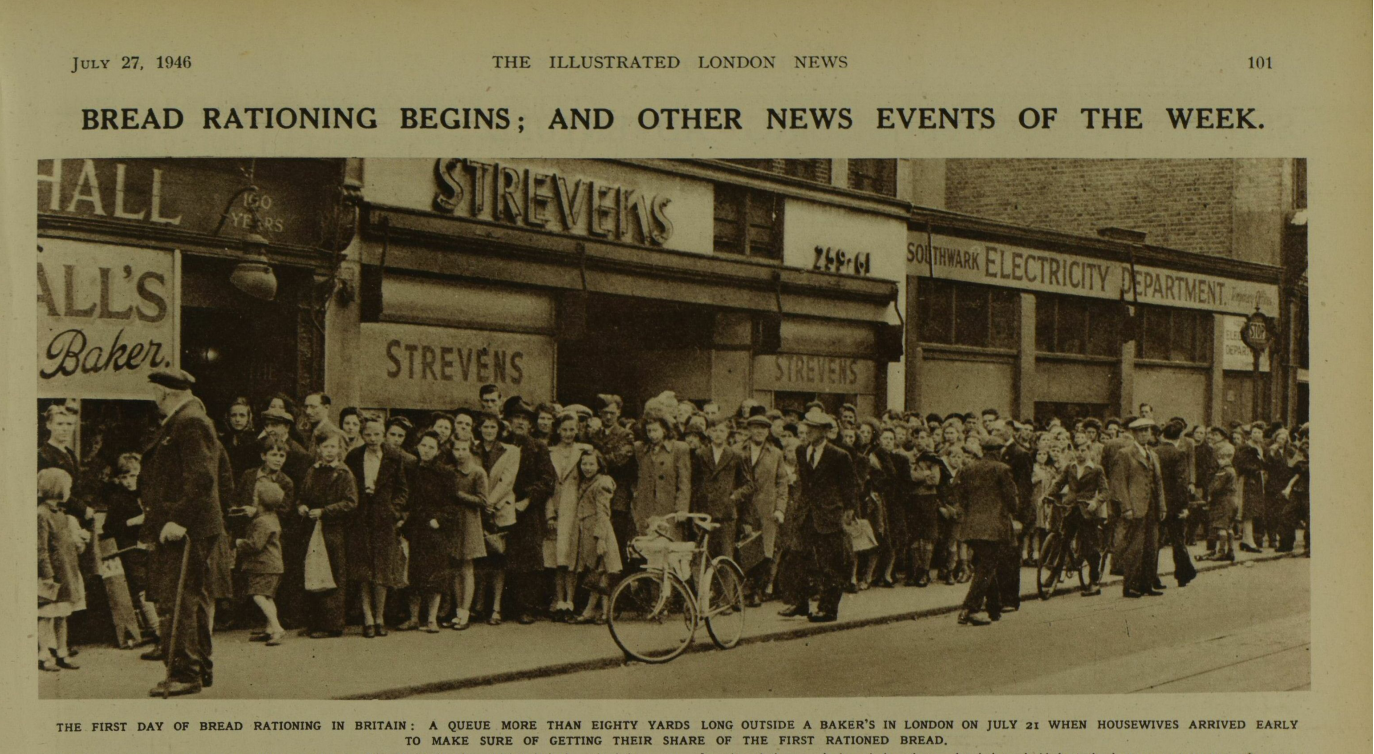
Looking for inspiration as to what to write about I searched Google for important events in history that fell between July and August. 22 July 1946 – Bread rationed for the first time in the UK leapt out at me. I always thought bread had been rationed during World War 2? I was keen to find out more.
Screenshot of "Bread Rationing Begins; and Other News Events of the Week." Illustrated London News, July 27, 1946, 101. The Illustrated London News Historical Archive, 1842-2003.
I researched the topic through the University’s databases, starting with our newspaper archives. We have access to ProQuest Historical Newspapers, which includes access to The Guardian (1821-2003), The Observer (1791-2003) and The Scotsman (1817 -1950) and Gale Primary Sources and Gale News Vault which contain access to many historical newspapers including to the Daily Mail Historical Archive (1896-2004) and Times Digital Archive (1785 to 2011). ...continue reading "Bread Rationing: a surprising and timely subject"
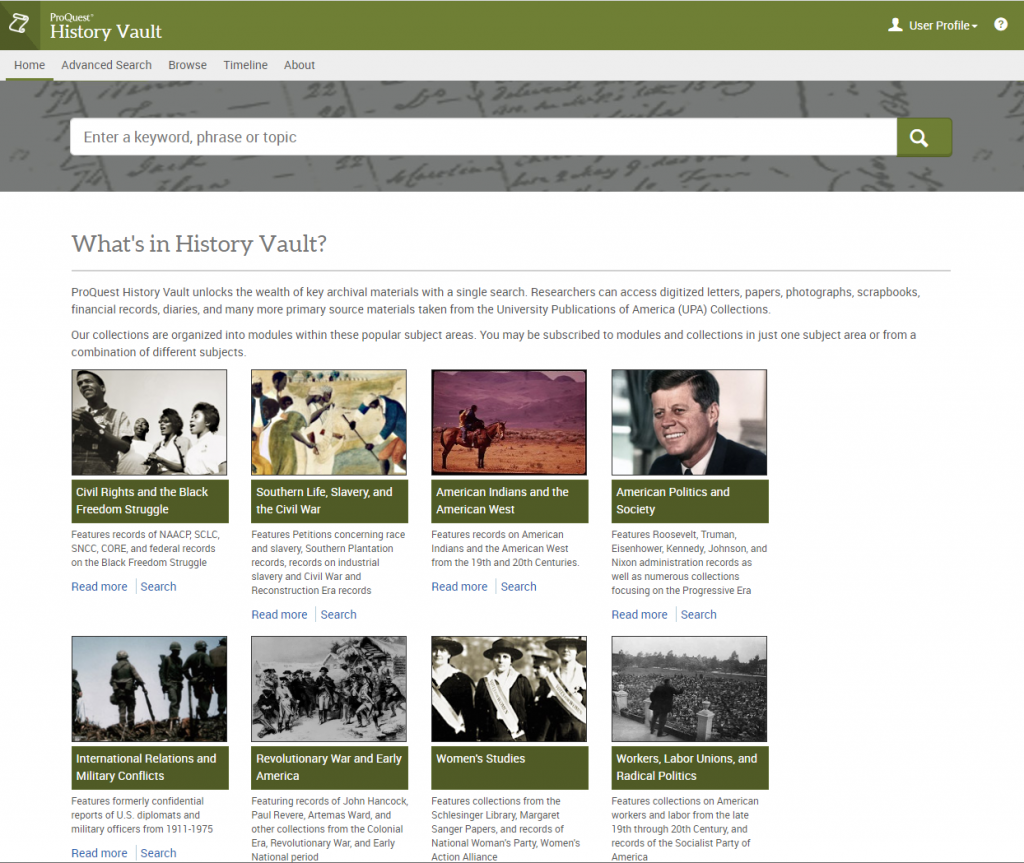
Interested in American history? Then ProQuest History Vault may be exactly what you are looking for.
History Vault gives you access to millions of pages of cross-searchable, full-text/full-image documents including articles, correspondence, government records, photographs, scrapbooks, financial records, diaries and more, documenting the most widely studied topics in 18th- through 20th-century American history. It's a fantastic resource for those teaching, learning or researching in the areas of history, African American studies, women’s studies, political science, social sciences, sociology, and international studies.
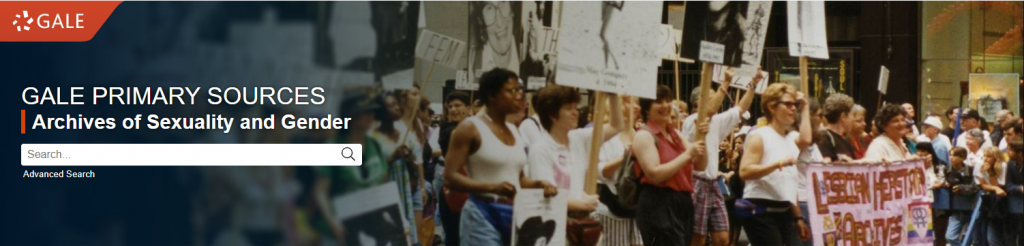
It's LGBT+ History Month in the UK and there are a number of events being run around the University by the Staff Pride Network and the Students' Association. However, if you're interested in delving into the archives to find out more about LGBT+ history in the UK then the Archives of Sexuality and Gender may be just the place to start.
Archives of Sexuality and Gender spans the 16th to the 20th century and is the largest digital collection of primary source materials relating to the history and study of sex, sexuality and gender. Documentation covering social, political, health and legal issues impacting LGBT+ communities around the world is included, as well as rare and unique books on sex and sexuality from the sciences to the humanities.
This extensive resource is made up of 3 databases, LGBTQ History and Culture Since 1940 Part I, LGBTQ History and Culture Since 1940 Part II and Sex and Sexuality, Sixteenth to Twentieth Century, which between them cover 54 collections that are international in their scope and coverage. But I want to highlight those collections that specifically look at LGBT+ history in the United Kingdom.
Gay Activism in Britain from 1958: The Hall-Carpenter Archives
Spanning the period from 1958 to 1990, this collection chronicles the activities of the Albany Trust, an organisation that was initially focused on decriminalising homosexuality and increasing social acceptance of gay people. The Albany Trust centered its work on counseling services, research, and public education, helping to steer society and the law away from older, traditional ideas regarding homosexuality. ...continue reading "Spotlight on: Archives of Sexuality and Gender"
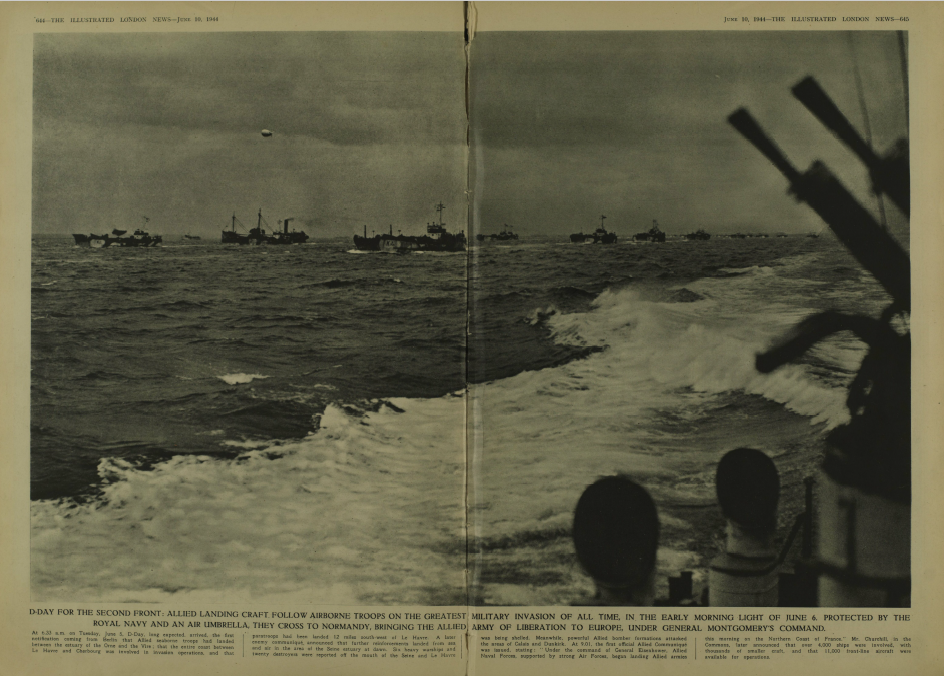
On this day, 6 June, 75 years ago the Normandy landings took place. This was part of a major combined naval, air and land assault on German-occupied France by Allied forces, codenamed Operation 'Overlord'. The D-Day landings saw around 150,000 Allied troops land on French soil but it was just the start of a much longer operation to liberate France. In this week’s blog post I have pulled together just a small selection of our digital library resources that will help you explore the Normandy landings, the events leading up to it and the aftermath. And you can use many of these to find out more about the many other events happening around this time that contributed to the end of the Second World War.
D-Day For the Second Front, 'Illustrated London News', Saturday 10 June 1944, pp. 644-645. From Illustrated London News Archive.
What did the papers say?
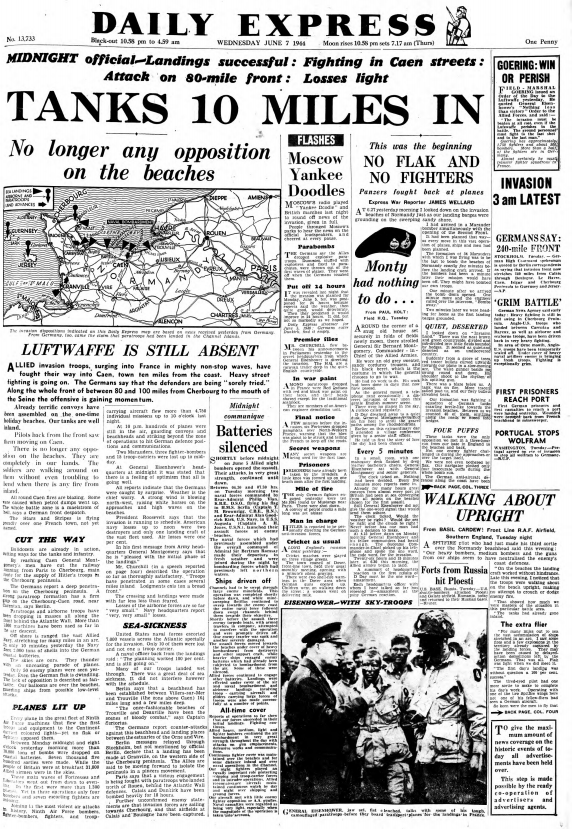
Operation Overlord was top secret, so it wasn't until the 6th June that news of the invasion began to filter through. Reports of the Normandy landings does appear in some late editions of newspapers from that day but it is mostly covered in issues published the next day, 7th June, or on next subsequent publication date.
Front page of the 'Daily Express', Wednesday 7 June 1944. From UK Press Online.
The Library subscribes to a large number of digitised newspaper archives that will allow you to see what events were being reported on at the time and how they were being reported. Read full text articles, compare how different newspapers were covering the same issues and stories and track coverage of Operation Overlord from the Normandy landings onwards. ...continue reading "Normandy landings: through our digital primary sources"
This is part of an occasional series highlighting some of the digital resources available at the Library that will be of interest to students and staff in History, Classics and Archaeology.
Federal Bureau of Investigation [Public domain]The Federal Bureau of Investigation (FBI) was formed in 1908 by then Attorney General, Charles Bonaparte, under President Theodore Roosevelt. Initially known as the Bureau of Investigation (it added "Federal" in 1935) over the next 110 years the FBI's remit and influence grew considerably and they are synonymous with American cultural, social and political history in the 20th century and beyond.
The FBI have been involved in a large number of famous, not so famous and infamous cases dealing with organised crime, terrorism, civil rights, white collar crime, espionage, violent crime and more. And did you know that through the Library you have access to a range of digitised files from the FBI?
FBI Files in Archives Unbound
Through the Library's subscription to Archives Unbound (an enormous digital primary source database) you have access to over 20 collections of digitised material direct from the FBI, covering over 70 years of American history. You'll spot some famous cases and names within these but possibly also some less known. However, between them they provide a fascinating insight into the political, cultural and social climate of the United States in the 20th century.
FBI File: Julius and Ethel Rosenberg
Julius and Ethel Rosenberg were a nondescript couple accused in 1950 by the U.S. government of operating a Soviet spy network and giving the Soviet Union plans for the atomic bomb. The trial of the Rosenbergs, which began in March 6, 1951, became a political event of greater importance than any damage they may have done to the United States. It was one of the most controversial trials of the 20th century. Their guilt and the harshness of their sentences continue to be vigorously debated to this day. ...continue reading "Spotlight on: FBI Files"
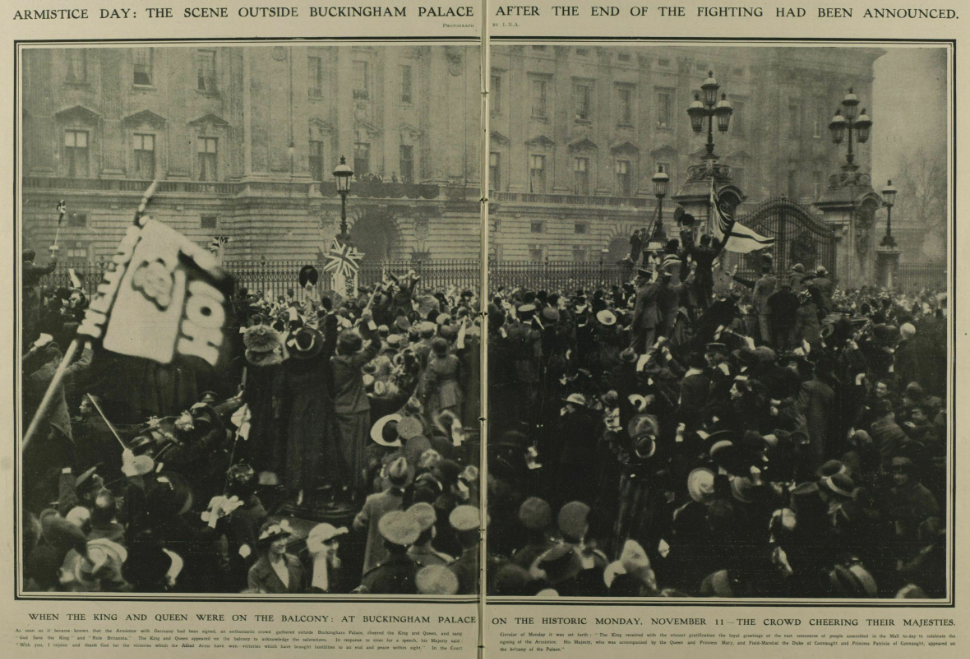
This weekend, Sunday 11th November, marks the 100th anniversary of the end of the First World War. In this week’s blog post I have pulled together just a small selection of Library resources, digital and physical, that will help you explore the First World War, the events leading up to it and the aftermath.
"Armistice Day: The Scene outside Buckingham Palace after the End of the Fighting Had Been Announced." Illustrated London News [London, England] 16 Nov. 1918: n.p. Available from Illustrated London News Historical Archive.
What did the papers say?
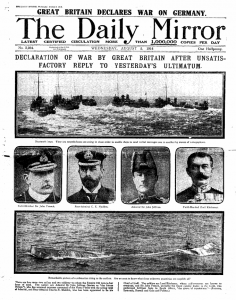
Screenshot of front page from The Daily Mirror, Wednesday, August 5, 1914. Available from UK Press Online.
During the war the British Government tried to strictly control reporting on events, particularly from the front line. Legislation was passed in 1914 which allowed the War Office to censor the press and at first journalists had to go undercover to try and report on what was happening. Even when the Government relented and agreed to send accredited British war correspondents to the front line their reports were still heavily censored and were often overt propaganda, with actual facts about events never being reported (see reporting or non-reporting on the Battle of the Somme as an example).
The Library subscribes to a large number of digitised newspaper archives that will allow you to see what events were being reported on at the time and how they were being reported. Read full text articles, compare how different newspapers were covering the same issues and stories and track coverage of the First World War from the escalating hostilities prior to the outbreak to its conclusion and aftermath. ...continue reading "First World War: through our Library resources"
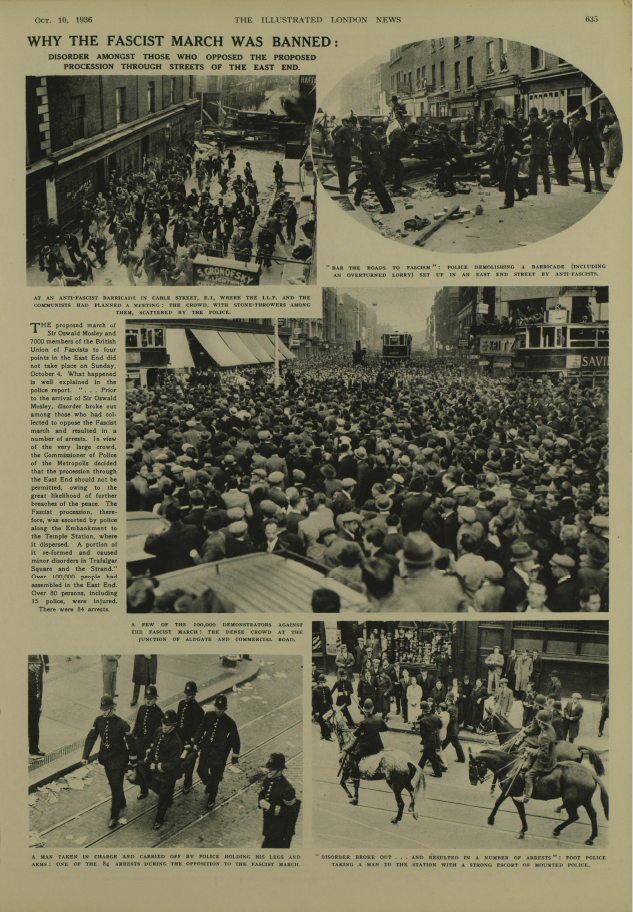
On this day, 4th October, in 1936 large crowds of people gathered in London’s East End, an area of the city that had a large Jewish population, in an attempt to stop a march through the area by the British Union of Fascists (BUF). The protests turned into a riot with anti-fascist demonstrators clashing with Police, large numbers of demonstrators were arrested and even larger numbers of them (and Police) were injured. But they did manage to prevent the march from taking place.
In this week's blog post I’m using some of the Library’s digital newspaper databases to find primary source material about the Battle of Cable Street (as the demonstrations became known).
Screenshot from Illustrated London News, October 10, 1936, p. 635. From The Illustrated London News Historical Archive.
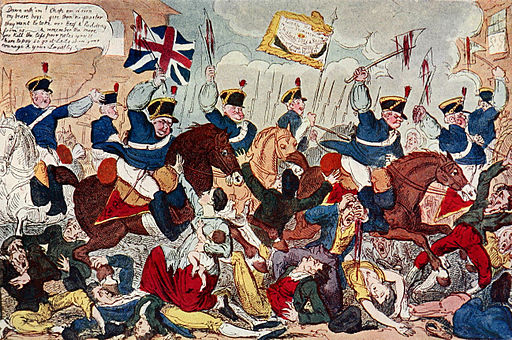
Next year on this day, 16th August, it will be the 200th anniversary of the Peterloo Massacre. The ironic name given to events at St Peter's Fields in Manchester on 16th August 1819 when the cavalry charged into a peaceful crowd of 50,000-80,000 people who were attending a mass demonstration for political reform. Between 10-20 people were killed and 100s were injured. In this week's blog post I have pulled together just a small selection of Library resources, digital and physical, that will help you explore Peterloo, the events leading up to it and the aftermath.
The Massacre of Peterloo. George Cruikshank [Public domain], via Wikimedia CommonsThe 19th century was a period of huge economic, social, political and idealogical changes. Post the Napoleonic Wars, which ended just four years before Peterloo ("Peterloo" a play on Waterloo), demands for political reform were growing. Industrial cities such as Manchester had no representation in Parliament,only relatively small numbers of wealthy male citizens were eligible to vote and working and economic conditions were incredibly poor. Campaigns for parliamentary reform became more strident and found growing levels of support, political radicalism in the UK was on the rise. ...continue reading "“Ye are many—they are few”: Exploring the Peterloo massacre through our library resources"
70 years ago today, 5 July, the National Health Service (NHS) was established, one of a number of social and welfare reforms from the post-World War II Labour government (though initial proposals for the NHS came from the World War II coalition government). Launched just over two years after Aneurin Bevan, Minister of Health, published his National Health Service Bill, the NHS provided medical and healthcare services for free at the point of delivery.
On the NHS's 70th birthday I have pulled together a small selection of primary resources, digital and physical, you have access to at the Library that will help you explore the history of the NHS.
What did the people think?
Mass Observation was a pioneering social research organisation founded in 1937. The aim was to create an 'anthropology of ourselves', and by recruiting a team of observers and a panel of volunteer writers they studied the everyday lives of ordinary people in Britain. This original work continued until the early 1950s and gives unparalleled insight into everyday life in Britain during that time.
Through our Library you have access to Mass Observation Online, which makes available the entire Mass Observation archive from that period and includes original manuscript and typescript papers (such as diaries, day reports, questionnaires, observations, etc.) created and collected by the Mass Observation organisation, as well as printed publications, photographs and some interactive features.
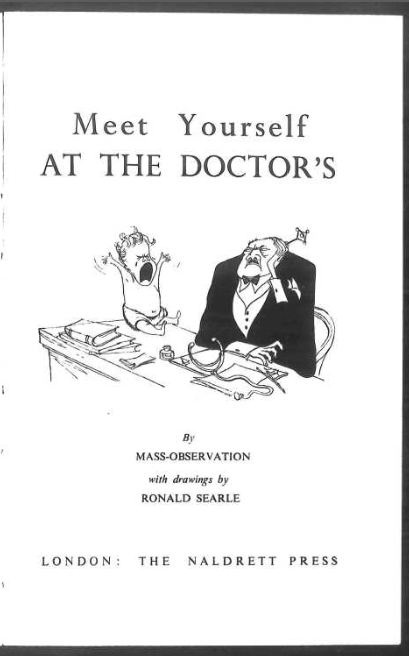
Mass-Observation. 1949. Meet Yourself at the Doctor's. London: Naldrett. Available from Mass Observation Online.
In Mass Observation Online you will find a large amount of material detailing people's opinions and experiences of the NHS from its earliest days. From Mass Observation's own file reports and publications pulling together people's comments, observations and experiences of the NHS to the original diary entries and questionnaire responses.
The material available allows you to read about people's views on the NHS prior to it being launched and their opinions and experiences of the service in its first few years of existence.