Any views expressed within media held on this service are those of the contributors, should not be taken as approved or endorsed by the University, and do not necessarily reflect the views of the University in respect of any particular issue.
I was delighted to be able to participate in the 4th International Staff Week at the Biblioteki Politechniki Gdańskiej recently. I work as the Senior Photographer for Edinburgh University’s Library and University Collections, so when I saw that the programme included a visit to the Pomeranian Digital Library it looked like a great opportunity. Additionally, this was the home institution of one of the delegates on our own Knowledge Exchange Week in 2018, allowing further development of previous Erasmus links.
There’s no doubt that in our digital age, social media and online presence is crucial to engaging with your customers, audiences or users. Due to the growing demand of higher quality images on these platforms, several of us in the DIU have recently given talks about achieving the best image quality using low-tech solutions. The great thing about phones and tablets is that we’re able to share content to social media from anywhere, creating a sense of immediacy and dynamism. Being able to take great photos and videos with just our phones can be challenging, but knowing the best settings and set-up can help to create great images that will make your posts more engaging. Continue reading “Training Sessions: Low-Tech Imaging for Social Media”
Last week the i2S CopiBook V-Shape arrived in the Digital Imaging Unit where it was installed and demoed by Pascale Thuilliez from i2S. This high-quality bookscanner was bought with the view to being used for the next phase of the Session Papers Project (read my previous blog here for more information on the project itself).
Team DIU (well, half of it!) have been visiting the Rijksmuseum again for the biennial conference on 2 and 3D photography. 2 full days of speakers followed by another workshop day left us with lots to think about. This year’s conference built on the last, Robert Erdmann released the open source code for his amazing curtain viewer which can be tried out in the Bosh Project here http://boschproject.org/#/ . Malcolm is going to delve deeper in to Erdmann’s latest developments below. Otherwise 3D technology seems to be taking root, with debate over the level of quality and detail needed, and advances such as ‘videogrammetry’ and ‘unstructured light field renderings’ (see below) entering the fray.
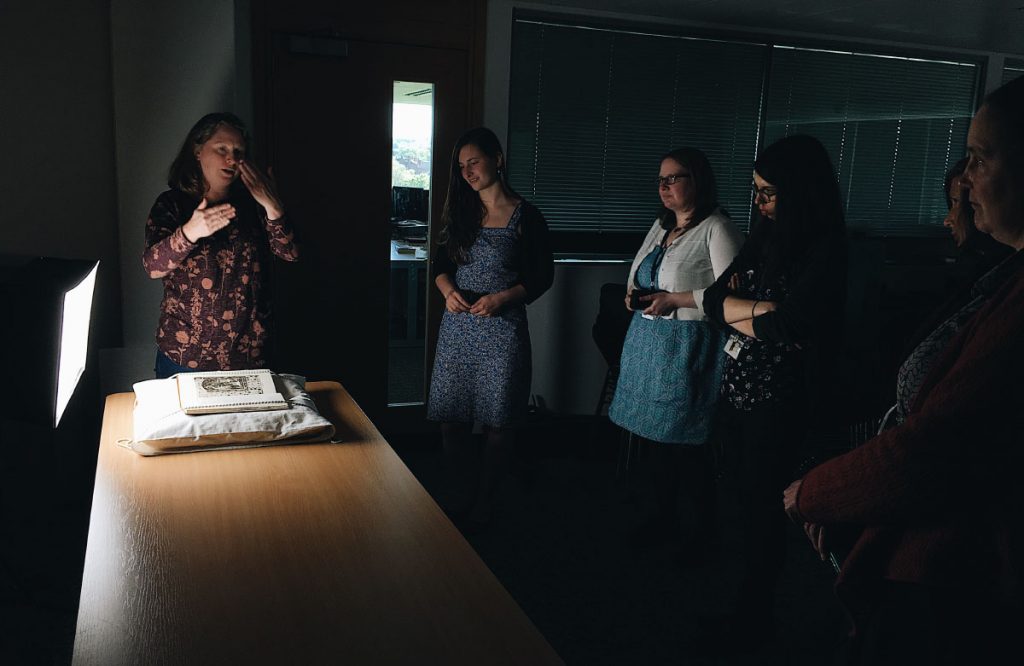
At present I am working on a pilot project, digitising the Scottish Court of Session Papers. The collection is held across three institutions; The Advocate’s Library, The Signet Library and the University of Edinburgh’s Library and University Collections. The collection itself consists of circa 6500 volumes, comprising court cases which span the 18th and 19th century.
The aim of the pilot is to determine the most effect digitisation methods for these materials with a view to a potential mass digitisation project covering the entire collection. The digitisation tests and experiments I have been undertaking have raised the many challenges that such a large project would present, namely around the issue of recording metadata and which digitisation practices to employ in relation to the condition and size of any particular volume.
During a photogrammetry training session with Clara Molina Sanchez, we were recommended to choose objects with a matt surface, small to medium in size, and which didn’t have many holes or occlusions. We settled on a Gandharan Buddha from the Art Collection, a Paolozzi maquette from the Edinburgh College of Art collection and, just to test what would happen, a thigh bone trumpet wrapped in shiny metal filigree from the Musical Instruments collection.
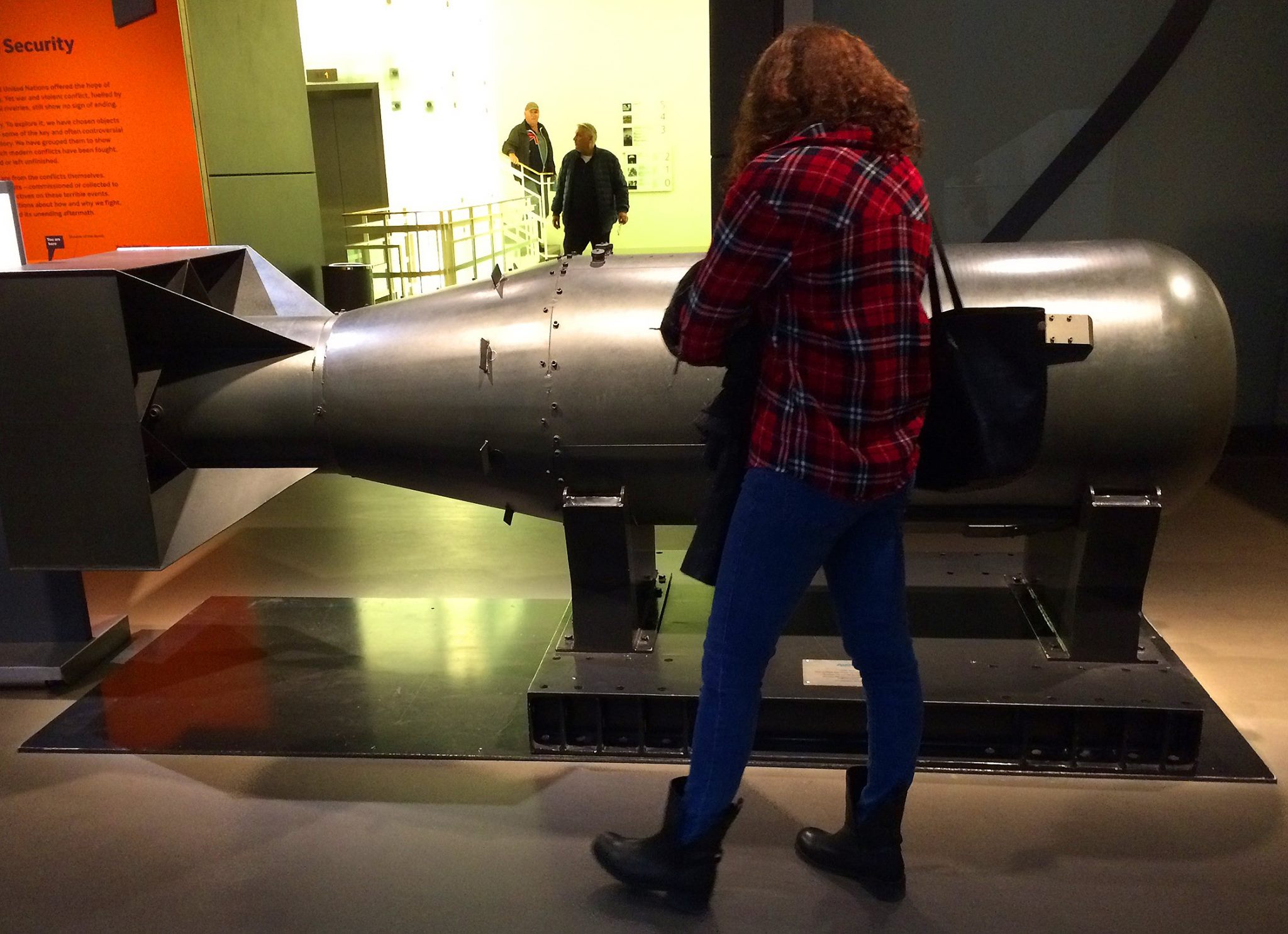
This year’s conference was hosted by The Imperial War Museum London. Diane Lees Director-General of the Imperial War Museums opened this year’s conference with the idea that “Photography delivers the curatorial message”. The presentations that followed certainly backed that statement up and demonstrated the complexity of support that photography brings to the curatorial message. Of particular note during a varied day of talks an emphasis on photogrammetry emerged as opposed to 3D scanning. The presentations that left an impression on me are discussed below but abstracts of all the conference talks can be found here:
The Drexel Digital Museum: Interpreting the digital historic fashion object.
This was a very engaging presentation by Daniel Caufield-Sriklad. He highlighted that there needs to be a different approach to digital interpretation as opposed to physical museum interpretation. Within his presentation he demonstrated how the Drexel Digital museum web site pulled in many different sources of information relating to the one physical object in the collection. Each object entry online could contain still photographs of the object and dedicated detailed shots. The entry would also contain moving image sequences and sound recordings relating to that object. In addition the object entry would also contain Giga Pan Process capturing 720 images per object and stitched those together to give a detailed 360 degree view of the object. These images “can be displayed at 1:1 scale, rotated 360 degrees, and zoomed into details far beyond what can be perceived by the unaided human eye”. 3D Motion capture was also used to create a 3D model to demonstrate the garment during movement using digital draping technology. HTML 5 was used to deliver their site. The overall approach provides multiple layers of interpretation in one central space.
The Strines Journal: Practice-led research into Historic Photographic Processes
Tony Richards from John Rylands Library Manchester gave an illuminating talk on his journey of trying to reproduce historic photographic processing. This included a lot of research into early wet processing formulas and their execution in studio practice. It revealed that published practice was misleading at times and it took a lot of cross referencing of published early formulas to finally achieve any kind of results similar to the early photographic collections that we hold in our museums. This work has brought the early photographic process to life again through in depth practice and research. Definitely an expert view in relation to our early photographic collections.
Digitising, Geo referencing and Transcribing 1100 Tithe maps
Scott Waby from The National Library of Wales delivered an engaging and well-paced talk on the progress of the project. It is an ambitious project to layer the Welsh national historical collection of maps on top of current map data for Wales. Scott and his team built a large curved magnetic wall to facilitate pin sharp capture of large maps in the collection. They had noticed that focus was falling off towards the edges of the map capture and so devised the curved wall to maintain the same focal length across the entire map whilst keeping the camera in a fixed position.
Day Two Workshops
Tate Britians move to Digital X-Ray
An opportunity to view Tate’s new digital x-ray system launched in January this year, replacing old x-ray set with a more powerful one and specially designed art table.
Fascinating insight into the digital x-ray world. At a cost of £93k Tate Britain have established a digital x-ray work flow. The results of which have uncovered the working process of artist like Picasso, Rene Magritte and Reynolds to name a few. This appeared labour intensive with all six staff having to vacate the studio each time an x-ray is triggered. The capture area is around A3 size so the larger works require multiple exposures which are then stitched together and for the medium sized Reynolds painting that was demonstrated final image was around 1.45 Gb. This in itself adds another cost in terms of processing images. The set up included a tripod to mount the X-Ray generator for use in the field. This also included guidelines and markers to calibrate safe distances before triggering the x-ray.
All round a challenge to implement requiring government inspectors to assure no health risk and a sizeable space away from people. Obviously the final images are a huge boon to conservators and people marketing and studying these historic processes.
Metamorfoze Preservation Imaging Guidelines and its daily use
Hans van Dormolen & Tony Harris
This was a practical real world walk through of studio implementation of the Metamorphose guidelines approved by unanimous vote at 2D + 3D Practices and Prophecies conference 2014 Rijksmuseum Amsterdam. Metamorphose guidelines are now law in the Netherlands if you are photographing national collections. The guidelines were written over a seven year period of research by Hans van Dormolen a researcher at UK Government Art Collection.
The walk through consisted of a standard copy stand set up with lights and camera in a static position photographing a large version x-rite colour chart. The main opening point driven home by Hans was “Gain Modulation”. Put simply the lights and camera and distance from object all have to remain static in order to maintain a consistent gain modulation. Readings are taken from the digital image of the chart using capture one sampling tool focussing on the reading shown in the green band. These readings are then checked against the Metamorphose guidelines and adjustments are made to the lights until the required readings are achieved. This took 6-7 adjustments to the lights. There is a small tolerance allowed within the guidelines. Once the initial target square patch E5 on the x-rite reads at 242 the setting is achieved and reading continues on J6, F5, I6, K6, G5 etc. following the guidelines.
Hans noted that each x-rite chart has a batch number and advised that more recent charts would aid accuracy. Also clean your chart from dust. After numerous studio tests Hans also noted that a black background was preferable for placing your chart on for optimum colour accuracy.
The walk through diverged at this point into discussion around uniform illumination and how one could check this by photographing a white sheet of paper and using Photoshop’s histogram palette, using the illumination drop down menu and referring those readings to the Metamorphose guidelines. Uniform illumination can also be checked using the threshold tool again in Photoshop and noting the values at the point where black begins to enter the image and the point where white almost leaves the image.
The workshop never completed the task of calibrating for colour accuracy in the two and a half hour slot allocated with it has to be said the experts driving. It’s a complicated task to image using the guidelines and would only be useful in a real world setting where lighting and object distance were static so that gain modulation was static. However this could be achieved on projects that have same size objects like our recent glass plate negative project.
The Imperial War Museum was an astonishing museum in many ways, it had very clever use of moving images that merged with physical collections in an immersive way. However I was struck by just how much energy and physical effort and ingenuity human beings put into killing each other. Tremendously sad.
Malcolm Brown Deputy Photographer Library & University Collections Digital Imaging Unit
Last month I was asked to take some photos of the McEwan Hall which is currently undergoing a major redevelopment to bring it into the 21st century. Having previously photographed Rowand Anderson’s architectural drawings for the building, I have long been looking for excuse to see inside and was delighted to have this chance. This huge auditorium has a seating capacity of 2000 and was presented to the University in 1897 by the Brewer and Politician William McEwan. We have a lovely illustration in the collections of a holly festooned McEwan giving the Graduation Hall to the University on a platter, with Old College’s golden boy in the background.
In the studio, with a very limited access to backdrops and props, it can be difficult to enliven the more creative shots of objects. We are well set up now for standard record images against a neutral grey background and it is easy when you need to close in on the details of objects, however, these can start to look a bit ‘samey’ when you have lots of images to do for a project. This is the position I found myself in recently when working on the MIMED collection of musical instruments (see http://images.is.ed.ac.uk/luna/servlet/s/s4mynr). Thankfully, at the University we are blessed with some stunning locations to use instead, but with both of the obvious choices – St Cecilia’s Music Hall and the Reid Concert Hall – off limits for redevelopment, an alternative location required a bit of forethought and planning. Our colleagues at the Anatomy School very kindly agreed to let us use their beautiful Rowand Anderson designed building which provided sympathetic architectural details to arrange the instruments against and Malcolm and I decamped from the studio for 2 days to continue with the project.
Last week saw the start of a new project- photographing many of the University’s Musical Instruments while they are in storage at the Library during the re-development of St. Cecilia’s Music Hall. These images are planned for use in the new museum space, in printed materials, for social media and interactive Apps. The only guidance we have been given is ‘coffee-table book’ which gives the DIU team huge scope for interpretation and creativity. As the project progresses we hope to bring 3D photography into the mix, but for starters, this week the musical instruments team brought me 3 items for some studio shots.
The first was a Triple-fretted clavichord, possibly Flemish and c1620 (ref. 4486). Although this piece was quite simple and unadorned, it did have a bright red ribbon woven through the strings and the keys made a beautiful pattern, so I decide on a detail shot to highlight the mechanism.
The second item was a Rahab from Western Malaysia, c1977 (ref. 2101). This was a far more ornate and colourful piece. In fact, I was torn- both the front and back of the instrument presented interesting features to photograph, but how to get both sides at once? While at the Rijksmuseum conference Malcolm and I were impressed by their use of a black reflective surface in the photography of fashion accessories (see https://www.rijksmuseum.nl/formats/accessoires/index.jsp?lang=en). Malcolm suggested that we might be able to get a similar effect using a piece of black velvet and some glass, so I set up the studio to try it out. In the end I chose an angle looking down on the instrument that allowed details of both the strings and the red woollen back to be seen, however, the reflection adds further interest to the shot.
The final piece presented quite a different challenge. It is very rare that an object comes to us that leaves me scratching my head, but the ‘Jingling Johnny’ or Chapeau (ref. 6110) certainly did. A large, top heavy shiny brass instrument covered with dangling bells and fragile metalwork set atop a stick- how to keep it upright and perfectly still? The many shiny surfaces indicate that we will need to build a light tent to minimise reflections. This was clearly going to require some thought and planning, so we reluctantly decided to return this one to the store to reconvene another day!
In the coming months we will keep you posted on the projects progress.



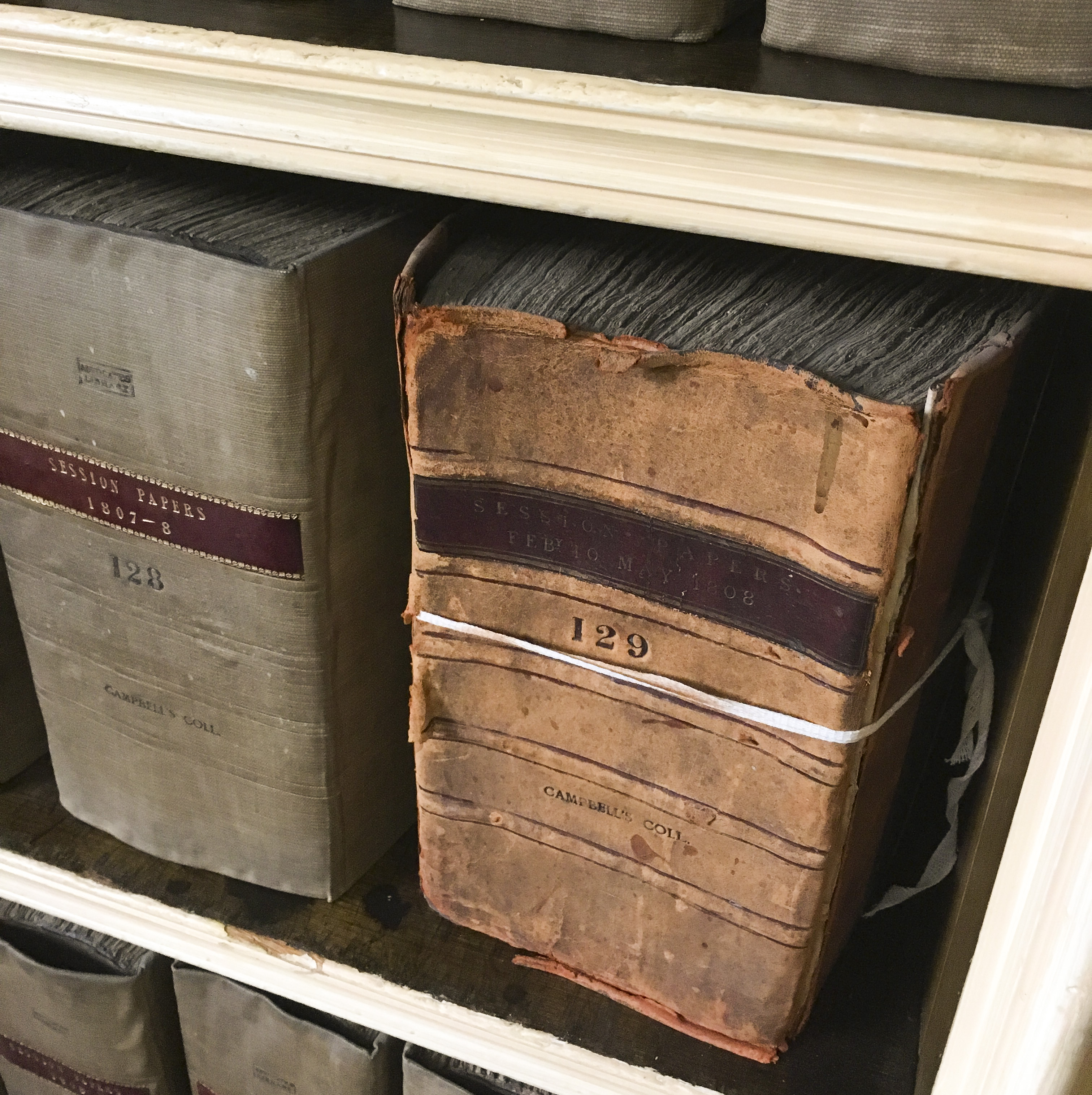 At present I am working on a pilot project, digitising the Scottish Court of Session Papers. The collection is held across three institutions; The Advocate’s Library, The Signet Library and the University of Edinburgh’s Library and University Collections. The collection itself consists of circa 6500 volumes, comprising court cases which span the 18th and 19th century.