Any views expressed within media held on this service are those of the contributors, should not be taken as approved or endorsed by the University, and do not necessarily reflect the views of the University in respect of any particular issue.

Dating a Book

For the last couple of months I have had the pleasure of both volunteering with the DIU and now working a bit more seriously through my work placement as part of the MSc in Book History and Material Culture. My undergraduate degree is in Creative Writing and I primarily focus on Children’s Literature in my current studies, so the Digital Imaging Unit might seem like a strange fit for me at first glance. The exact opposite is true though. In the world of Children’s Literature, illustrations and images in general are essential to the construction and survival of texts. During my time here I have been working on compiling the metadata for our ECA Rare Books Image Collection. This project is dear to my heart for two reasons. 1) I am exposed to images and illustrations of every variety, both artistically and mechanically. 2) I learn something new every day. There are many books in this collection that are far out of my expertise and for that reason I am forced to research all sorts of things I have never even heard of. Because of this I have become a huge fan of nature lithography, Italian architecture and handmade books. The latter is what I would like to discuss today.

As I was researching the ECA Rare Book Collection, I found that many of the materials I was working with had no author and no date. Because of the nature of these type of handmade scrapbook-like works, there is no imprint or page of information on the piece. In this way, dating a work becomes a bit of a guessing game. If there is an attributed author or illustrator one can narrow down the production date to the lifetime of this person. If it is known to be made in a certain region by this person, for example, that can also narrow down the search for the date. It becomes a Sherlock Holmes kind of exploration to put all the pieces together and decide on a more narrow range of dates that a book could have been produced.

In this collection there are many examples of successful dating as well as some cases that have proved to be a bit trickier to pin down. I first noticed this when looking at a page from a hand created book titled by the cataloguer as ‘Album of printed initials, ornaments, illustrations and title pages, cut from books: collected as examples of typographical design, woodcut, engraving, illustration and ornament’. The particular page (see below) is of printed initials that have been cut from another book and then rearranged and adhered to the page as part of a collection of typographical designs, woodcuts, engravings, illustrations and ornaments. The book itself, or rather portfolio because the leaves are not bound together, has not been dated. The reason we know anything about the age of this book is from the age of the books in which were borrowed to create the new one. From some identified works, the collection of images comes from sometime around 1490 all the way to 1715. The pages themselves seem to have been compiled around 1880 to 1920.


Collection: ECA Rare Books; Persons: -; Event: N/A; Place: N/A; Category: Art; Design; Description: -


A second example of dating from context is a curious photo album from Lord Elgin’s diplomatic missions to China. Unlike with the printed initials, these images have names attributed at points and even dates in the case below. Because of these acknowledgements, it becomes much easier to place this piece in history. Oddly enough though, some photographs are heavily annotated and others sit alone without any clues to what exactly they represent. We cannot be entirely sure when these were taken and if found out to be earlier or later than the other images, it could skew the data on the item as a whole.


0055640d


A third very interesting undated book is that of calico samples that have been neatly cut and arranged, much like the printed initials from our earlier example. The manufacturers of these fabrics have been identified by the creator, which narrows down the date to the time in which these were all in business. The most helpful bit for this work though is a racehorse. One of the fabrics shows an image of ‘Gladiateur’, a racehorse who was accomplished from 1865-1866. This unsuspecting clue is mighty helpful when trying to confirm the time in which these fabrics would have been made and collected. If this particular horse had gone unnoticed, situated next to many other animal designs, we would know much less about this funny little collection.


0055610d


One thing I didn’t expect to gain out of my work placement at the DIU was detective skills but it seems that I now know a bit more about how to date a book than I did a month ago. Unfortunately, there is one book that has no date and also has no catalogue information. This unique piece is a book of shawl designs that have been labelled and neatly placed on paper. There are some clues on these pieces that help us date it to a certain point (most noticeably the stamp from the Trustees for Manufacturers) but even with this it seems to remain quite mysterious. If you feel like testing your skills, feel free to check out the images of ‘Shawl Design’ at http://images.is.ed.ac.uk/luna/servlet/UoEwmm~3~3 and let me know if you find anything.

0024472d

0024475d

-Caitlin Holton, MSc Book History and Material Culture
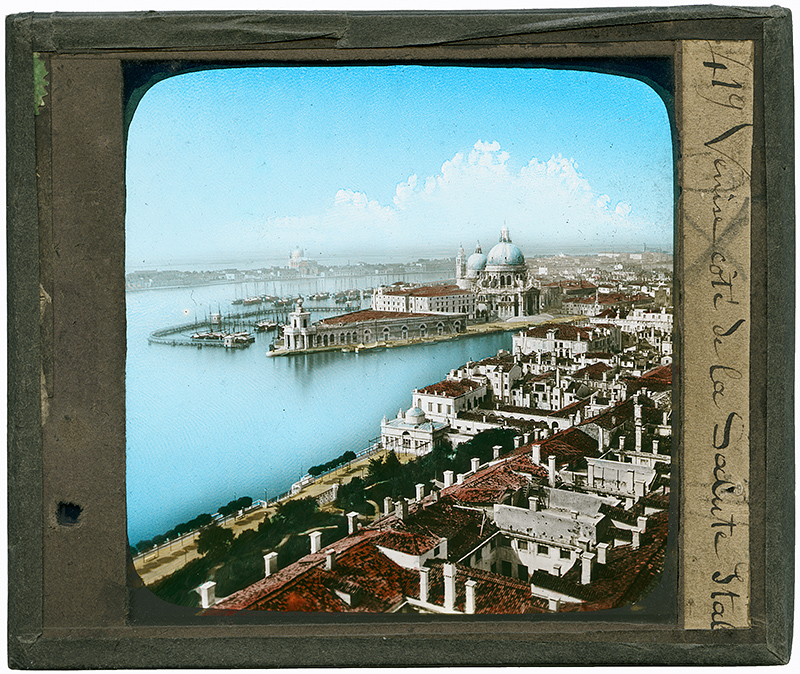
Grand Tour Slide Show

Santa Maria della Salute, Venice, Italy.

Some time ago we digitised the hand coloured glass slides in the Cavaye collection, but we didn’t have time to do the much larger black and white part of the collection. So when our project photographer John Bryden, found a bit of spare time, we were delighted to have the remaining slides completed.

The whole collection is wonderful, apparently from a Grand Tour of Europe around the turn of the 20th century. I suspect that many of the slides were bought on the trip, much like we buy postcards today. Some of them were probably only lovingly hand tinted on return to Britain- in one of Palermo the tinting appears to be half finished. Continue reading “Grand Tour Slide Show”

Instrumental Challenges

0031996d

Last week saw the start of a new project- photographing many of the University’s Musical Instruments while they are in storage at the Library during the re-development of St. Cecilia’s Music Hall. These images are planned for use in the new museum space, in printed materials, for social media and interactive Apps. The only guidance we have been given is ‘coffee-table book’ which gives the DIU team huge scope for interpretation and creativity. As the project progresses we hope to bring 3D photography into the mix, but for starters, this week the musical instruments team brought me 3 items for some studio shots.

The first was a Triple-fretted clavichord, possibly Flemish and c1620 (ref. 4486). Although this piece was quite simple and unadorned, it did have a bright red ribbon woven through the strings and the keys made a beautiful pattern, so I decide on a detail shot to highlight the mechanism.

0067016d

The second item was a Rahab from Western Malaysia, c1977 (ref. 2101). This was a far more ornate and colourful piece. In fact, I was torn- both the front and back of the instrument presented interesting features to photograph, but how to get both sides at once? While at the Rijksmuseum conference Malcolm and I were impressed by their use of a black reflective surface in the photography of fashion accessories (see https://www.rijksmuseum.nl/formats/accessoires/index.jsp?lang=en). Malcolm suggested that we might be able to get a similar effect using a piece of black velvet and some glass, so I set up the studio to try it out. In the end I chose an angle looking down on the instrument that allowed details of both the strings and the red woollen back to be seen, however, the reflection adds further interest to the shot.

The final piece presented quite a different challenge. It is very rare that an object comes to us that leaves me scratching my head, but the ‘Jingling Johnny’ or Chapeau (ref. 6110) certainly did. A large, top heavy shiny brass instrument covered with dangling bells and fragile metalwork set atop a stick- how to keep it upright and perfectly still? The many shiny surfaces indicate that we will need to build a light tent to minimise reflections. This was clearly going to require some thought and planning, so we reluctantly decided to return this one to the store to reconvene another day!

In the coming months we will keep you posted on the projects progress.

Susan Pettigrew, Photographer

Roslin Slide Collection – Composition

Black Japanese Bull, 4 as 5 Years, 1090 lbs'. Photograph of a Black Japanese bull, 4 as 5 years old and weighing 1090 lbs standing in a lane with a man holding its rope lead in the early 20th century.

Over the course of digitising the Roslin Slide Collection, amongst all the slides of tables, charts and the like, it has been the images of people, and their animals, that have grabbed my attention most of all. I have noticed two particular styles of photographic composition that are common throughout; the group shot (still popular today of course!) and the ‘one man and his animal’ shot. These images provide a sort of typology where the composition often remains the same with the people and environment changing. Continue reading “Roslin Slide Collection – Composition”

3 Additions to the LUNA Book Reader Collection

ScreenGrab01

We kick off 2015 with the addition of 3 new Book Readers added to LUNA. The first two are both music manuscripts that came down to the DIU as part of the Readers Orders trolley. It is not often that we receive volumes to be digitised in their entirety this way, so it seemed a good opportunity. As a result we spared a bit of time to do the additional work to prepare them for the book reader software after the High Resolution images had been delivered to the customers. Continue reading “3 Additions to the LUNA Book Reader Collection”

The Most Beautiful Book in Scotland and the Oldest Scottish Manuscript?

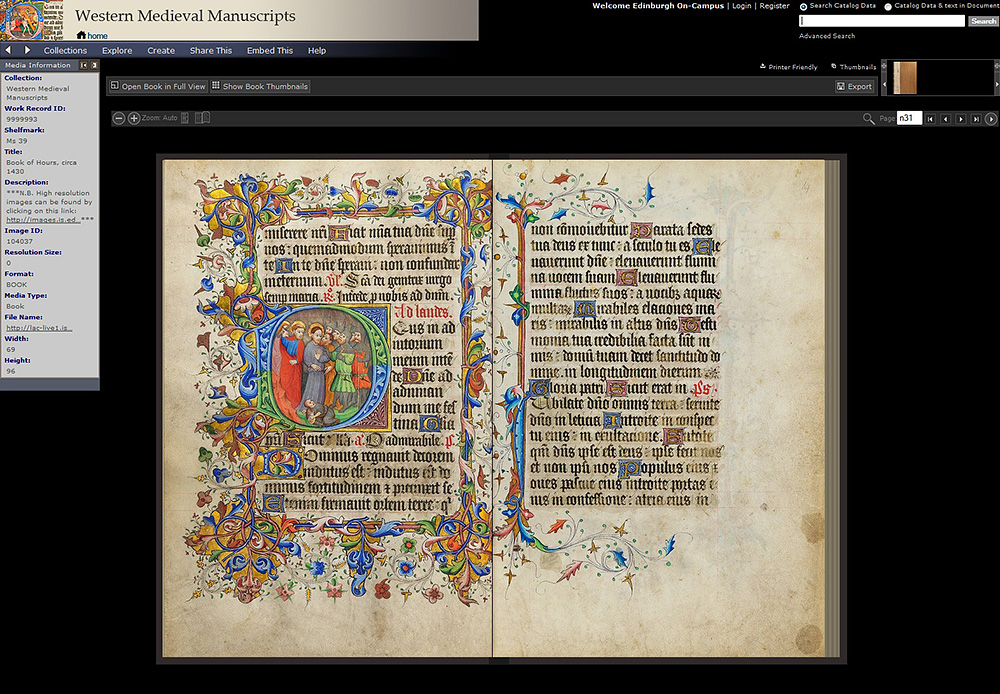
Ms39BookReader01
The new Ms 39 Book of Hours available in LUNA Book Reader

We are delighted to announce that 2 manuscripts have been added to our growing collection of Book Readers in LUNA!

The first is Ms 39, an amazing early 15th century Book of Hours, with rich gold work, detailed miniatures and vibrant colours. See http://images.is.ed.ac.uk/luna/servlet/s/d4wx22 for the Book Reader. A note in the front of the book claims this is the most beautiful book in Scotland, what do you think? What are the other contender’s? Continue reading “The Most Beautiful Book in Scotland and the Oldest Scottish Manuscript?”

RASHID AL-DIN 1314 Library Exhibition Time Lapse Film

For the past month or so the DIU have been capturing our first ever time lapse footage of the installation of the current library festival exhibition RASHID AL-DIN 1314. We filmed over several weeks trying to capture the main installation events. This included the prep work by conservation, the delivery of objects from the National Museum, swathes of discussion over the exhibition, hard core carpentry skills and an insane press pack in full flight all leading up to the opening night. What we captured is only part of the story in that all the planning had been completed and work scheduled before shooting began including our own part of supplying the images for the display boards and background supports. It has been a huge revelation to see and document the level of application that goes into creating a Library exhibition. The overriding impression is of a truly massive collaborative effort involving many departments across institutions. Definitely worth a watch if only for the wonderful music by our very own Art Collections Curator Neil Lebeter.

RASHID AL-DIN 1314 Library Exhibition Time Lapse Film from DIGITAL IMAGING UNIT FILM on Vimeo.

Malcolm Brown, Deputy Photographer.

Photographists and the Grand Tour

01-060

One of my daily problems in this job is being drawn into the objects we are digitising- it is always too tempting to start reading, and yesterday was one of the toughest challenges I have faced! A reader had requested a book-scan copy of a transcript from a Diary of John Shaw Smith and his wife Mary as they did the Grand Tour of the Mediterranean and Middle East between 1849-1852 (see http://www.archives.lib.ed.ac.uk/catalogue/cs/viewcat.pl?id=GB-237-Coll-20&view=basic ). Perhaps it was that John Shaw Smith was one of the earliest photographers to visit these regions (see http://www.luminous-lint.com/app/photographer/John_Shaw__Smith/A/), or perhaps it was because I have visited many of the places they travelled to, however once I started I became fascinated by the lively, sharp witted pair and their adventures. Continue reading “Photographists and the Grand Tour”

Making the Most of the Intern(et)

Our wonderful Intern Gemma is leaving us today, but she has managed to squeeze in one more post before she goes. Gemma has done some really amazing work for us, after completing her cataloguing project of Oriental Manuscripts (her work can be seen here http://images.is.ed.ac.uk/luna/servlet/UoEsha~4~4 ) in record time, she has helped out with Flickr, Walter Scott and a new project about not yet officially started too. I’d like to say a very big thank you to Gemma for all her hard work- we’re going to miss her! Over to Gemma…

Flickr

Since I finished my project with the Oriental Manuscripts Collection a few weeks ago (see my blog below for more info http://libraryblogs.is.ed.ac.uk/diu/2014/07/02/discovering-the-orient/#more-931 ), I’ve been working on a few other projects to make the most of my remaining time here at the CRC. Of these, one of my main tasks has been to update the department’s Flickr account (https://www.flickr.com/photos/crcedinburgh/).

Continue reading “Making the Most of the Intern(et)”

Discovering the Orient

Detail of portrait showing a group of women washing clothes in a river. This miniature comes from a collection of portraits (Tasawir), which originate from India and date to the mid-19th century. Although many of the images in the oriental manuscripts collection tend to relate to religion or mythology, this portrait is interesting as it provides a fascinating insight into the life of ordinary people, during the rule of the British Raj.


On the 2nd June, I was lucky enough to begin employment as the Employ.ed Digital Collections intern for the CRC. Although I begin with a little trepidation – like most people when they start a new job, I spent the night before worrying that I’d be really bad at it or that no one would like me – I am now in my fifth week and enjoying it immensely: I don’t really want to leave! Continue reading “Discovering the Orient”

css.php

Report this page

To report inappropriate content on this page, please use the form below. Upon receiving your report, we will be in touch as per the Take Down Policy of the service.

Please note that personal data collected through this form is used and stored for the purposes of processing this report and communication with you.

If you are unable to report a concern about content via this form please contact the Service Owner.

Please enter an email address you wish to be contacted on. Please describe the unacceptable content in sufficient detail to allow us to locate it, and why you consider it to be unacceptable.
By submitting this report, you accept that it is accurate and that fraudulent or nuisance complaints may result in action by the University.

  Cancel