Any views expressed within media held on this service are those of the contributors, should not be taken as approved or endorsed by the University, and do not necessarily reflect the views of the University in respect of any particular issue.
Last month I was asked to take some photos of the McEwan Hall which is currently undergoing a major redevelopment to bring it into the 21st century. Having previously photographed Rowand Anderson’s architectural drawings for the building, I have long been looking for excuse to see inside and was delighted to have this chance. This huge auditorium has a seating capacity of 2000 and was presented to the University in 1897 by the Brewer and Politician William McEwan. We have a lovely illustration in the collections of a holly festooned McEwan giving the Graduation Hall to the University on a platter, with Old College’s golden boy in the background.
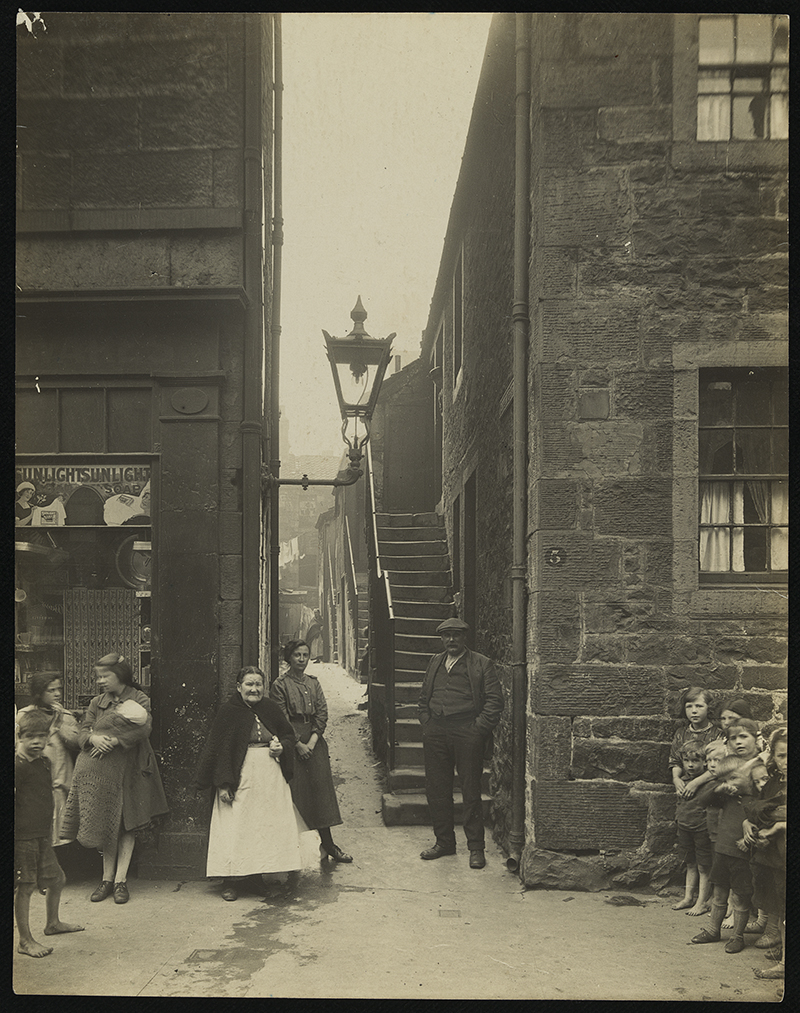
When Fraser Parkinson first contacted us about the collection of historic photographs of Leith that he had been entrusted with, my colleagues and I at the Centre for Research Collections were very excited. The photographs were taken to show the slums of Leith prior to the ‘Edinburgh (Leith) Improvement Scheme of 1924’, where large areas were to be cleared and rebuilt. Fraser tells us that:
‘The Town Council Minutes of 3rd April 1924 propose the demolition or reconstruction of ‘certain houses, courts, and alleys unfit for human habitation’.
The concerns of William Robertson, Medical Officer of health for the City and Royal Burgh of Edinburgh, were that the
‘narrowness, closeness and bad arrangement, or the bad condition of the streets and houses, or the want of light, air, ventilation or proper conveniences or other sanitary defects are dangerous or injurious to the health of the inhabitants of the buildings in the said Areas, or of the neighbouring buildings.’
The scheme involved large-scale demolition in this area of Leith, and the re-housing of most displaced residents out-with the areas covered by the scheme.
These photographs were taken as a record of the area at this time by the City Council. They provided the photographic evidence of the conditions that presented significant risk to public health at this time.’
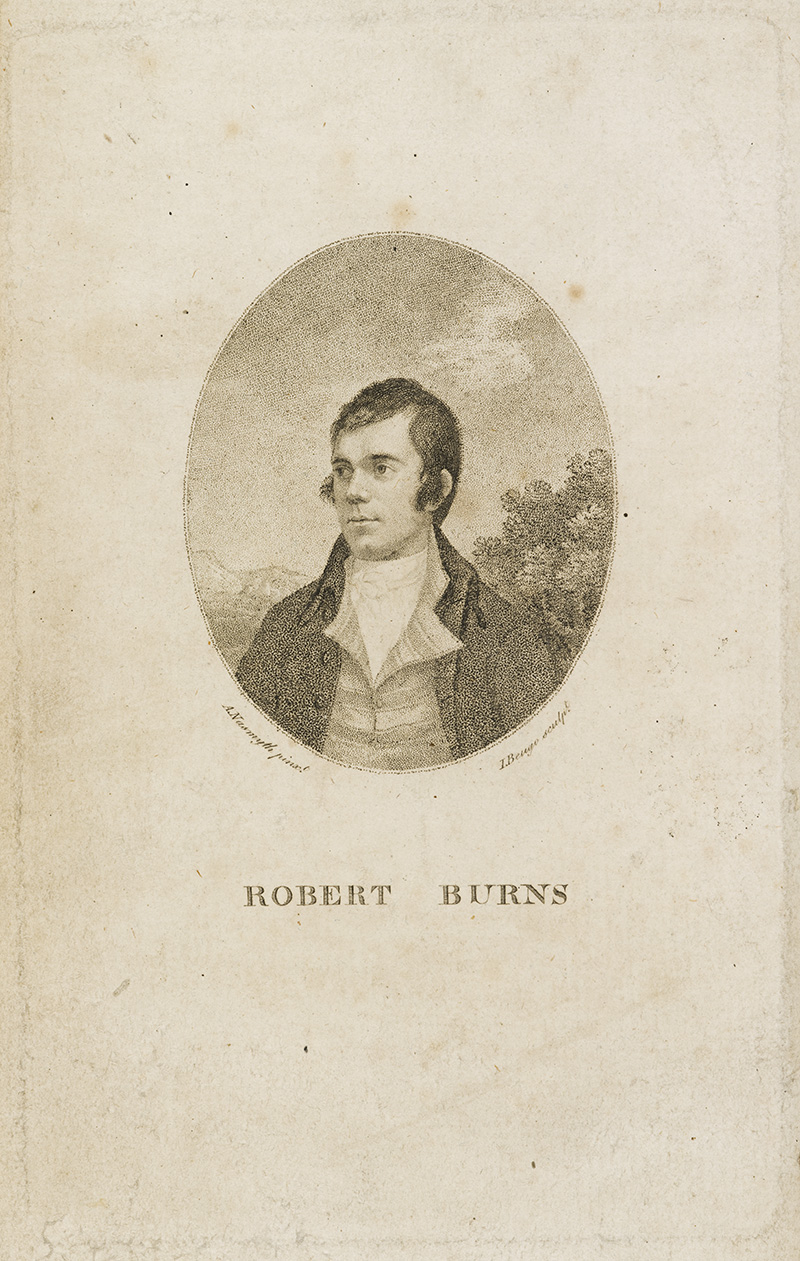
The most important manuscript collection at the University of Edinburgh has long been acknowledged to be the Laing Collection. This treasure trove was donated to the University of Edinburgh in 1878 by David Laing (1793-1878) and contains a startlingly vast array of texts and artefacts. To gloss this diversity only briefly, the University’s description of the Laing collection attests that one can find more than 100 Western medieval manuscript books, a 9th-century Koran, over 3000 charters, manuscript poems, texts, and letters written by Robert Burns (1759-1796), the lovely illustrated “Album Amicorum” (book of friends) by Michael Van Meer (?-1653), and poetry by Elizabeth Melville (1582-1640). Even the handlist for the collection is itself an archival artefact of sorts, having been drawn up in 1878 at the time of the bequest and bearing traces of additions and corrections made over the years since.
As important as the Laing collection is though, I’ll admit that until a couple of months ago, I didn’t know much about it and I certainly hadn’t spent any time delving into what it has to offer. I’m an English literature PhD here at the University of Edinburgh and my research focuses on archives, digital humanities, and, in particular, the study of idiosyncratic texts, like concrete poetry and scrapbooks. I like that these works challenge traditional literary classifications and give some pause when users must decide how to read them, digitise them, or otherwise interpret them. These interests led me to volunteer with the DIU, where I have been working to enrich the descriptive metadata of digitised items from the University’s Special Collections and Library holdings. This is also what finally led me to the Laing collection.
With the 400th anniversary this year of the death of one of our greatest and most influential playwrights, William Shakespeare, I found myself cropping images of some of his first printed quartos for the creation of an e-reader as part of the Shakespeare image collection. Now existing as high quality e-readers are the plays Love’s Labours Lost (1st Quarto Edition) and Romeo and Juliet (2nd Quarto Edition), both of which are used as part of the collaborative project concerning Shakespeare’s printed quartos, The Shakespeare Quarto Archive (http://www.quartos.org/index.html). These works themselves have very unique histories and are important in Shakespearean studies for many reasons. Their place in the Special Collections in the University of Edinburgh Library is invaluable.
Recently I was asked to scope the digitisation of a beautiful scroll we have in our collection, Or.Ms 510, or better known as the Mahabharata. Gemma Scott, our former Digital Library intern, says that:
‘the Mahabharata tells the tale of a dynastic struggle between two sets of cousins for control of the Bharata kingdom in central India. One of the longest poems ever written, eclipsed only by the Gesar Epic of Tibet, it is said to have been composed between 900 and 400BCE by the sage Vyasa, although, in reality, it is likely to have been created by a number of individuals. To Hindus, it is important in terms of both dharma (moral law) and history (itihasa), as its themes are often didactic.’
Our scroll dates to 1795 and came to Edinburgh University in 1821 when it was donated by Colonel Walker of Bowland. It is 13.5cm wide and a staggering 72m long, housed in a wooden case, wound around rollers and turned by a key in the side. It has 78 miniatures of varying sizes and is elaborately decorated in gold, with floral patterning in the late Mughul or Kangra style. The text itself is dense, tiny, and underpinned with yet more gold leaf decorations.
We are thrilled to announce that we now have online the entire manuscript of Abu Rayhan Al-Biruni, his ‘Chronology of Ancient Nations’. Al- Biruni was a famous astronomer and polymath and he completed this compendium in the year 1000. It records a vast number of calendars and chronological systems from a variety of different cultural and religious groups in the late antique and medieval periods in the Hellenic world, Central Asia and the Near East, even detailing festivals and liturgical practices.
One of the works in the ECA Rare Book Collection that places us firmly in a place and time in history is a book of photographs taken around the time of the notable expedition of Lord Elgin, James Bruce, to China on a diplomatic mission and military campaign. If one does not know much about Chinese history, which I must admit I know little of, you might view this image at first glance as simply another beautiful view of Chinese landscape and architecture. Upon further reading into the life of the 8th Earl of Elgin and the Old Summer Palace, as well as the photographers whose works are featured in the album, it becomes a much different story. One of these photographers was the talented Felice Beato who was known for photography that created images of war as a continuous process. He documented each stage of his subjects, including gruesome scenes of the aftermath of battles and seizes. This method provides great insight into the progression of Lord Elgin’s presence in China as many images fit into his timeline. Although the above photograph taken in 1860 seems to show a sturdy structure overlooking a stunning mountain range, it does depict a cultural landscape that was near the end of its time and one that was extremely vulnerable at the time. The caption for the image tells a snapshot of the gruesome story. The caption reads “View of the Summer Palace, Yuen-Min-Yuen, showing the Pagoda before the burning, Pekin. Octr 1860.” This could easily be one of the last photographs of the site before its infamous looting and burning on October 18, 1860. Many of the items taken from this event are still held today in the UK and other prestigious museums in Europe, although there is an ongoing conversation of where these works of great art and cultural importance belong.
For the last couple of months I have had the pleasure of both volunteering with the DIU and now working a bit more seriously through my work placement as part of the MSc in Book History and Material Culture. My undergraduate degree is in Creative Writing and I primarily focus on Children’s Literature in my current studies, so the Digital Imaging Unit might seem like a strange fit for me at first glance. The exact opposite is true though. In the world of Children’s Literature, illustrations and images in general are essential to the construction and survival of texts. During my time here I have been working on compiling the metadata for our ECA Rare Books Image Collection. This project is dear to my heart for two reasons. 1) I am exposed to images and illustrations of every variety, both artistically and mechanically. 2) I learn something new every day. There are many books in this collection that are far out of my expertise and for that reason I am forced to research all sorts of things I have never even heard of. Because of this I have become a huge fan of nature lithography, Italian architecture and handmade books. The latter is what I would like to discuss today.
As I was researching the ECA Rare Book Collection, I found that many of the materials I was working with had no author and no date. Because of the nature of these type of handmade scrapbook-like works, there is no imprint or page of information on the piece. In this way, dating a work becomes a bit of a guessing game. If there is an attributed author or illustrator one can narrow down the production date to the lifetime of this person. If it is known to be made in a certain region by this person, for example, that can also narrow down the search for the date. It becomes a Sherlock Holmes kind of exploration to put all the pieces together and decide on a more narrow range of dates that a book could have been produced.
In this collection there are many examples of successful dating as well as some cases that have proved to be a bit trickier to pin down. I first noticed this when looking at a page from a hand created book titled by the cataloguer as ‘Album of printed initials, ornaments, illustrations and title pages, cut from books: collected as examples of typographical design, woodcut, engraving, illustration and ornament’. The particular page (see below) is of printed initials that have been cut from another book and then rearranged and adhered to the page as part of a collection of typographical designs, woodcuts, engravings, illustrations and ornaments. The book itself, or rather portfolio because the leaves are not bound together, has not been dated. The reason we know anything about the age of this book is from the age of the books in which were borrowed to create the new one. From some identified works, the collection of images comes from sometime around 1490 all the way to 1715. The pages themselves seem to have been compiled around 1880 to 1920.
A second example of dating from context is a curious photo album from Lord Elgin’s diplomatic missions to China. Unlike with the printed initials, these images have names attributed at points and even dates in the case below. Because of these acknowledgements, it becomes much easier to place this piece in history. Oddly enough though, some photographs are heavily annotated and others sit alone without any clues to what exactly they represent. We cannot be entirely sure when these were taken and if found out to be earlier or later than the other images, it could skew the data on the item as a whole.
A third very interesting undated book is that of calico samples that have been neatly cut and arranged, much like the printed initials from our earlier example. The manufacturers of these fabrics have been identified by the creator, which narrows down the date to the time in which these were all in business. The most helpful bit for this work though is a racehorse. One of the fabrics shows an image of ‘Gladiateur’, a racehorse who was accomplished from 1865-1866. This unsuspecting clue is mighty helpful when trying to confirm the time in which these fabrics would have been made and collected. If this particular horse had gone unnoticed, situated next to many other animal designs, we would know much less about this funny little collection.
One thing I didn’t expect to gain out of my work placement at the DIU was detective skills but it seems that I now know a bit more about how to date a book than I did a month ago. Unfortunately, there is one book that has no date and also has no catalogue information. This unique piece is a book of shawl designs that have been labelled and neatly placed on paper. There are some clues on these pieces that help us date it to a certain point (most noticeably the stamp from the Trustees for Manufacturers) but even with this it seems to remain quite mysterious. If you feel like testing your skills, feel free to check out the images of ‘Shawl Design’ at http://images.is.ed.ac.uk/luna/servlet/UoEwmm~3~3 and let me know if you find anything.
-Caitlin Holton, MSc Book History and Material Culture
Last week saw the start of a new project- photographing many of the University’s Musical Instruments while they are in storage at the Library during the re-development of St. Cecilia’s Music Hall. These images are planned for use in the new museum space, in printed materials, for social media and interactive Apps. The only guidance we have been given is ‘coffee-table book’ which gives the DIU team huge scope for interpretation and creativity. As the project progresses we hope to bring 3D photography into the mix, but for starters, this week the musical instruments team brought me 3 items for some studio shots.
The first was a Triple-fretted clavichord, possibly Flemish and c1620 (ref. 4486). Although this piece was quite simple and unadorned, it did have a bright red ribbon woven through the strings and the keys made a beautiful pattern, so I decide on a detail shot to highlight the mechanism.
The second item was a Rahab from Western Malaysia, c1977 (ref. 2101). This was a far more ornate and colourful piece. In fact, I was torn- both the front and back of the instrument presented interesting features to photograph, but how to get both sides at once? While at the Rijksmuseum conference Malcolm and I were impressed by their use of a black reflective surface in the photography of fashion accessories (see https://www.rijksmuseum.nl/formats/accessoires/index.jsp?lang=en). Malcolm suggested that we might be able to get a similar effect using a piece of black velvet and some glass, so I set up the studio to try it out. In the end I chose an angle looking down on the instrument that allowed details of both the strings and the red woollen back to be seen, however, the reflection adds further interest to the shot.
The final piece presented quite a different challenge. It is very rare that an object comes to us that leaves me scratching my head, but the ‘Jingling Johnny’ or Chapeau (ref. 6110) certainly did. A large, top heavy shiny brass instrument covered with dangling bells and fragile metalwork set atop a stick- how to keep it upright and perfectly still? The many shiny surfaces indicate that we will need to build a light tent to minimise reflections. This was clearly going to require some thought and planning, so we reluctantly decided to return this one to the store to reconvene another day!
In the coming months we will keep you posted on the projects progress.
As there were several separate requests recently for images from the splendid ‘Song School St Mary’ manuscript by Phoebe Anna Traquair, we decided the time was right to digitise the book from cover to cover, replacing some fairly mixed quality old digital images and preparing it for the LUNA Book Reader http://images.is.ed.ac.uk/luna/servlet/s/109unz . This item is one of my favourites (yes, I know I have many…), and it is a beautifully illuminated, vibrantly coloured, jewel-like treasure. Although made in 1897, Traquair created this on vellum, which adds to the impression of exquisite quality. Continue reading “A Traquair Treat”

 With the 400th anniversary this year of the death of one of our greatest and most influential playwrights, William Shakespeare, I found myself cropping images of some of his first printed quartos for the creation of an e-reader as part of the Shakespeare image collection. Now existing as high quality e-readers are the plays Love’s Labours Lost (1st Quarto Edition) and Romeo and Juliet (2nd Quarto Edition), both of which are used as part of the collaborative project concerning Shakespeare’s printed quartos, The Shakespeare Quarto Archive (


