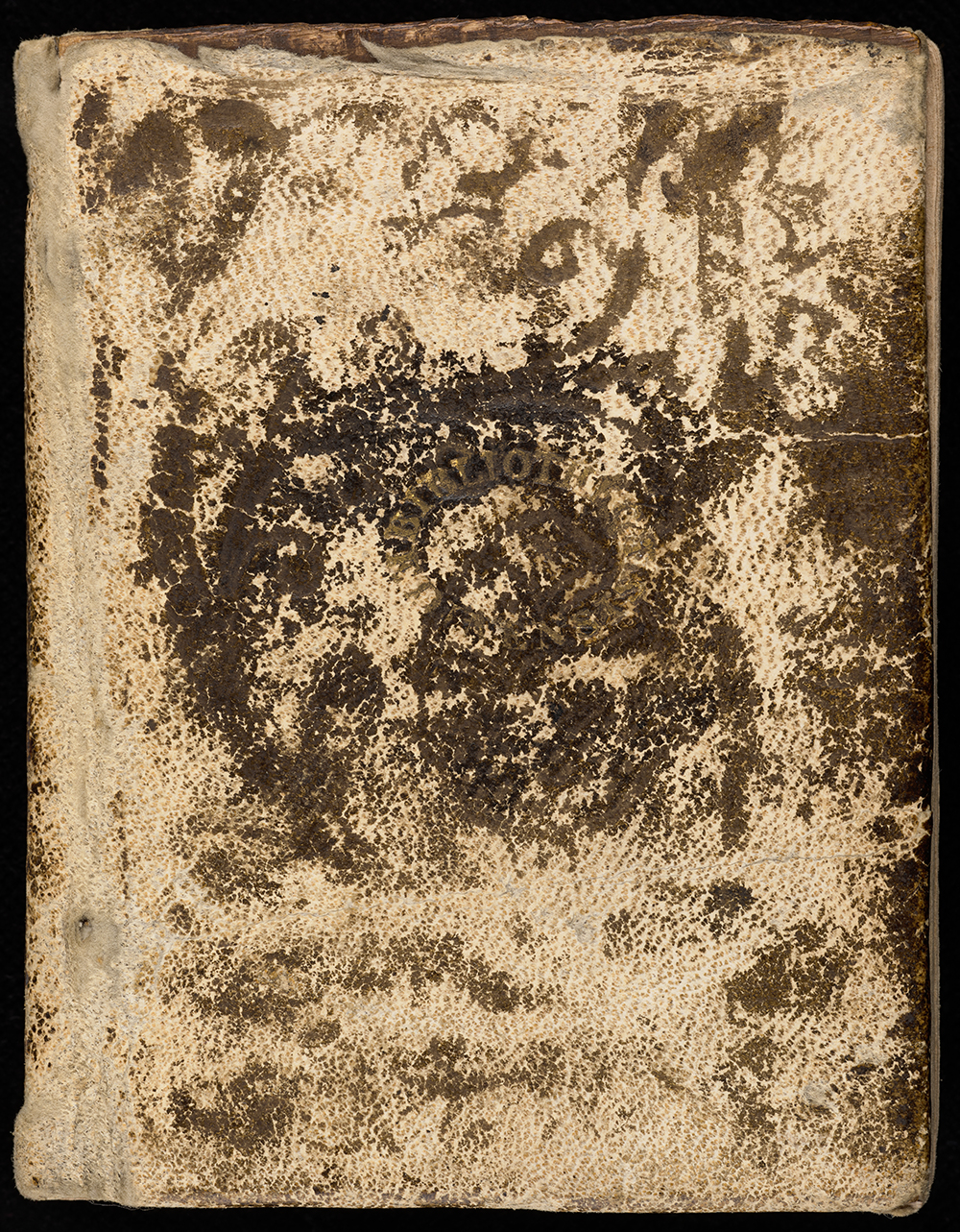
According to researchers at the Centre for Research Collections, The Indian Primer is a tiny book containing Christian instruction, mainly in the native American Algonquian language. Printing began in America in 1640 and was used by missionary John Eliot, who translated the Bible and many other works into the native language for the first time. This unique 1669 copy was gifted to the University Library in 1675 by James Kirkton. Amazingly, this copy is still in its original American binding, of decorated white animal skin over thin wooden boards.

Like the Gaelic Liturgy, The Indian Primer makes up part of the Iconics Collection which forms part of our Digitisation Strategy. The exact physical make-up of the bookcover remains somewhat a mystery and is the subject of on-going academic research. Rare Books Librarian, Elizabeth Quarmby Lawrence, asked that I carry out some raking light photography on the front and back cover of the book in an attempt to uncover more information.
Raking light photography as a technique is carried out using a single light source in a way that aims to reveal further information about the topography of a particular material. It is used to show possible planar distortions and can reveal important characteristics as to which materials may or may not have been used.
Generally, the light is placed at an oblique angle, about 10° to the surface of the object. We find that this lighting technique gives more of a contrast between the highlights and shadows, and in this case uncovers the contours on the book’s surface. At this stage, it is worth noting that the image you see below involved very little post-processing other than some basic sharpening.

Here, we can see that a pattern in the shape of a strawberry and some text has been unveiled in greater detail giving a more 3-dimensional form. This marks a stark contrast to the flat lighting used with the more standard digistisation approach (image below).
The book can be viewed in its entirety on our collections website here.
John Bryden
Assistant Photographer